
SANTA NDER. – A city and diocese of Spain on the Cantabrian coast; it comprises within its territory the civil province of the same name, with the exception of the judicial districts of Portes and Reinosa, but it extends into the valleys of Mena, Tudela, and Angulo in the province of Burgos.
It has an area of 4,104 sq. km and a population of 350,000, of whom 349,000 are Catholics, distributed in 383 parishes served by 385 diocesan priests and 252 religious; its cultural center is the Pontifical Seminary and University of Comillas (q.v.), and it also has the conciliar seminary of Corban (St. Catherine) and a minor seminary; 25 male and 50 female religious communities (Ann. Pont. 1952, p. 363).
The patrons of the diocese are the holy martyrs Emeterio and Celdonio (Aug. 30) and Our Lady of the Good Apparition (Sept. 15 and 22). In S. is the rich Menéndez y Pelayo Library.
Until 1754 the territory of S. was under the ecclesiastical jurisdiction of the archbishop of Burgos, of which diocese it is still a suffragan; but since this was too extensive, Pope Benedict XIV in 1754 created this new and flourishing diocese. The ancient name would be Fanum S. Andreae. The bishop resides in the city of the same name.
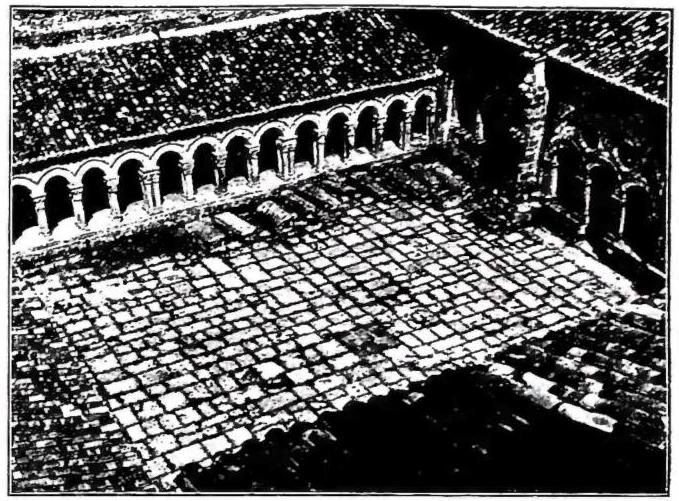
The cathedral is modern, begun as a collegiate church in 1752; however, its crypt, which is the most interesting part, dates from the 12th or at latest the 13th century, and was the church of the abbey of SS. Emeterio and Celedonio and also the burial place of its abbots. The new building is in Gothic style and rectangular in form with three naves without a transept, which detracts from its elegance. The cloister belonging to the old church is also Gothic. The seminary was opened in 1852; previously the students attended courses at the seminary of Burgos. Among the celebrated shrines of the diocese is that of Our Lady of Vicente de la Barquera.