
SASSABASAR (Hebr. Šēlbašsar). — A personage who played an important role in the first repatriation of the Jewish exiles from Babylonia to the land of Israel: he received from Cyrus the sacred vessels returned for the Temple of Jerusalem and stood at the head of the first caravan that returned to the homeland (Eid. 1, 11; 5, 14-16). The close interconnections in the biblical narrative between S. Zorobabel (v.) have given rise to the question whether they were two distinct personages or one and the same person, as Flavius Josephus seems to have held (Actiq. Iud., XI, 1, 3), and as the majority of exegetes still maintain.
S. would be another Chaldean or Assyrian name (probably Šamaš-bal-uzur, “Šamaš protect the son,” or Sin-bal-uzur, “Sin [the] goddess of the Moon] protect the son”) of Zorobabel. The presumed identity is based on the following data: S. is called “prince of Judah,” a title that also belongs to Zorobabel, son of a son of King Ioachin (I Par. 3, 17-19); S. is appointed by Cyrus pehāh, that is, “governor” (Eid. 5, 14), and Zorobabel bears the title “governor of Judah” in the second year of Darius (Agg. 1, 11); to both are attributed almost identical leadership roles in the repatriation of the exiles (Eid. 1, 8-11 and 2, 2; 3, 2; 4, 2); S. lays the foundations of the Temple of Jerusalem (ibid. 5, 16), and Zorobabel likewise undertakes its reconstruction a first and a second time (ibid. 3, 8 ff.; 5, 2 ff.; Agg. 1, 14; Zach. 4, 9). There are nevertheless difficulties against the identification: first of all, the documents never expressly state that S. and Zorobabel were the same person; moreover, both names are of genuinely Babylonian origin: it is indeed frequent for Jews in Babylonia to have a double name (cf. Dan. 1, 7), but it is surprising that a Jew should have had two names, both Babylonian. The identification, therefore, although very probable, is not beyond all doubt; and some (F. Kaulen, J. Nikel, Meyer, A. Vaccari) hold that S. was Zorobabel’s predecessor, that is, the one who initially held the leading role in the repatriation of the Jews. But P. Riessler’s opinion, which identifies both of them with Nehemiah, is entirely unfounded (Bibl. Zeitschrift, 2 [1904], p. 15 ff.).
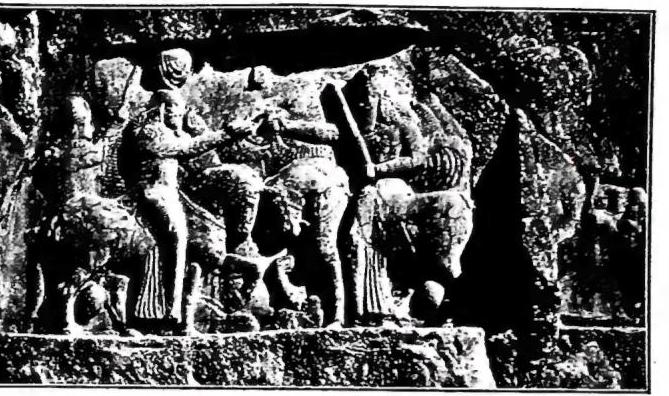
(from A. Upham Pope, A Survey of Persian art, IV, Oxford 1931, p. 15/4) SASSANIDI — Naqš-i-Rustam, investiture of Ardāšir. Rock relief (ca. 230 A.D.).
p. 106 ff.; I. Schuster-G. B. Holzammer, Manuale di storia biblica, I, there 1939, pp. 971-73. Gaetano Stano