
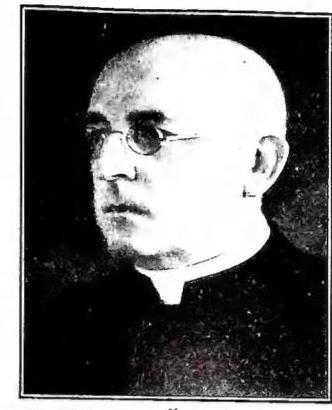
SEIPEL, IGNAZ. - Austrian politician, b. in Vienna on 19 July 1876, d. at Berndorf near Vienna on 2 August 1932. Son of humble and modest parents (his father was a coachman), after completing his gymnasial studies he entered the ecclesiastical state and was ordained priest on 23 July 1899.
Chaplain at Staatz in Lower Austria, he remained there until 1902, when he was transferred to Vienna. In the capital he obtained his doctorate in theology in 1903 and began a highly commendable scientific activity. A particular echo was aroused by a volume of his on the ethical-economic doctrines of the Fathers of the Church (*Die wirtschaftlichen Lehren der Kirchenväter*, 1907), in which he refuted the assertions of T. Sommerlad (*Das Wirtschaftsprogramm der Kirche des Mittelalters*, 1903), which tended to present Augustinianism as a negation and a degeneration of the economic and social doctrines of the Gospel and of the Fathers of the Church. The work earned him the conferral of the *venia legendi* in moral theology at the University of Vienna and his appointment, in 1908, as full professor of the same subject at Salzburg. In the tranquil city on the Salzach, Seipel not only continued to devote himself passionately to his beloved theological studies, but also played a major role in the city’s Catholic life, founding a branch of the *Leogesellschaft* and collaborating with the *Salzburger Kirchenzeitung* and the *Salzburger Chronik*. Thus his interest in social issues gradually led him decisively into political life.
The particularly difficult internal conditions of the Habsburg monarchy during the First World War spurred him to address the national problem in the work *Nation und Staat* (1916), with the intention of indicating the appropriate means to avert the feared disintegration of the Empire. Called to the University of Vienna in September 1917, he immediately became a frequent attendee at meetings of the Christian-Social Party and in February 1918 joined a commission tasked with studying constitutional reform. A supporter of a federalism based on broad autonomist principles in his *Gedanken zur Reform der österreichischen Verfassung* of 1917, Seipel served as Minister of Social Welfare in the last imperial cabinet presided over by the pacifist Lammasch. After the proclamation of the Austrian Republic, he worked successfully to maintain the unity of the Christian-Social Party, which threatened to split into two groups, republican and monarchist. Elected deputy to the Constituent Assembly in 1919, his prestige within the Party grew steadily, and in 1921 he became its president.
From June 1922 to November 1924 he was Federal Chancellor and succeeded in ending inflation. He returned to the chancellorship in October 1926 and managed to form a coalition cabinet with only the Social Democrats in opposition. The polarization of political positions led to serious disturbances in Vienna in July 1927 (the burning of the Palace of Justice by socialists), which Seipel managed to suppress by force of arms. He was nevertheless unable to prevent the rise of a right-wing extremism as a reaction to Social Democratic policy. He resigned in April 1929, after a brief interval as Minister of Foreign Affairs in the Vaugoin cabinet, and in 1930 he withdrew from political life due to his precarious state of health.