
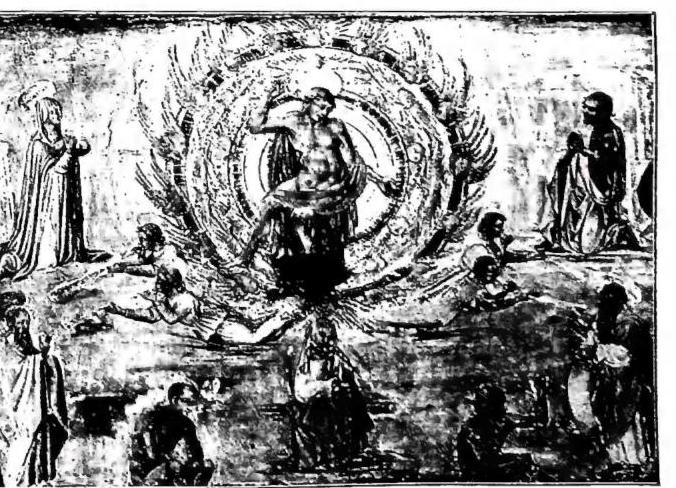
SERAPHIM (Hebr. šárabh, plur. šeráphim). — The only biblical text that speaks of the Seraphim is the vision with which Isaiah’s prophetic ministry begins: Seraphim surround the throne of God, whom they acclaim with the trisagion “Holy! Holy! Holy!”; one of them symbolically purifies the prophet (Isa. 6:2–7). They are celestial beings represented in human form with six wings.
Much has been debated about the meaning of the name and the nature of these mysterious beings. The Hebrew term, according to the most probable opinion, is connected with the root šárabh “to burn, to be ardent.” This concept can also apply to serpents, which in the desert kill the rebellious Israelites (Num. 21:4–7; Deut. 8:15); because of their deadly venom they would be conceived as “breathing fire.” Yet no allusion in Isaiah allows us to suppose that the beings he saw had any connection with serpents or dragons, or that they were partly theriomorphic, as they were sometimes represented.
Finally, he compiled a scientific catalogue and devoted several decades to it, a monumental work that brought the author renown and fame in the international field of numismatics.
He meanwhile published reports on his studies and discoveries in various periodicals: in the Bollettino della Commissione archeologica comunale di Roma (see vols. for 1891, 1895, 1897, 1898 and then 1943–44); in the Atti e Memorie dell’Istituto italiano di Numismatica (vol. 1, 1912); in the volume of essays in honour of Bartolomeo Nogara (1937); and finally in the work on the excavations beneath the confessio of St Peter’s in the Vatican (carried out in 1940–49), I, Vatican City 1951, pp. 225–44.
The Catalogue of the Vatican Coin Collection (Le monete e le bolle plumbee pontificie del Medagliere Vaticano), compiled by S., consists of four large volumes totalling 1,676 pages, published under the auspices of the Vatican Library in 1910, 1912, 1913 and 1927 (Milan). Here the papal series from the earliest beginnings of coinage down to modern times, now numbering more than 20,000 pieces, are systematically arranged in strict chronological order by metal and mint; each piece is meticulously described in every detail. The volumes are illustrated overall by more than 200 plates of coins, 20 plates of leaden bullae and several dozen plates of monograms and coats of arms. They are complemented by numerous partial and general indexes and many pages of notes addressing every problem pertinent to the individual series. This work will remain a worthy monument to those rich collections and a distinguished testimony to the effort expended by S. himself.
After 1929, when S. was called to assume the high office of Governor of the State of the Vatican City, he was obliged to slow down and curtail his scholarly activity. This was further constrained by the burden of years and the turn of events that followed, even as he continued to give scrupulous care to the many delicate responsibilities in various fields of administration and charity entrusted to him by the confidence of five Popes whom he served and by the public esteem in which he was held. He also took part in the activities of the numerous academies, associations and societies of numismatics, archaeology and culture of which he was a sought-after member.
The Cherubim (v.) in Babylon. The only possible interpretation is that the S. are angelic creatures, as already explained by ancient Judaism. According to the Book of Enoch (61:10; 71:7), the S., together with the Cherubim and the 'Ophanim, are the spirits that constantly watch over the throne of God.
Pseudo-Dionysius (De coelesti hierarchia, 7: PG 3, 205) assigns the S. the highest place in the angelic hierarchy: they are the first choir; he therefore attributes to a spirit of lower rank the symbolic act upon the prophet’s lips (ibid., 13: PG 3, 299–320). St. Gregory the Great (In Evangelia hom., XXXIV, 7: PL 76, 1249) presents the same hierarchical order, which remained traditional thereafter (cf. Dante, *Paradiso*, XXVIII, 99).
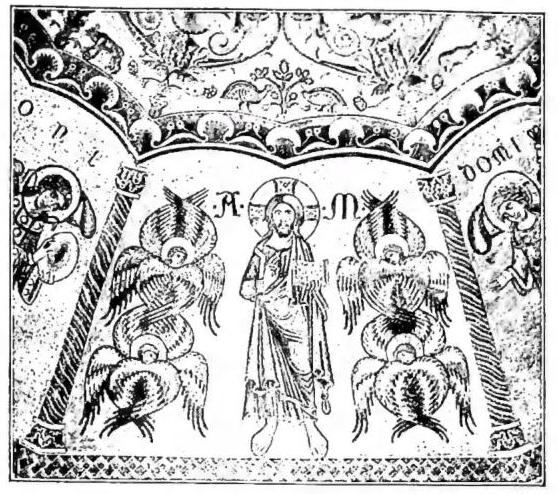
For the theological aspect v.: ANGELI. For art v.: CHERUBINO. — See plate XXI.