
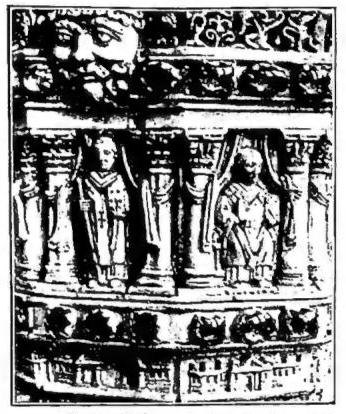
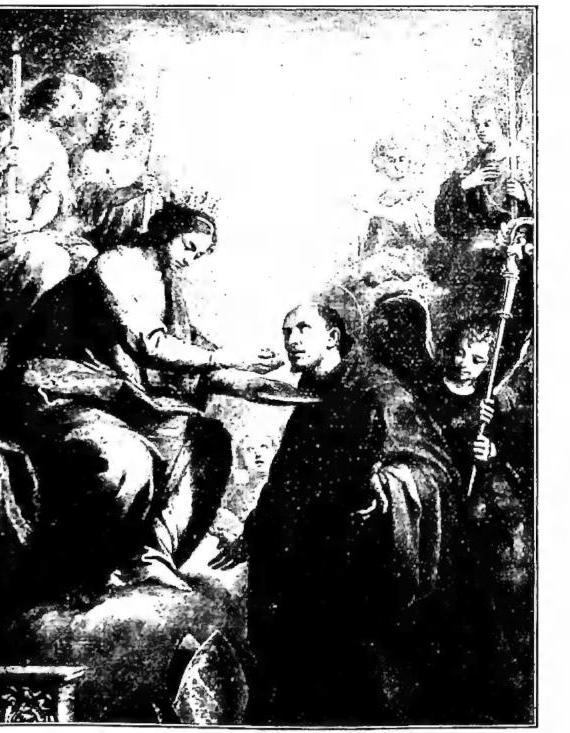
SILVESTER GUZZOLINI, Saint — St. Sylvester, abbot, school of the Veronese. Fabriano, hermitage of St. Sylvester.
Sent to the University of Bologna to study law, he followed an inner impulse and devoted himself to theology, thereby incurring his father’s indignation, which he bore with heroic patience. After his ordination as a priest, he was appointed canon in his native town, until the horrifying sight of the corpse of a distinguished relative prompted him, at the age of fifty, to leave Osimo. He first settled at Grottafulcie, in the mountains of La Rossa (Marche Apennines), and then, in 1230, on Montefano near Fabriano, where he founded a monastery. Later, he erected twelve more monasteries, which at his death housed some four hundred monks, forming a new Benedictine congregation that came to be known as the Silvestrines. Some rivals, moved by envy, denounced him to the Roman Curia; to defend himself, he had to go to Rome. He presented himself to those who were acting in the place of Pope Innocent IV, who was in Lyon, either in 1246 or early in 1247. From Rome, however, he obtained confirmation of his congregation by a bull dated 27 June 1247. His stay in Rome helped to spread knowledge of his holiness and brought great benefit to his institute. Indeed, moved by his miracles, the canons of the basilica of St. Peter ceded to him the church of St. James in Settimiano alla Lungara, near which a monastery later arose. It was precisely to oversee the work on its construction that the Saint returned to Rome between 1260 and 1265. He also established a female branch of the order, which, though it did not flourish greatly, nevertheless lasted until 1822. Until the end of his life, the Saint carried on a remarkable apostolate that made him famous in the Marches and beyond. He died surrounded by his spiritual sons at about ninety years of age and was immediately venerated as a saint. He enjoyed heavenly favors and performed miracles, on account of which, when a monastery was opened in Osimo, Paul V paid him a singular tribute of praise in the bull *Sanctorum virorum* of 23 September 1617. Clement VIII inserted his name in the Roman Martyrology; Benedict XIV, Clement XIV, and Pius VI extended his cult, which Leo XIII extended to the universal Church (19 August 1890). The Saint is generally depicted receiving Communion from the Blessed Virgin; a notable canvas preserved above the high altar of the church dedicated to him on Montefano and attributed to Claudio Ridolfi, called “il Veronese,” is especially prized. His relics are preserved above the high altar of that church in an elegant marble ark.
ANTONIO CANCELLIERI