
SIMON STOCK, Saint
The Madonna presents the Saint with the Carmelite scapular. Painting by G. B. Tiepolo, on the ceiling of the upper hall of the Scuola dei Carmini (1739-44) - Venice.
Mauritius conferred the benefice on others, and Eudes complained about this to Alexander III (letter in J. B. Pitra, *Amplecta novissima spicilegii Solseminis, altera continuatio*, II, Frascati 1888, pp. xxix ff.). Having succeeded his master in teaching (1165), he was shortly afterwards granted a benefice at Tournai and became involved in various disputes concerning non-residence, until full recognition was granted by Stephen, Bishop of Tournai (1192-1203). His chair was, for some time, the most brilliant in Paris, also on account of the open character and wit of its holder, who thus incurred several enmities.
He wrote: *Summa theologica*, or *Institutio in sacra pagina* (unpublished, in six manuscripts; cf. Glorieux [art. cit. in bibl.], col. 2126), divided into 8 parts, in which the whole of theology is expounded, with preference for *de sermone theologico*, *de Deo*, and *de paenitentia*; *Expositio in symbolum Athanasii* (ed. in *Bibliotheca Casinensis*; *Florilegium*, IV, Montecassino 1886, pp. 322-46); *Abbreviatio in sententiis Petri Lombardi* (ms. of Troyes 1371): a simple compendium of the Lombard; *Disputationes* (ed. J. Warichez, *Les disputationes de Simon de Tournai*, in *Spicilegium sacrum Lovaniense*, XII, Louvain 1932): his principal and most original work, in which, through 102 discussions (the *disputatio* attained scientific dignity with S. de T.), he touches upon almost all topics of dogma and morals, with dialectical skill and constant recourse to sources, showing himself sincerely traditionalist and entirely orthodox (in contrast to the rumours spread about him). An admirer of Aristotle, he became more independent of St Augustine in controversial matters, but succeeded in formulating a happy compromise regarding the limits and relations between reason and faith: « *Apud Aristotelem argumentum est ratio faciens fidem, sed apud Christum argumentum est fides faciens rationem. Unde Aristotele sì intellige ut credas, sed Christus: crede et intelliges* » (opening of the commentary on the *Quicumque*). His influence was considerable at the end of the 12th century and the beginning of the 13th: followed by Alan of Lille and Martin de Fugeriis, he was cited with affection by William of Auxerre and St Albert the Great.
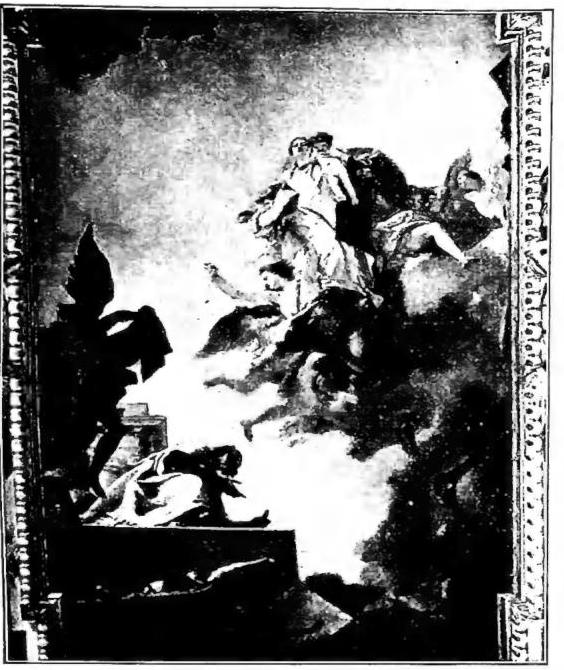
Simon Stock, Saint - The Madonna presents the Saint with the Carmelite scapular. Painting by G. B. Tiepolo, on the ceiling of the upper hall of the Scuola dei Carmini (1739-44) - Venice.
SIMON STOCK – SIMONY
of the Carmelite scapular, is completely silent on the question of the vision, of which S. would have been the recipient.