
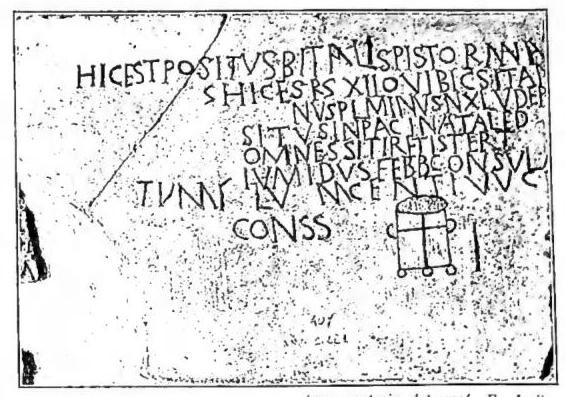
SOTER, Saint, Virgin and Martyr — Epitaph of the baker “Bitalis,” buried on the feast day of St. S. (A.D. 401). Basilica of St. Paul Outside the Walls, upper cloister.
(E. Diehl, Inscriptions christianae latinae veteres, Berlin 1925–31, no. 2115). At the time of St. Gregory the Great (590–604), a certain John collected oil from the martyr’s tomb and brought it to Queen Theodolinda (R. Valentini and G. Zucchetti, Codice topografico della città di Roma, II, Rome 1942, p. 41). The Notitia Ecclesiarum, which in its circuit comes from St. Sebastian, indicates her tomb on the Via Appia after visiting the tomb of Pope Cornelius, i.e., nearer to the city (ibid., p. 88); on the contrary, the “de locis” topography, which departs from Rome, lists her first on the Via Appia (ibid., p. 110). The 7th-century interpolation in the Gesta regum Anglorum, which follows the same order as the Notitia Ecclesiarum, places St. S. after St. Cornelius and before the group of martyrs called “Greci” (ibid., p. 149). The Itinerary of Einsiedeln also records the martyr between the group of SS. Mark and Marcellian and St. Sixtus II (ibid., p. 172). In the biography of Pope Stephen II (752) it is recorded that he restored the roof of the oratory of St. S., which had collapsed (Lib. Pont., I, p. 444).
G. B. De Rossi believed he could identify the cemetery of St. S. in the area adjacent to the eastern triclia in the cemetery of Callistus. But in 1901 J. Wilpert, in his topographical study of the cemeteries of the Appian and Ardeatine Ways, guided by the 7th-century itineraries, demonstrated that the tomb of St. S. was not to be sought in the area of the Callistus cemetery but to the north of it, in a place still on the Appian Way closer to the city, before the tomb of Pope Cornelius. In 1905 J. Wittig, basing himself on the conclusions of J. Wilpert, proposed recognizing the cemetery of St. S. to the left of the Appian Way opposite St. Cornelius. No foundation exists for J. Wilpert’s attempt to identify the sarcophagus in which the martyr would have been laid as one fragmentary piece found in the area of the Callistus cemetery, on whose lid is a rectangular opening and an eagle clutching a crown above an orant figure (Sarcophagi, II, pl. 159, 2).