
SPAIN - Iberian jar, from the necropolis of Cabecio del Tesoro.
Murcia, Provincial Museum.
Barcelona, Raymond Berengar IV. Thus was effected the union of Aragon and Catalonia so as to constitute a Mediterranean Iberian power.
To the west, however, the Kingdom of Castile-León suffered weakening through the separation of Portugal (v.). Alfonso Henriques in 1139 arbitrarily proclaimed himself king, then in 1143 became a vassal of the Pope; reconciled with the King of Castile, he acknowledged him as his lord, but in 1179 had himself absolved from all ties.
After the death of Alfonso VI of Castile, his daughter and heir Urraca, widowed from Raymond of Barcelona, married Alfonso I, King of Aragon. Thus for a moment at the beginning of the 12th century there was a union of Aragon and Castile; but the marriage was declared null by the Pope and the two Kingdoms returned to being divided. Urraca’s son, Alfonso VII, in his ambition to dominate all Spain, in 1135 assumed at León the title of Emperor of Spain, imposing feudal homage on the various princes. He did not, however, forget the struggle against Islam: in 1146 he occupied Córdoba. In 1147 the leader of the Almohads, a new Islamic movement developed in the Maghrib, appeared in Spain. This new wave recaptured many cities from the Christians: the defense of Castile and Aragon was hindered by the conflicts between the two kings. Only after 1147 was there an understanding between Castilians and Aragonese, and in 1179 Alfonso II of Aragon and Alfonso VIII of Castile stabilized the division of future conquests. The Almohad leader an-Nāṣir was defeated in the great battle of Las Navas de Tolosa (1212) by Alfonso VIII of Castile and Peter II of Aragon. Although the victory was not immediately exploited, it was evident that with the fall of the Almohads, Spanish Islam had lost all its vitality and offensive capacity.
4. The balance between the Spanish monarchies in the 13th–15th centuries
If during the 12th century Castile had held supremacy among the various Iberian states, in the 13th century the Aragonese-Catalan state, further enlarged by the counties of Montpellier and Urgel, was able to rival victoriously with the Castilian one. Peter II in 1204 visited Pope Innocent III and obtained from him the royal crown. After Las Navas the struggle against the Arabs ceased; only James I in 1229 resumed the advance: he drove the Muslims from Majorca and Minorca, then occupied the Kingdom of Valencia as far as Cape de la Nao. At the same time, Ferdinand III of Castile occupied Andalusia, made the King of Murcia his vassal, and imposed his alliance on the King of Granada. The two Christian kings now concluded an agreement to partition the conquests: the boundary would be at Biar near Alicante; the lands conquered to the south would belong to Castile. Castile and Aragon now had independent lives. Ferdinand III was succeeded in Castile by Alfonso X the Wise (1252–84). In his struggle against the Moors of Granada he launched expeditions against Cádiz and against Cartagena.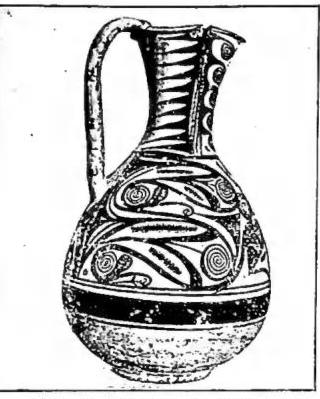
Spain — Iberian jar, from the necropolis of Cabecio del Tesoro. Murcia, Provincial Museum.
From the king. The Spanish bourgeoisies could organize hermandades to defend themselves against the violence of nobles and princes; in the 14th century they had statutes, assemblies, officials; they assembled in arms to punish serious crimes (somaten). In the Catalan state Barcelona had exceptional importance, where a wealthy bourgeoisie of merchants and shipowners held sway. The Cortes were general assemblies derived from the development of the king’s Curia and comprised: the ricos hombres, the ecclesiastics, the procurators of the cities. They met at the king’s order, to hear royal decrees and the imposition of taxes; they swore loyalty to the new king; they participated in the formation of regencies; they presented petitions, and in the 14th century exercised a certain control over revenues and expenditures. The Cortes of Castile were dominated by a sense of monarchical loyalty, devotion, and collaboration with the kings. In Aragon there were no general Cortes, but particular ones for Aragon, Catalonia, and Valencia, dealing with the affairs of each individual kingdom. Despite local variations, Castile and Aragon offered a typical unity of institutions and race and were therefore countries destined to unite.
6. The Castilian-Aragonese unification
The 15th century saw in the Iberian peninsula the conclusion of medieval political history with the unification of the principal Christian kingdoms and the definitive destruction of Muslim rule. The two dominant states were now Castile and Aragon. Navarre, caught between the influence of Castile and that of France, lost all possibility of acting actively in the peninsula. In Castile King John II, by marrying his cousin Maria of Aragon in 1418, already established an important link between the two kingdoms. The king’s weakness allowed a resurgence of civil strife, poorly controlled by the Constable Álvaro de Luna in his attempts to subdue the overbearing nobility. The reign of King Henry IV (from 1454) was feeble and full of unrest: the conflicts now concerned succession; the king, forced to acknowledge the legitimacy of his daughter, recognized as heir his sister Isabella, who agreed to marry her cousin Ferdinand of Aragon (1468). In Aragon, after the extinction of the old dynasty with Martin I (1410), the Cortes among the various claimants elected King Ferdinand of Antiquera, a Castilian, who had to fight against the rival, the Count of Urgel. Alfonso V, who succeeded his father in 1416, soon threw himself into the struggles in Italy for the conquest of the Kingdom of Naples and was a king more Italian than Spanish; of his 42 years on the throne, he spent 29 in Italy. In Aragon, his consort Maria governed for him, and then his brother John, king-consort of Navarre, who succeeded him in 1458. Now Aragon entered a long period of strife due to the conflict between the king and his first-born son Charles of Viana. Only in 1472 did Aragon find peace; in 1479 John was succeeded by his son Ferdinand II, who had married Isabella, queen of Castile since 1474.The organization of the dual kingdom of Castile-Aragon was regulated by the agreements established in the marriage contract (capitulaciones) and by the arbitration pronounced between the two monarchs in 1474 by Cardinal Ximenes: justice was exercised by both and by each separately; royal documents were signed by both; the coins bore the effigies of both kings; the seal and the coats of arms of both kingdoms. The principle of absolute equality is evident in the famous formula: “tanto monta, monta tanto Isabel como Fernando.” The Castilian-Aragonese union led to the resumption of the struggle against the Muslims of Granada, which had been dormant since 1431 when Álvaro de Luna had defeated the Moors at La Higuera and imposed a tribute; it resumed in 1482 with the advance of the Castilians under Granada. The strife within the family of King Abū l-Ḥasan facilitated the occupation of all the castles around Granada: in 1487 Málaga fell, in 1489 Almería as well, and the capital itself, Granada, was besieged and forced to surrender on 2 June 1492; the Muslim inhabitants were granted life and property and the right to depart.
7. The Age of the Catholic Monarchs
The reign of Ferdinand and Isabella represents for Spain an era of great glory. In the same year in which the Christian reconquest was completed, Christopher Columbus, acting on the contract agreed with the Queen at Santa Fe (17 Apr. 1491), set sail from Palos with the three caravels that on 12 Oct. reached the island of Guanahani in the Bahamas (S. Salvador, Watling). Thus began that series of geographical discoveries which were to make Spain, within a few decades, the most important European colonial power until the 19th century. The conflicts with Portugal, which was also engaged in voyages of exploration and colonization toward the East, were resolved by the bull of Alexander VI, which established a line of demarcation (4 May 1493), and by the Treaty of Tordesillas (7 June 1494). Free from any internal concerns, the two monarchs followed with great interest the political events of Europe. By the Treaty of Barcelona (1493), Ferdinand recovered from France the Cerdagne and Roussillon, lost by John II; then the conquest of Naples by Charles VIII reopened the conflict. Taking part in the anti-French coalition, Ferdinand drove Charles VIII out of Naples and established his dominance over the Aragonese of Naples; the new invasion by Louis XII led to the Franco-Spanish agreement for the division of the Neapolitan kingdom (Treaty of Granada, 1500); but in the end the French were expelled and Ferdinand became master of the entire kingdom (1503). Spain now became one of the fundamental pillars of the European political system, participating in the League of Cambrai against Venice (1508), in the Holy League of Julius II against France (1511), and securing definitive dominance in the Italian peninsula.In domestic policy, under the Catholic Monarchs the monarchical power gained in strength. The aristocracy’s uprisings no longer had any chance of imposing themselves. The centralization of government made progress: royal officials were created to conduct inquiries. The nobility found itself stripped of much of its political authority but retained its social privileges and began to evolve into a court nobility. The authority of the Cortes also weakened considerably: in Castile the Queen convened them nine times; in Aragon, Ferdinand only seven; six in Catalonia; and once in Valencia.
Great reforms were undertaken in the field of finance, reorganized with the creation of new taxes, as well as in justice. A permanent army was organized, modeled after the Swiss mercenary companies, through the efforts of Gonzalo of Córdoba. Isabella died in 1504, and her loss was keenly felt in the cohesion and direction of government. The only daughter who could succeed her was Joanna, known as the Mad (because of her mental incapacity); Isabella appointed her consort, Ferdinand, as regent. He sought to maintain a firm grip on the direction of affairs. He launched a series of expeditions against the Barbary States (1508–11); in 1512 he attempted the annexation of Navarre. Ferdinand died on 23 Jan. 1516.
8. The Habsburg Monarchy
The Habsburgs ruled in Spain from 1516 to 1700: they truly created the unity of the Spanish state. Charles I, son of Joanna the Mad and Philip of Habsburg, assumed the regency for his mother in 1516 but soon considered himself the true king. He was unfamiliar with Spain and did not speak Castilian, having been born in Ghent (1500). Upon his arrival in Spain, he surrounded himself with Flemish advisors, and when he was elected emperor in 1519, he viewed Spanish interests only within the context of the interests of his various dominions: the Netherlands inherited from his father, the Empire, and the Spanish and Italian states inherited from his maternal ancestors. The government of Charles I in Spain initiated a very rigid financial policy and soon aroused discontent; many cities rebelled: Toledo, Segovia, Ávila, Burgos, Zamora. The Comuneros movement of the bourgeoisie was led by noblemen, among whom Juan de Padilla distinguished himself. The governor of the kingdom, Cardinal Adrian of Utrecht, failed in his attempt to suppress the uprising with an expedition against Segovia. On 29 July 1520, deputies from 15 cities formed the Santa Junta, swearing to live and die in the service of the King and the *Comunidad*.The rebels protested their loyalty to the King but demanded reforms in finance and justice; however, the movement soon took on an anti-noble character and lost momentum. Already in 1521, the militias of the Santa Junta were defeated; the leaders Juan de Padilla, Maldonado, and Bravo were beheaded. Charles V, having returned to Spain in 1523, announced a general pardon, but with many exceptions that masked a harsh repression. After the crisis, royal authority appeared even more firmly established; the Cortes, however, retained the right to complain and to vote subsidies. Social unrest also occurred in Valencia and Majorca but was harshly suppressed.
The war that broke out between France and Spain in 1521 also had military engagements at the border, particularly in Navarre. It seems the Comuneros attempted to reach an agreement with Francis I against Charles V: the latter, weakened by the internal crisis, was at a disadvantage compared to a united France. The Franco-Spanish war spread from Navarre to Italy: at Pavia, Spanish forces won on 24 Feb. 1525. Francis I was captured and taken to Madrid, where on 15 Jan. 1526 he signed a treaty renouncing his claims to Italy and the Netherlands. After his release, the King of France organized a league against Charles V to wrest Naples and Milan from him. To punish Clement VII for joining this league, Charles V organized the expedition that ended in the sack of Rome. The news of this terrible event made a strong impression in Spain and embarrassed Charles V.
After the Peace of Cambrai with France (1529), the King of Spain reconciled with the Pope, who crowned him emperor in Bologna. In 1535, after the death of Francis II Sforza, Spanish forces occupied Milan, although it belonged juridically to the Empire. The struggle between Spain and France for dominance in Italy resumed and lasted until the Peace of Cateau-Cambrésis (1559). Forced to address the serious problems in Germany, Charles V paid little attention to Spanish affairs after 1530. He sought to defend Spanish prestige in the Mediterranean with an expedition to Tunis in 1535 to suppress piracy. A second expedition along the African coast in 1541 ended in complete failure. Spanish troops later went to Austria to support Ferdinand of Austria, Charles’s brother, against the Turks.
While the King spared no expense in financial and military resources to establish the primacy of his House in Europe, Spanish officials beyond the ocean explored the American continent and created the great possessions of Central and South America: the discovery of the silver mines of Potosí significantly strengthened Charles V’s European policy. In 1556, the King, weary (though not old) of a political life so tumultuous that had lasted forty years, abdicated the throne of Spain in favor of his son Philip, who also received the Netherlands, the Italian dominions, and the American possessions; in 1558 he relinquished the Empire and the Habsburg domains to his brother.
FILIPPO II reigned over the Holy See from 1556 to 1598. The program of his 42-year rule was to establish the predominance of the Holy See over Europe, which for him coincided with the triumph of the Catholic faith over heresy. After concluding the war following the Battle of Saint-Quentin (10 Aug. 1557) with the Treaty of Cateau-Cambrésis, which marked France’s humiliating surrender, Philip II had to direct his efforts in various directions. The threats posed by the Turks to Malta and Cyprus led to the formation