
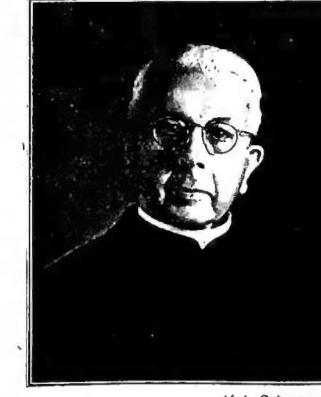
Having entered the Society of Jesus in 1888, he studied mathematics, physics and astronomy at the University of Leiden (1895–1901). Ordained priest in 1903 at Maastricht, in 1906 he was summoned to Rome to the Vatican Observatory as assistant to Fr. Hagen. In 1910 he returned to his homeland and taught until 1930 at the Collegio S. Ignazio in Amsterdam. After a journey to Egypt undertaken on the mandate of Pius XI to explore the possibility of establishing a branch of the Vatican Observatory in Ethiopia, he was named in 1930 to succeed Fr. Hagen as director of the Vatican Observatory, an office he held until his death.
His scientific activity, owing to particular circumstances, was chiefly theoretical and historical. An indefatigable worker, endowed with uncommon intelligence and sound judgment, he acquired vast erudition in astronomy and the allied sciences of mathematics and physics, which he placed with great selflessness at the disposal of all who sought his aid.
In 1901 he earned the doctorate in physical and astronomical sciences with a thesis on the determination of the variation of latitude at Leiden (Beobachtungen zur Bestimmung der Breitenvariation in Leiden nach der Horrebow-Methode). An expert in the theory of variable stars, he published various studies and compiled, for the great encyclopedia on variable stars by Fr. Hagen, the second volume Die Veränderlichen Sterne, 2. Band. Mathematisch-physikalischer Teil (Freiburg 1924), in which he expounded the mathematical and physical aspects of the explanation of the light variation of these stars. After the death of Fr. Hagen he supervised the publication of series VIII of his Atlas stellarum variabilum (1934) and compiled series IX and final (1941). He also collaborated on the Astrographic Catalogue by searching for double stars in the zone assigned to the Vatican Observatory. The experiments of Fr. Hagen on the rotation of the earth led him to rescue from oblivion the classic experiments of Kamerlingh-Onnes, for which he prepared a new French edition with appropriate additions (1910). On the occasion of the reappearance of Halley’s comet he published a historical study (Caliste III et la comète de Holley, Rome 1909), in which he thoroughly refuted the legend that Callistus III had excommunicated the comet. He also published on this occasion (1910) Un documento inedito del ro66 sulla cometa di Halley, discovered by Msgr. G. Bevilacqua in the Archive of the cathedral of Viterbo. Although the duties of teaching at the school considerably hindered his scientific research, this period was no less fruitful for his activity as a writer and popularizer. About fifty scientific articles appeared in Studien, the general culture review of the Dutch Jesuits. He inspired circles of Dutch amateur astronomers and served as editor for the astronomical section of their journal Hemel en Dampkring, for which he had contributed 106 articles on the most varied subjects until his departure for Rome.
His most important and most fruitful work for astronomy remains his wise reorganization of the Vatican Observatory, which he transferred to Castel Gandolfo as a more favorable site and succeeded in equipping with instruments suited to modern research. He also added, under the direction of Fr. Gatterer, an astrophysical laboratory, increasing the staff devoted to scientific research.
He was a member of various scientific societies, ordinary fellow of the Pontifical Academy of the New Lincei, and later a supernumerary member of the reorganized Pontifical Academy of Sciences, and corresponding fellow of the Royal Dutch Academy of Sciences.