
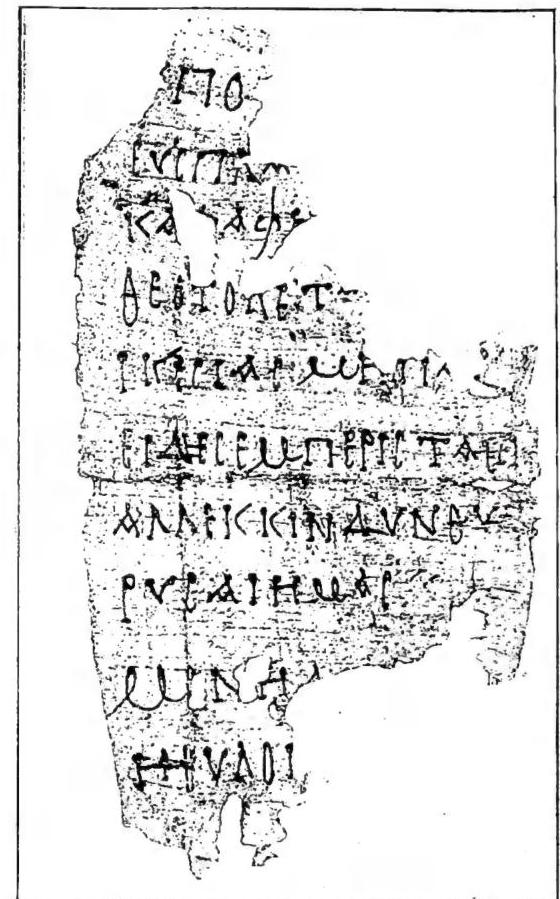
* SUB TUUM PRAESIDIUM — Fragment of a 3rd-century papyrus containing the Greek text of the S. t. p. — Manchester, Rylands Library.
4 Sub tuum
misericordiam
confugimus
Dei Genetrix; nostram
deprecationem ne de-
spicias in necessitate
sed de periculo
libera nos,
sola casta
et benedicta.
(d) A. F. Mercenier, L’Antienne Marie grecque la plus ancienne, in Le Muséon 52 (1932), p. 231.
* SUB TUUM PRAESIDIUM — Text of the Rylands Library papyrus no. 470, col. 1, compared by Fr. F. Mercenier with Byzantine texts, col. 2 (Σπόλογιον τό μέγα, ed. Rome 1938, p. 232); Roman, col. 3; Ambrosian, col. 4 (Missale Ambrosianum, Milan 1831, pp. 381-92); and the Latin version of the Coptic text, col. 5.
The text forms part of the single daily exercise of piety that the Jesuits practise in common. Notable is the opening, simplified by the omission of the word “misericordia” (εὐσπλάγχνα), and the ending: Libera nos semper, Virgo gloriosa et benedicta. The word semper is joined, even in the Gregorian melody, to libera nos, whereas critically it should be attached to Virgo, in accordance with the characteristic Greek epithet ἀστραπήγος; this term, however, is not found in the original formula nor in the Byzantine liturgy, which instead has the corresponding μόνν ἁγνή. The word gloriosa is likewise a Roman variant whose antiquity is uncertain; Fr. Mercenier admits that it may be original (σεμνή); it is absent from the Antiphonary of Compiègne and from the Dominican liturgy. The Gregorian melody, in the 7th mode, with its almost syllabic simplicity, expresses a feeling of confident and filial abandonment, and in its insistent motif the urgency of immediate aid. Before the Gregorian restoration, another melody in the 2nd mode was also in use in Italy (cf. J. Pothier, Antienne «S. t. p.», in Rev. du chant grég., 2 [1893-94], pp. 3-4).
b) Ambrosian Liturgy. — The Milanese text (Sub tuum misericordiam) derives from the Byzantine (‘Υπὸ τὴν σὴν εὐσπλάγχνιαν), but appears to postdate St Ambrose, also on account of the erroneous translation “ne inducas in tentationem” (instead of: ne despicias in necessitate), which cannot be attributed to the Saint, who was well versed in Greek; this variant, however, may not belong to the original translation and could be a late contamination from the Our Father. In the Middle Ages the prayer was used (according to cod. T 103 Sup. of the Ambrosian Library) on the 6th Sunday of Advent, among the antiphons or litanic psallendae (cf. Cagin [V. op. cit. in bibl.]); today it is heard only as a post-Epistle antiphon in certain Masses of the Blessed Virgin (5 Aug. and 16 July [same Mass]; S. Maria in Sabbato [ferial Mass] and Solemn Votive Mass). It is also sung by the people with a melody proper to the rite.
c) Byzantine Liturgy. — Compared with the original text given by Pap. Ryl. 470, the Byzantine liturgical form is more elaborate, with variants chiefly due to rhythmic requirements.
In the Byzantine liturgy (and therefore in the various languages of the rite) the prayer serves as a θεοτοκίον (troparion in honour of the “Mother of God”) at the end of ferial Vespers (Προλόγιον, Rome 1876, p. 104; 2nd ed. 1873, p. 232), always following the Ave Maria, which precedes as the first troparion (θεοτοκίον Παρθένε χαῖρε).
d) Other Eastern Rites. — The Armenian, Syro-Antiochene, Syro-Chaldean, Malabar, Maronite and Ethiopian Churches, although they do not possess the S. t. p. in their liturgy, include it in their devotional books (apparently under Roman influence). The Maronites make very frequent use of it (in Arabic, employed in all eschatological functions) together with the Litany of Loreto. For Ethiopian Catholics the text was translated from Latin by missionaries and is recited together with the Salve Regina. The Syro-Antiochene formula, which seems very ancient, exhibits several biblical-sounding variants that constitute a profound reworking (cf. P. Hindo, Disciplina Antiochena antica: Siri, IV [Fonti per la Cod. can. Orient., 2nd ser., fasc. 28], Vatican City 1943, p. 307, note 1).