Machine translation of the 1948–1954 Italian original. The original text is authoritative.
TESMOFORIE. – Greek festival connected Mother Earth (v.) and consequently with that of woman. It was celebrated throughout the Greek world in honour of Demeter, who was, in the aspect of Thesmophoros, that is, giver of the Law, insofar as she was the institutor of agriculture.
The details of the T. are obscure; its course is better known in Attica, where the festival lasted 3 days. It took place around the middle (11–13) of the month Pyanopsion, that is, at the time of the winter sowing, and was celebrated only by married women (men and girls were strictly excluded), two of whom from each demo organized it, while their husbands were required to bear its expenses.
On the first day, called «Ανοδος», that is, «ascent» (sometimes called «ἀθοδος», «descent»), it seems to have consisted in the ascent (and consequently the return) of the matrons in procession to the Thesmophorion, situated (Aristophanes, Thesmophor., 624) on the hill of the Pnyx, where they remained beneath huts of branches specially constructed for the occasion. The second day of the T., the most important, was called Νεστειά, that is, the day of «fasting», during which no sacrifice was performed and which was a day of mourning. On this same day the women drew from a pit the Shira, that is, the remains of piglets and pine branches and other symbols of fertility, buried there on the occasion Schiroforie (v.), celebrated 4 months earlier; these remains, mixed with the new seed, seem to have been put back into the ground in order to auspicate greater luxuriance for the earth. Finally, on the third day, called Καλλιγένεια, the women cele-
(phot. Enc. Catt.)
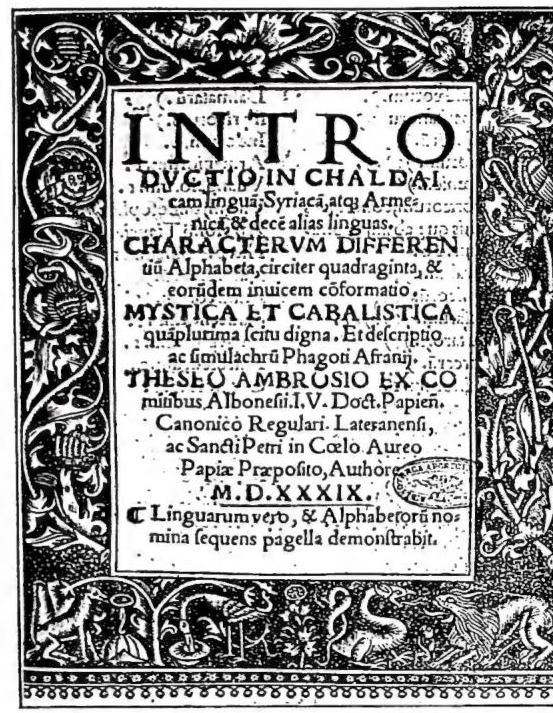
TESEO, AMBROSIO — Frontispiece of the Introductio in Chaldaicam linguam..., Pavia 1539 — Copy in the Vatican Library, deposited at the Biblical Institute.
offered sacrifices precisely in order to obtain a happy and numerous progeny.
BIBL.: J. Harrison, Proleg. to the study of Greek religion. Cambridge 1903, pp. 120 ff.; P. Stengel, Die griech. Kultusaltertümer, Munich 1920, pp. 231 ff.; L. Deubner, Attische Feste, Berlin 1932, pp. 50 ff. Cesare D'Onofrio
Cite this article
“TESMOFORIE.” Enciclopedia Cattolica, vol. XII (1954), p. 25. Azione Romana digital edition, https://azioneromana.com/article/tesmoforie.