
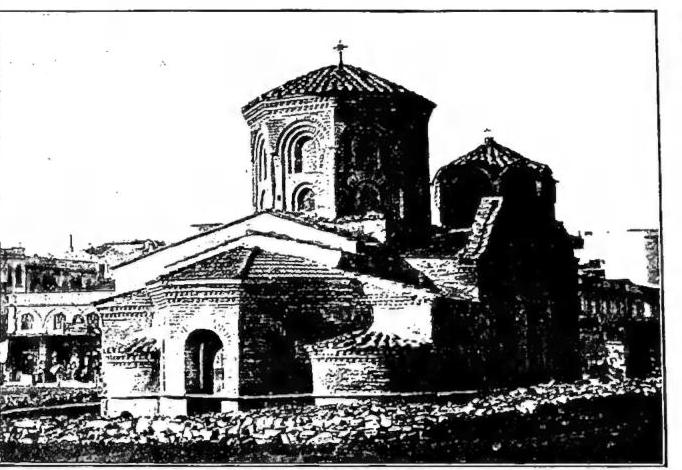
TESSALONICA (now SALONICO). — A city on the Aegean Sea, still a busy port and a populous city. In ancient times it bore the name of Therma, whence the Thermaic Gulf, at the head of which it lies, was formerly called.
Cassander rebuilt and enlarged it (316 B.C.), giving it the name of his wife Thessalonica, daughter of Philip II, king of Macedonia. After the battle of Pydna (168 B.C.) it fell into the power of the Romans and became the capital of the second of the four provinces of Macedonia. The city had a hinterland of very fertile countryside, watered by several rivers, including the Vardar; but its characteristics were those of a port city. The port was the object of special care on the part of the Macedonian kings, and later of the Romans, who had docks there (navalia: Livy, XLIV, 10. 32) and brought it to notable prosperity. It was the headquarters of the Pompeians before the battle of Pharsalus (48 B.C.). During the second civil war, it sided with the triumvirs Octavian and Antony; and these, after the victory at Philippi (42 B.C.), granted it the status of a free city, governed by six πολυπράγμoνες, a title used in Acts 17, 6.8. Because of its geographical position, between Thrace, Macedonia, and Achaea, Thessalonica attracted St. Paul, who must have considered it a center for the spread of the faith, which it indeed became (1 Thess. 1, 6 ff.).
From Thessalonica there extended an important road network, whose main artery was the Via Egnatia, which came from Dyrrachium and was considered the overseas extension of the Via Appia. It was a meeting point of religions and races, sustained by the traffic of the entire basin of the Eastern Mediterranean and by the various industries that flourished there, especially the textile industry. St. Paul (ca. 50 A.D.) found there an important colony of Jews.
EVANGELIZATION. — Christianity penetrated into Thessalonica in the apostolic age. In 50-51, during his second journey, St. Paul, coming from Philippi via Amphipolis, accompanied by Silas (Silvanus) and Timothy, preached in the synagogue for three consecutive Sabbaths (Acts 17, 2); there he founded the second Christian community in Europe, recruited especially from the Greek element. The Jews fomented disturbances and forced the missionaries to take refuge first in Beroea and then in Athens, where Paul had Silas and Timothy join him (Acts 17, 15; 18, 5), whom he later sent back to Thessalonica (1 Thess. 3, 1).
Born in Thessalonica, this city became from 860 onward a missionary center for the evangelization of the Slavs. In 904 Thessalonica was devastated by a Saracen raid, and in 1185 it was taken by the Normans. In 1204 the Kingdom of Thessalonica was created for Boniface of Montferrat (v. CRUSADES), which had a short life; in fact, in 1246 Thessalonica returned to the Greek Empire of Nicaea. Ceded to Venice in 1423, it was taken by the Turks in 1430, who held it until 1912, when it passed to Greece.
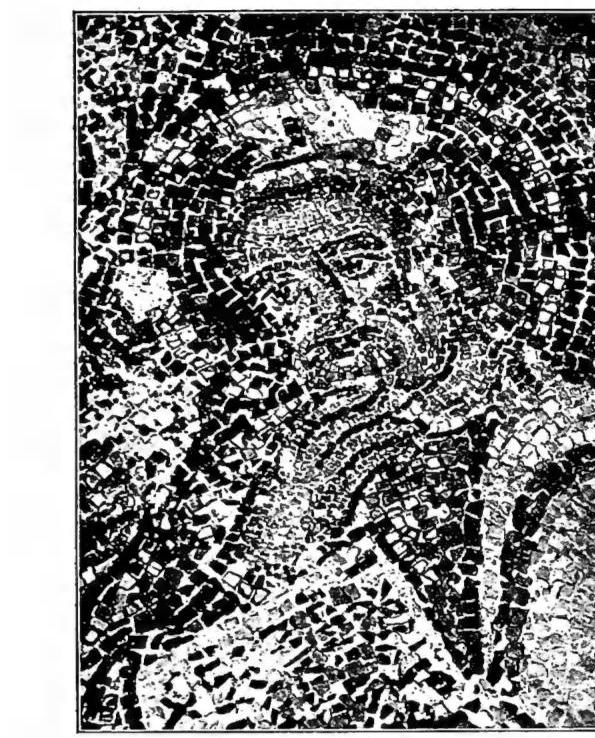
EARLY CHRISTIAN MONUMENTS. — The church of St. George was built on a Roman rotunda contemporary with the Arch of Galerius (A.D. 297); it was transformed into a church in the 5th century, adding an apse to the east. In the dome and in the niches carved into the walls the mosaics imitate Hellenistic models, while the figures of the saints are in the Eastern style. Especially noteworthy is the frieze with the calendar from the mid-6th century, important especially for the inscriptions relating to the cult of the saints (E. Weigand, in Byzantinische Zeitschrift, 39 [1939], pp. 116-45). The church of St. Demetrius, erected on the site of the martyr’s execution, was built in 412 under Leontius, prefect of Illyricum. It was rebuilt in the 7th century in the form of a cross and restored several times thereafter; in 1917 it was very badly damaged by a fire. The original building was a Hellenistic basilica with an atrium, narthex, first with three and then with five aisles separated by columns and matronea. After the fire, some mosaics from the 4th to the 9th centuries were recovered (St. Demetrius, the Blessed Virgin in prayer, St. Sergius) and some frescoes dating from the 6th to the 9th centuries. The church of St. Parasceve (or the Virgin Acheropoeitos), from the 5th century, presents the type of the Hellenistic Christian basilica with three aisles, of perfect symmetry, with columns, arches, and Theodosian capitals. The metropolitan church of St. Sophia is the last church built in Justinian’s time; it is a domed basilica with mosaics from the 8th-9th centuries (the Virgin in prayer, Christ, the Ascension). Later are the church of St. David with mosaics from the 9th-10th centuries depicting a beardless Christ with the symbols of the Four Evangelists; the church of the Theotokos from 1028; the church of the Apostles with five domes, with a cruciform plan, erected in the 14th century under Patriarch Niphon on a pre-existing building; lastly, the church of the Transfiguration from the 14th-15th centuries.
THE CHRISTIAN CEMETERY OF THESSALONICA. — Discovered in 1899, it developed behind the pagan necropolis that was located along the Via Egnatia outside the gates of the Calamaria and Tell-Capon. It consisted of a series of *formae* arranged in several rows, lined internally with thick stucco, more rarely with white marble; some were paved with large bricks; they were closed with large marble or schist slabs and then covered with earth; the inscription was incised on a small slab of white marble. A large vaulted tomb was found, accessible by a small staircase; it was decorated on the sides with panels; in the center a cross between two palm branches and a bird; in the vault a large cross. Among the epigraphs, one in Latin with «Deposito Barbatiosi notarii vivi (christianissimi)» is noteworthy; another in Greek of a Dorotheus, probably from a village in Syria, and of a Theodora (P. Perdrizet, Le cimetière chrétien de Thessalonique, in Mélanges d'archéologie et d'histoire, 19 [1899], pp. 541-48). In the Royal Museum of Brussels some Christian inscriptions from Thessalonica are preserved, one in Greek belonging to a soldier named Maximianus of the *Ascarii minores*; a Latin one commemorates a certain «Domesticus positus ad do(mnum) Ioan(nem)» who paid three and a half solidi for his tomb (P. Perdrizet, Inscriptiones de Salonique, in Mélanges d'archéologie et d'histoire, 25 [1905], pp. 81-95 and pl. 1). Notable is the Greek inscription of Calocerus to Macedonia and Sosigenia, his most beloved parents, with the wish: «sleep until the resurrection», and the fish (G. B. De Rossi, in Bull. arch. crist., 1890, pp. 54-60 and pl. 5, 2); here the word κοιμητήριον is used in an individual sense, as in other inscriptions from Thessalonica (P. Perdrizet, Inscriptions de Thessalonique, in Mélanges d'archéologie et d'histoire, loc. cit.). Characteristic is that of a Flavius Callistus, prefect in charge of the administration of the emperor’s domains in the region, which also repeats the wish to sleep there until the day of the resurrection (P. Perdrizet, Inscriptions de Thessalonique, in Mélanges d'archéologie et d'histoire, 20 [1900], p. 229); others again with the expression κοιμητήριον in an individual sense (ibid., 25).
The Christian community of Thessalonica developed regularly, as evidenced by the Edict of Protection of Antoninus Pius (138-61) mentioned by Melito (in Eus.
[1905], pp. 86-88; Ch. Azen and Ch. Picard, *La nécropole de Thess.*, ibid., 32 [1912], p. 351). In the church of St Sophia a Greek epigraphic fragment was found mentioning a young woman Ioanna who died on 21 Nov. 535 (I. Pargoire, *Le soi-disant épithéâtre de la fille de Bélisaire*, in *Échos d’Orient*, 5 [1901-1902], pp. 302-303; ibid., 6 [1903], pp. 62-63). About 30 km east of Thessaloniki in the mountains stands a cruciform church of St Andrew at Péristerai dating from the 9th century (A. Orlandos, *Το καθολικόν της παρά την Θεσσαλονίκη μονής περίστερον*, in *Αρχείον των βυζαντινών μνημείων της Ελλάδος*, 7 [1951], pp. 146-47). Recently Ch. I. Makaronas has described the discovery of an octagonal masonry building, preserved to a height of 7 m above the original ground level, paved with marble and decorated with brickwork representing a cross between two cypresses. A fragment of a nude male statue and part of an early-Christian pulpit were found there (Το κτὰ γωνία τῆς Θεσσαλονίκης, in *Πρακτικά Αρχαιολογικής Εταιρείας*, 1950, pp. 303-21).