
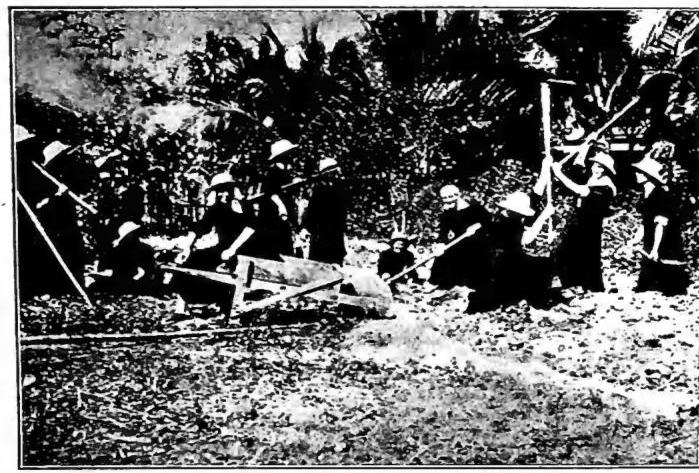
THAILAND - Seminarians on vacation work on the construction of a corral - Rajaburi, Seminary.
Menam constituted the T'ai State of Xieng Mai, which fell prey to the Burmese in 1556. The annals of Ayuth'ya are filled with the centuries-old struggle against the ancient dominators, the Khmer of Cambodia, whom the Siamese gradually reduced to a very small state and who were saved only by the French protectorate (1867).
In the 16th–18th centuries the great enemy was Burma, against which Thailand waged war at times with severe disasters. In these wars a great part was played by mercenaries and foreign adventurers (Portuguese at the beginning of the 16th century, Japanese at the beginning of the 17th). After 1680 the government practically passed into the hands of a Greek from Cephalonia, Constantine Ierakis called Phaulkon, with whose help French influence became supreme; it ceased, however, with the fall and death of Phaulkon in 1688. The 18th century was an era of decline, ending with the Burmese invasion of 1767; Ayuth'ya was taken and burned, and the kingdom passed under the Burmese yoke. But in the following months the national resurgence, led by the general P'ya Taksin, of Chinese origin, was completely successful; and in 1769 Thailand was reunited under his sceptre. P'ya Taksin established the capital at Bangkok and in 1775 reunited under his kingdom the area of Xieng Mai (upper basin of the Menam). His capricious cruelty, however, alienated the people; and in 1782 he was overthrown by the general P'ya Chakri, founder of the Rama dynasty still reigning today. During the 19th century Thailand found itself exposed to the political pressure of Great Britain from the south and west, and from France from the east, but managed to preserve its independence precisely because of the balance achieved between the two European influences. The treaties of 1907 and 1909 definitively regulated the borders with the powerful neighbours, not without serious sacrifices for Siam.
King Chulalongkorn (1868–1910) then reigned and took the first steps along the path of modernization. Under Vajiravudh (1910–25) Thailand nominally took part in the First World War as an ally of the Entente. Prajadhipok (1925–35) was the last absolute king of Thailand; in 1932 a bloodless military coup forced him to grant a constitution. Three years later, coming into disagreement with his ministry, he was forced to abdicate; his successor Ananda (1935–46) was a minor and resided in Switzerland for almost his entire reign. In 1938 power passed to Colonel (later Marshal) Luang Pibul Songgram, whose government soon assumed a dictatorial character. In December 1940 and January 1941 Thailand waged a brief war with France to reclaim positions lost in Indochina in the previous century; and in December 1941 it joined in the Japanese invasion of Burma. Active military operations were, however, spared the country; it was therefore
(Itd. Fides) of a new
Luciano Petech
III. EVANGELIZATION OF THAILAND - The first missionaries of whom we have notice are the two Dominicans Jeronimo da Cruz and Sebastião da Canto, who, summoned by Portuguese merchants, arrived in Ayuthia in 1567 (not in 1554 or 1555). Jeronimo was killed in that same year; Sebastião likewise met his death with two other Dominicans in 1569 during the war between Burma and Thailand. At the end of the century Dominicans, Franciscans and secular priests are found, and at the beginning of the 17th century also Jesuits. Missionary activity was very often interrupted by the continual wars between Thailand and Burma and between Thailand and Cambodia. It was carried on not so much among the Siamese as, from 1691, and in 1694, among the Portuguese, who had become numerous after the capture of Malacca by the Dutch in 1641, and the Cochin Chinese, who had taken refuge during the persecution in Cochin China at Ayuthia. In 1662 there were about 2,000 Catholics in Ayuthia with 11 priests: 4 Jesuits, 2 Dominicans, 2 Franciscans and 3 secular priests, all under the Portuguese padroado.
In 1662 Msgr. Lambert de la Motte (q.v.) arrived in Ayuthia, appointed by Propaganda as apostolic vicar of the recently erected vicariate of Cochin China, with 2 priests from the Paris Seminary and 3 stationed at Ayuthia, because he could not enter his vicariate on account of persecution. Only in 1668 did he obtain jurisdiction also over Thailand, which, however, was not recognized by the Portuguese priests and gave rise to unpleasant disputes. Thanks to good relations with France under King Phra-Narai and his minister Phaulkon and to the Treaty of 10 December 1685, which granted missionaries freedom of preaching in Thailand, the future of the mission seemed assured; but in 1688 a revolution destroyed everything and the missionaries were imprisoned. It is true that this first persecution ended in 1691, but in the course of the 18th century calm periods alternated with fierce persecutions, especially in the years 1730 and 1779 (expulsion of missionaries), to which were added the destructions caused by the Burmese–Siamese wars, so that the mission steadily worsened. Under Msgr. Arnaud-Antoine Garnault (1786–1811), who fixed his see on the Island of Pinang (under English rule from 1786), missionary work in Thailand was able gradually to resume and even develop under his successors, especially after the Franco-Siamese Treaty of 15 August 1856, which granted freedom to erect churches, seminaries, schools and hospices throughout the Kingdom of Thailand. From 1881 the mission was able to extend into Siamese Laos. In 1925 the Salesians took over missionary work in Siamese Malacca. In the field of education the Brothers of St Gabriel have been at work (since 1901), the Sisters of St Paul of Chartres (since 1898) and the Ursulines (since 1924). In 1944 an apostolic vicariate was erected at Chantaburi for indigenous clergy.
Thailand is today divided into six ecclesiastical circumscriptions: Bangkok, erected as an apostolic vicariate of Siam in 1673, with its present name in 1924, entrusted to the Paris Foreign Mission Society; CHANTABURI, erected as an apostolic vicariate in 1944 and entrusted to secular clergy; RAJABURI, erected as a mission *sui iuris* in 1930, as an apostolic prefecture in 1934, as an apostolic vicariate in 1941, entrusted to the Salesians; THARÉ, erected as an apostolic vicariate of Laos in 1899, with its present name since 1950, entrusted to the Paris Seminary; UBNON, erected as an apostolic vicariate in 1953 and entrusted to the Paris Seminary; UDONTHANI, erected as an apostolic prefecture in 1953, entrusted to the Redemptorists.
IV. SITUATION OF THE CHURCH IN THAILAND - The official religion of Thailand is Buddhism. The Constitution, issued in 1932 and amended in 1939, 1940 and 1952, in Chapter I, Section 25, states: “The King professes the Buddhist faith and is the head of the religion.”
However, the same Constitution openly affirms religious freedom along with the other various individual freedoms: “Everyone has full freedom to profess any religion, to belong to any sect or religious creed, and to practice the form of worship corresponding to their beliefs, provided that such form is not contrary to civic duties, public order, or good morals” (chap. II, sec. 25). “In the exercise of the freedom mentioned in the preceding paragraph, every person shall be protected from any act of discrimination that the State may commit (an act that would be contrary to the rights of the person themselves or harmful to their legitimate well-being) solely because the person professes a religion, belongs to a sect or religious doctrine, or practices a form of worship different from that of others” (loc. cit., para. 2). “Within the limits prescribed by law, every person has full freedom of property, of speech, of writing, of the press, of education, of public assembly, of association, and of forming political parties” (chap. II, sec. 26).
A special royal decree, issued on 27 Aug. 1909, regulates the status of the Catholic Church in Siam, recognizing legal personality for missions and the regime of their property. The Catholic Church in Siam, whatever the nationality of its missions and priests, receives, in accordance with Siamese law, for each of its apostolic vicariates, the civil personality required to own land under the conditions set forth in this decree (art. 1). An apostolic vicariate is, in the course of this decree, also called a bishopric or mission.
The apostolic vicar appointed by the Holy See as head of the mission, and in his absence the Superior of the mission, is the legal representative of the bishopric or mission considered as a distinct legal entity. In each station, the missionary in charge acts as the representative of the mission under the supreme authority of the vicariate (art. 2). No Catholic missionary, even if long a member of the mission, may in future acquire landed property in his own name (art. 3). Landed property belonging to missions shall be governed by Siamese law and subject to the jurisdiction of Siamese courts (art. 4).
Henceforth a mission may own landed property only directly, as provided by this decree. It may not own indirectly nor claim a right of ownership or interest in landed property except in its own name or in the name of a station, branch, or specific religious establishment (art. 5). Landed property belonging to a mission is divided into two classes according to its purpose: the first comprises the land of churches and other sacred buildings; the second, revenue-producing land (art. 6). In accordance with art. 3 of the Treaty concluded on 15 Aug. 1856 between Siam and France, missionaries have freedom to preach and teach, to build churches, seminaries or schools, hospitals or other sacred buildings anywhere in the Kingdom of Siam, always in conformity with the laws of the country (art. 7). The mission has freedom to purchase land anywhere for the founding of a new station or branch, to the extent actually necessary for that purpose (art. 10).
See pl. I.