
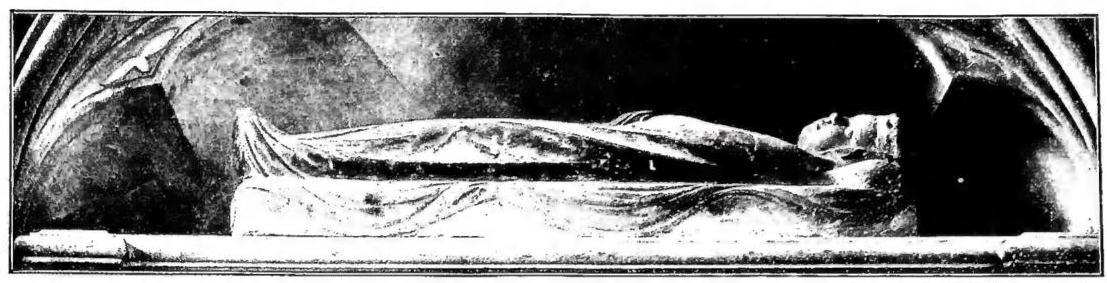
The earliest evidence of his activity is in Pisa, where Tino went, presumably as a collaborator of Giovanni Pisano in the work on the pulpit of the Duomo, and where in 1312 he decorated the Baptismal Font. In 1315, after having already received for some time the commission for the tomb of Henry VII, to be erected under the vault of the same great church, and after having been named capomaestro of the construction, he was forced to leave the city for having taken part in the Guelph faction and fought at Montecatini against the Ghibellines. In 1318 Tino was in Siena working with his father, also a sculptor, and others on the construction of the Duomo, of which, between 1319 and 1320, he was made capomaestro; then he went to Florence, but by 1325 he was already in Naples, where he remained until his death.
Among the earliest works of Tino is the urn formerly on the altar of St. Ranieri in the Duomo of Pisa and later transferred to the Camposanto. The sculpture perhaps belongs to the same period in which the young master collaborated with Giovanni on the pulpit, and the date 1306 seems the most probable. The clear evolution of Tino’s plastic style is understood by comparing that marble, where with cadenced rhythms and compact forms the figures crowd together almost breaking free from the background, with his later works, such as the remaining fragments of the baptismal font and the tomb of Henry VII. This latter, now disassembled between the Duomo, where is the sarcophagus with the recumbent figure, and the Museo dell’Opera, for the vigorous, peremptory liveliness of the figures, especially those of the five counsellors surrounding the emperor seated on the throne, ranks among the most significant sculptures of our 1300s. Here Tino inaugurates plastic styles clearly distinct from those of his master Giovanni; in them the figures, synthetic, rounded, defined within heavy masses, with their sudden variation of planes emphasized by deep rectilinear hollows, have affinities with those painted by Ambrogio Lorenzetti (Toesca). Similar styles appear in the tomb of Cardinal Petroni in the Duomo of Siena (1319-20), in that of Gastone della Torre in the cloister of S. Croce in Florence, while in the sarcophagus of Bishop Orso, which is also in the Duomo in Florence, a clearly evolution of the sculptor toward a preciosely Gothic style is evident, leading him to individual researches of linear rhythms that accentuate the plastic ones and sometimes replace them.
TINO DI CAMAINO — TINTORETTO JACOPO
During the period of Venetian domination (1207-1715) the Greek bishopric was suppressed; however, the Latin rite Catholic bishopric existed to which the prototypographic was subjected. The Greek bishopric was restored around 1719 and ceased in 1833 when it was incorporated into the metropolis of the Cyclades, whose see is in Ermopoli (Syra). The Catholic bishopric of Tino was united in 1930 with the Catholic archbishopric of Naxos, whose prelate resides part of the year in Naxos and part in Tino. Without doubt the history of Catholicism in Tino is consoling, even though, due to the smallness of the bishopric, it lacks grand traits; and although due to the emigration of not a few Catholics to Constantinople, Smyrna, and elsewhere the number of faithful has diminished. It consists of about 4,000 souls whose care is entrusted to about fifteen secular priests assisted by religious (Jesuits and Franciscans).