
TITUS (TITUS), Saint. — A pagan by origin and perhaps from Antioch, he was a companion and valuable collaborator of St. Paul, especially in pacifying the Christian community of Corinth (c. 57). Left temporarily by the Apostle in Crete to reorganize the churches of the island, he was soon afterwards summoned by him to Nicopolis in Epirus with a brief letter (v. PASTORAL EPISTLES; TIMOTHY) written perhaps in Macedonia in 66. During Paul’s final imprisonment, Titus went to Dalmatia (2 Tim. 4:9); in the following years, according to unanimous tradition, he was bishop of Crete until his death in advanced age.
Never named in the Acts (an omission difficult to explain), some have identified him with other known figures (Timothy, Silas, Titus Justus), but without foundation. He first appears with Paul and Barnabas on their way to Jerusalem for the Apostolic Council (c. 49–50): the presence of an exemplary Christian, converted from paganism (perhaps by Paul himself, who calls him “son”: Tit. 1:4) and uncircumcised, was a living expression of the Gospel freed from the Law (Gal. 2:1, 3). He was again with Paul at Ephesus (54–58), together with Timothy and others, though seemingly with greater independence from the Apostle. After the failure of Timothy and Paul himself at Corinth (v. CORINTHIANS, vol. IV, cols. 553–554), he agreed to go there, perhaps with the intermediate “letter of many tears,” succeeding in restoring order to that church (2 Cor. 7:6, 13; 12:17–18). He returned to Corinth again to complete the collection and perhaps to deliver 2 Corinthians. In character he differed from Timothy: perhaps older than him, certainly more resolute in the face of difficulties. He was probably still with St. Paul on the latter’s journey from Rome to the East after his release; at this time he was entrusted with reorganizing the Christian communities of Crete, perhaps founded by those Cretans converted three decades earlier (Acts 2:11). Then he followed or rejoined the Apostle, imprisoned in Rome in 66, from where he proceeded, certainly for reasons of apostolate, to Dalmatia, though seemingly to Paul’s regret, who was left almost alone (2 Tim. 4:9–10).
Titus died without leaving any writings; a supposed letter of his against the custom of “virgins cohabiting” (D. De Bruyne, *Epistula Titi, discipuli Pauli*, in *Revue bénédictine*, 37 [1925], pp. 47–72) is of Priscillianist origin. The Roman Martyrology commemorates him on January 4 and February 6, the latter date being observed in the Latin Church after
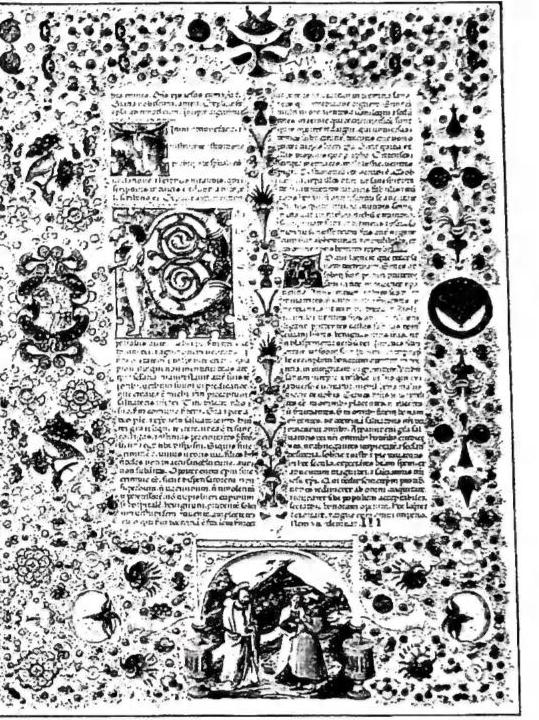
Titus, Saint — Incipit of the Epistle of St. Paul to Titus. Bible of Borso d’Este, with miniatures executed between 1423 and 1461 — Modena, Biblioteca Estense, vol. II, fol. 210v.
Pius IX having introduced his feast by decree of May 18, 1854. His body, long preserved in Gortyna, the capital of Crete, was transferred to Venice in the basilica of St. Mark. Andrew, Bishop of Crete (d. 740), wrote an enthusiastic encomium of him (PG 97, 1141–1169).
EPISTLE OF ST. PAUL TO TITUS. — Written by St. Paul at about the same time and for the same needs as 1 Timothy (v.), when compared with it presents a case analogous to that of Colossians compared with Ephesians and is generally considered slightly later than 1 Timothy, though the ecclesiastical hierarchy is less developed in II. According to the final note in some manuscripts, it would have been written from Nicopolis, but this may be a conjecture occasioned by Tit. 3:12; it is more likely that Paul wrote it from some locality in Macedonia before arriving in Epirus.
The literary authenticity, admitted in antiquity even by Tatian, presents fewer difficulties than 1 Timothy and was doubted only because of its affinities with the latter; even the adherents of the “fragmentary theory” recognize in Titus numerous phrases or notes certainly authentic. In the Pastoral Epistles, St. Paul displays a more extensive literary culture than in his other epistles, and this is also evident here, with various sources cited. Tit. 1:12–13 quotes and approves a verse by the Cretan poet Epimenides (6th c. BC), who is called a “prophet,” perhaps because his countrymen regarded him as such (Cicero, *Divin.*, I, 18); despite the approval of the addition, there remains ample room for poetic hyperbole and exceptions. Tit. 3:5–8 perhaps quotes a baptismal liturgical hymn (similar to that in 1 Tim. 3:16; cf. 1 Cor. 14:26; Eph. 5:14, 19). Some similarity with 1 Peter, written around the time when Paul was in Rome for the first time, has also been noted.
The content is analogous to that of 1 Timothy, of which Titus seems a summary.
In solemn form the prologue recalls God’s design, by which He willed to use Paul for the spread of the
TITUS — EMPEROR TITUS
A pupil for a short time in Naples with the Dutchman Van Haanen, Titus was still a boy when in Venice he became a pupil of Pompeo Marino Molmenti. In Venice he had his first great success at the Biennale of 1887, exhibiting *Pescheria Vecchia*, now in the Galleria d’Arte Moderna in Rome, where *La gomma* is also located. Other works of his, almost always depicting Venetian scenes, drawn from life or inspired by his fanciful imagination, are in the principal collections of modern art throughout the world. Indeed, E. T. was considered among the greatest painters of his age for the spontaneous breadth of his compositions, the easy skill in depicting foreshortenings and perspectives, and the harmony of certain resounding color effects, so much so that in his painting one can discern, if not a direct derivation, at least a certain typological aspiration toward the Venetian painting of the 18th century.
One of his famous altarpieces, *The Deposition from the Cross*, after achieving one of its greatest successes at the exhibition in Rome in 1911, was purchased by the Museum of Buenos Aires.