
UMBERTO III of Savoy, Blessed. — Son of Amadeus III, born c. 1135, died 4 March 1189, buried in the abbey church of Hautecombe.
He succeeded his father Amadeus III while still a minor; the latter died at Nicosia (Cyprus) on 19 April 1148. Umberto was placed under the guardianship of Bl. Amadeus of Hauterive, Bishop of Lausanne. He married four times, and only from his last wife, Beatrice, daughter of Count Gerard of Mâcon, did he have a male heir, Thomas I (1178). Little is known of his private life, nor does the moral portrait traditionally given of him correspond to the reliable documentation that has come down to us. This portrait is based on the *Crognuques de Savoye* of Giovanni Dorieville (D'Orvoville), called Cabaret, written between 1417 and 1420 (still unpublished; the principal source for the *Gestez et croniques de la mayson de Savoye* of Giovanni Servion, written between 1464 and 1465; ed. F. E. Bollati, I, Turin 1879, pp. 207-26; and for the *Croniques* of Perrinet Dupin, compiled from the two preceding works c. 1477; ed. F. E. Bollati, I, ibid. 1893, pp. 109-206). There is no doubt that he was a religious and beneficent prince in the manner of many lords of his time, but the claim that he was incapable of governing is untrue. He was generous in his donations to churches and monasteries; however, he became embroiled in strong jurisdictional and territorial disputes with St. Anthelm, Bishop of Belley (1163-73), with whom he eventually reconciled, and with the Bishops of Turin, Charles and Milo (1159-89), who were protected in their claims by Frederick Barbarossa. Umberto nevertheless had the courage to remain, together with the Bishops of Aosta, Tarentaise, Maurienne, and Belley, loyal to Alexander III,
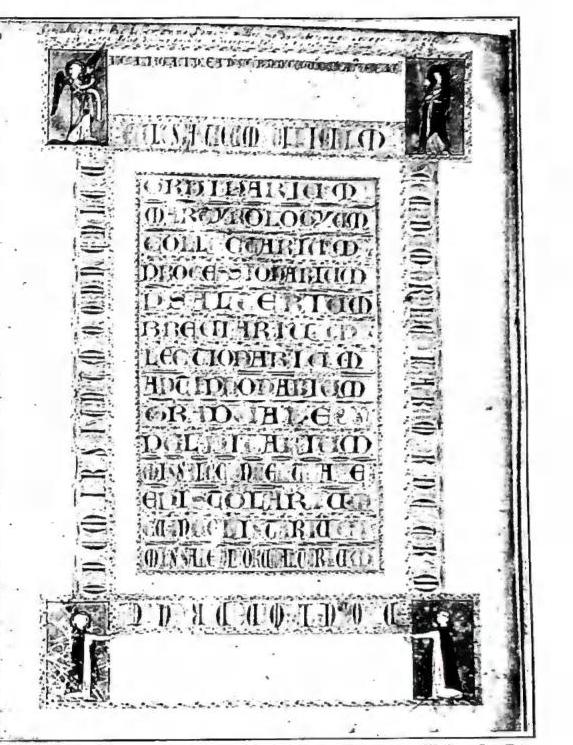
Umberto of Romans — Prototype of the Dominican liturgy, executed between 1234 and 1260 in Paris under the generalship of U. of R. Frontispiece with indications of the 14 books contained in the volume. The small figures in the frame represent the archangel Gabriel and the Virgin
while all around his state the imperial antipopes were being followed. In the political arena Umberto had to maneuver among many and powerful enemies, foremost among them Barbarossa, before whom in 1161 he interceded on behalf of Milan through St. Peter, Archbishop of Tarentaise. Up until the time when the fugitive Barbarossa had to pass through the Mont Cenis pass (February-March 1168), Umberto maintained a distrustful and hostile attitude toward him; from 1168 to 1183 their relations were correct, though this did not prevent Umberto from forming an alliance with Henry II of England (1171), who was as unwelcome to Barbarossa as to the King of France. After the Peace of Constance (25 June 1183), Frederick, now secure in his alliance with the Lombard League, showed himself once more hostile to the Count in the territorial dispute between Umberto and the Bishop of Turin. Summoned in vain in 1184 and 1187 to appear before the Emperor, he was placed under imperial ban by Henry VI, associated in the kingship (1187). Umberto once again met this with passive resistance, taking refuge in his Alpine states. Gregory XVI confirmed his cult in September 1838. Feast day: 4 March.
A. Pietro Frutaz