
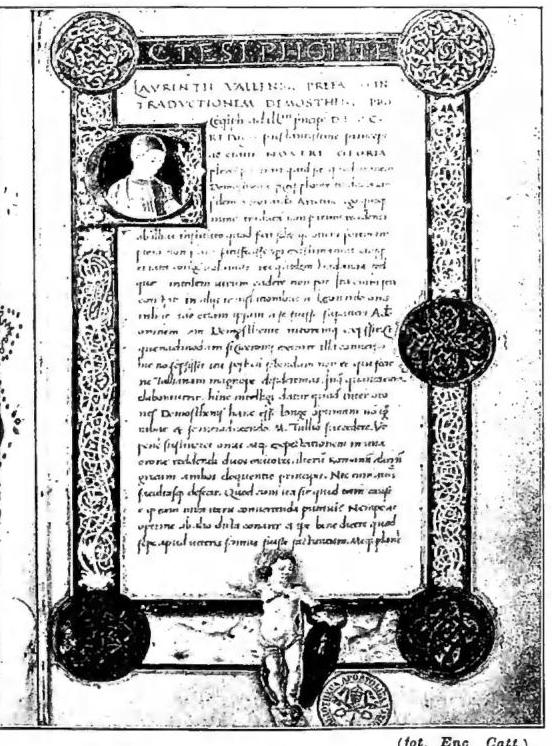
VALLA, LORENZO – Preface by L. V. to his Latin translation of the Oration *Pro Ctesiphonte* by Demosthenes. In the initial portrait of V. and below, the stemma of Federico da Montefeltro, miniature by a Ferrarese school – Vatican Library, cod. Urb. lat. 337, f. 17 (1475–82).
b. tres (1445); *De falso credita et ementita Constantini donatione declamatio* (1440), which aroused the liveliest controversies that lasted until the 18th century; *Ad Eugenium IV Apologia*; *Recriminaciones in B. Faciem*; *Antidotus in Poggium*, of a personal nature.
The markedly polemical character of the figure and work of Lorenzo V. still colours the judgments of scholars. The unscrupulousness of certain complacent attitudes of his toward «magnis et longo iam aevo probatis auctoribus», such as Aristotle, Cicero—whom he preferred to Quintilian—Boethius, Bartolus, and St Thomas Aquinas, together with his biting tone, earned him among many the reputation of a vulgar libeller and the charge of heresy. For others, his bold and disconcerting positions constitute a merit of V., regarded as the father of criticism and philology, a precursor of free thought and modern anticlericalism. To judge V.’s polemics and V. himself aright, it is necessary to delve further into the complex aspects of humanism. In particular, with regard to the religiosity of the humanists, caution is required, given the inadequacy of current research on the religious sentiment of Italians in the fifteenth century and because the sincerity of that sentiment cannot be measured by the yardstick of the sometimes negative contribution of their works. It therefore seems rash to dwell on certain extremely audacious attitudes of V., since he tackled the most arduous problems of philosophy, theology, and Sacred Scripture often with nothing more than the preparation of a grammarian and a scholar. His clear professions of faith seem entirely sincere, whereas the insinuations of Poggio, collected by Pontano, should be consigned to the stock themes of humanist polemic, which was all too often rich in invective and implausible accusations. As for *De voluptate*, despite certain vivid descriptions, the author’s favour toward Epicureanism is far from certain, even if one does not wish to consider the Christian conclusion of the third book as sincere or prefers to speak of an ambiguous work. The theologically dangerous premise may lie in the attempt to insert Epicureanism, seen as a lofty moral teaching and noble ideal of a serene and healthy life, into Christianity. The two doctrines would thus be evaluated on the same level, and the doctrine of Grace relegated to a subordinate position, even while acknowledging that only Christianity attains the supreme good.
The famous *Declamatio*, it is well to affirm decisively, was neither the first, nor the most original, nor the decisive refutation of the celebrated forged Donation of Constantine, which, despite and against V., found supporters even up to Baronius. V. nonetheless went too far. By falsely asserting that the Donation was the foundation, indeed the sole juridical foundation, of temporal power, he declared this power illegitimate and the source of all the evils of Italy. Hence the praise of the Reformation and the renewed sympathy of the 19th century for the humanist. He, however, even though the *Declamatio* was included in the Index of 1559, unequivocally extols the po
32. – ENCYCLOPEDIA CATHOLICA. – XII.