
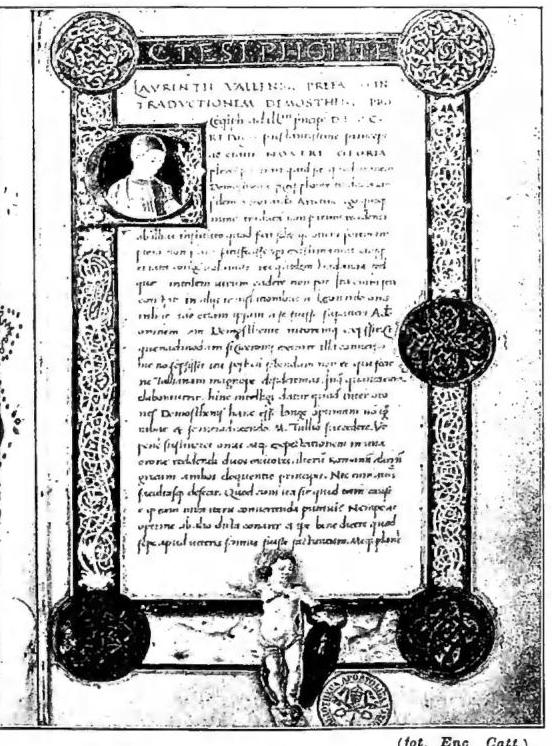
He taught rhetoric at Pavia (1431-33), from which he had to leave due to a writing against Bartolus. In 1435 he moved to Naples, where he became secretary to King Alfonso of Aragon, whom he followed in his various peregrinations and wars. In 1443, after the peace between Eugenius IV and the King of Naples, he attempted in vain to return to Rome, hindered especially by his *Declamatio* on the Donation of Constantine. Only in 1447, with the election of the humanist Nicholas V, could Valla settle in his city and become, according to an old desire, an apostolic writer. He died in 1457 and was buried in the Archbasilica of the Lateran, of which he had been canon since 1455. His tomb, removed from its original site, is indicated in the chapel of the Crucifix.
Ambitious and of vast culture, Valla himself states that he engaged “in almost every kind of learning.” Besides translations from Greek and numerous minor works, not all of which have come down to us, the *Elegantiarum latinae linguae libri sex* (before 1444) should be noted. The most important literary work, which brought wide renown to the author, is the *Dialecticarum disputationum libri tres* (c. 1440), anti-Aristotelian; *De libero arbitrio*; *De voluptate ac de vero bono* (1432), a dialogue on Stoic, Epicurean, and Christian moral doctrine; *De professione religiosorum*; *In Novum Testamentum ex diversorum utriusque linguae codicum collatione adnotationes* (1449?), which opened the way for Erasmus’s (v.) critique of the New Testament text; *De mysterio Eucharistiae*; *Historiarum Ferdinandi regis Aragoniae libri*.
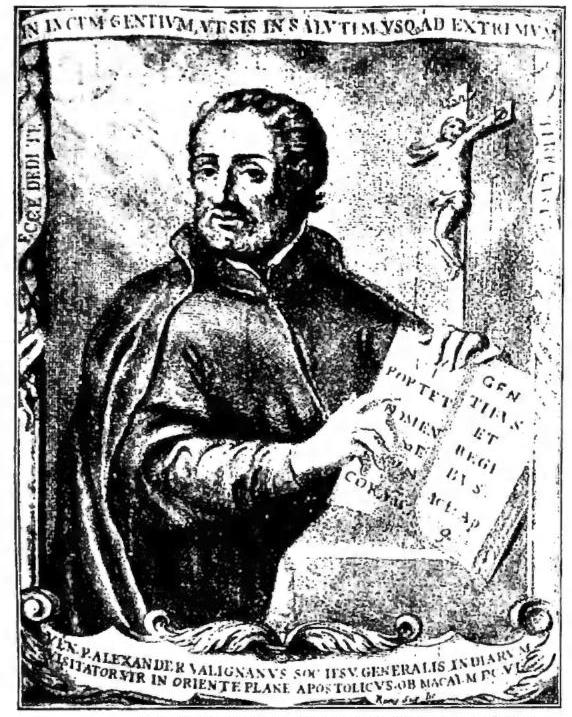
VALIGNANO, ALESSANDRO – When, upon being named the new visitor, on 22 April 1588 he undertook a second journey to Japan from Goa, accompanied by the Japanese ambassadors who had just returned from Rome. After a stop of nearly two years at Macao (28 July 1588–23 June 1590) to encourage the incipient mission to China, on 21 July 1590 he arrived once more in Japan and remained there for more than two years until 9 October 1592. During the other two years he spent at Macao (24 October 1592–15 or 16 November 1594), he approved the reforms in the method of apostolate of Ricci and urged him to reach Peking. Having returned to Goa on 4 March 1595, on 24 September following he resigned the office of visitor of India in order to retain only that of visitor of China and Japan, and in this new capacity he left India definitively on 23 April 1597 and arrived at Macao on 20 July of the same year. During this stay, he appointed Ricci superior of the China Mission and again exhorted him to go to Peking. Having left Macao on 16 July 1598, he arrived for the third time in Japan on 5 August of the same year and gave ever greater impetus to that mission. Departing again on 15 January 1603, he reached Macao on 10 February, and while preparing to visit the China mission, he died there. About 400 of his letters survive, almost all unpublished.
In the face of difficulties, his motto was: “Never retreat.” In India he consolidated and organized the work of Francis Xavier. On his deathbed he saw China opened to the Gospel through the work of Ricci and other brethren, five of whom were Chinese, and in Japan he left about 130 missionaries, nearly half of them Japanese, assisted by the first native priests, for he was a courageous and tireless advocate of an indigenous clergy. Besides the College of Macao, common to both missions, he left two large colleges founded at Nagasaki and in Arima, one beginning at Omura, and a “rector’s house” in the capital, a novitiate and two seminaries for Japanese, about twenty residences, and some 300 churches or chapels. The contemporary Father Celso Confalonieri best characterized him when he wrote that Valignano was “a man plainly outstanding and born for all great things.”