
X, Pope. — Emilio Altieri, born in Rome to the ancient Altieri family on 12 July 1590; a doctor of both civil and canon law, he served as auditor at the nunciature in Poland in 1623. On 26 November 1627, he was appointed Bishop of Camerino following the resignation of his brother Giovanni Battista, holding this see until 1666. He served as nuncio in Naples but was created cardinal by Clement IX only on 24 November 1669. Upon Clement’s death, after five months of conclave, at the age of eighty, he was elected pope on 29 April 1670. As he had no close relatives, he entrusted the management of affairs to Cardinal Paluzzi degli Albertoni, who assumed the surname Altieri.
A major concern of Clement X was the internal discord in Poland, which Muḥammad IV exploited to seize fortresses in the kingdom. Clement supported the efforts of John Sobieski, his victory at Chocim on the Dniester (11 November 1673), and Sobieski’s election as king on 20 May 1674.
During the war that simultaneously raged between France and Spain (1673–1675), Clement acted as a mediator for peace. He had already appointed Fabio Guinigi, Archbishop of Ravenna, as plenipotentiary (5 October 1675), when he died on 26 July 1676. A few years later, a monument to him was erected in St Peter’s, designed by Mattia De Rossi.
His pontificate was fruitful in works aimed at securing the welfare of his subjects and embellishing the papal see. He gave strong impetus to agriculture, promoted industrial progress, subsidized hospices and hospitals, and allocated funds for alms.
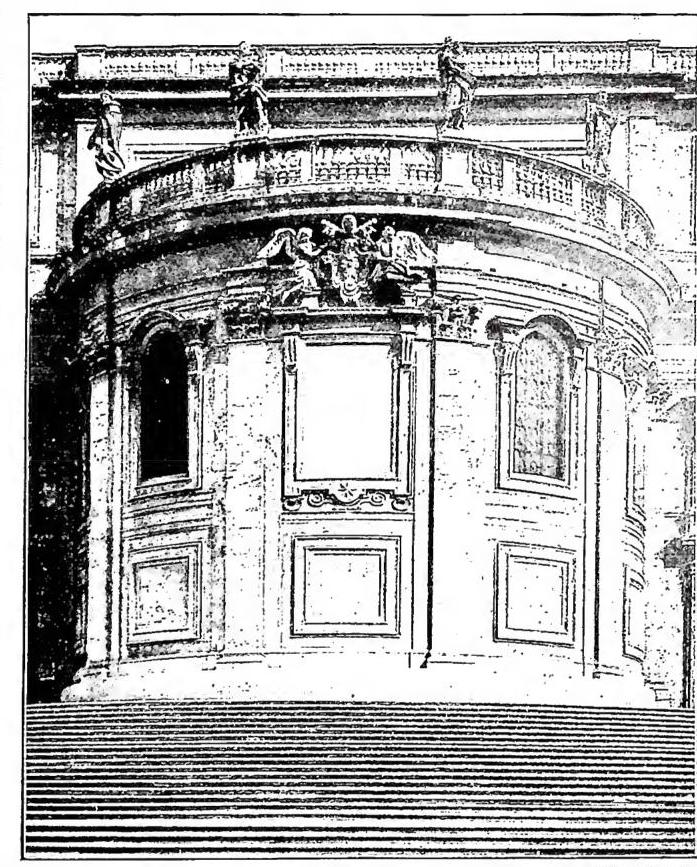
The arts were also favored. Carlo Rainaldi, appointed court architect in place of the aged Bernini, arranged the steps and tribune of S. Maria Maggiore and erected the monument to Clement IX there. Bernini completed the decoration of Ponte S. Angelo with four statues and executed the bronze ciborium for the chapel of the Sacrament in St Peter’s. The mosaic of the *Navicella* by Giotto was restored in the same basilica, and in the square the fountain corresponding to that placed by Maderno was erected; in the church of S. Maria sopra Minerva, the Altieri family chapel was embellished. — See Pl. CXVIII.
Clement canonized Louis Bertrand, Gaetano Thiene, Francis Borgia, Philip Benizi, and Rose of Lima in 1671.