
XILOGRAFICI, LIBRI (Fr. Livres xylographiques; Ingl. Blockbooks; Ted. Blockbücher)
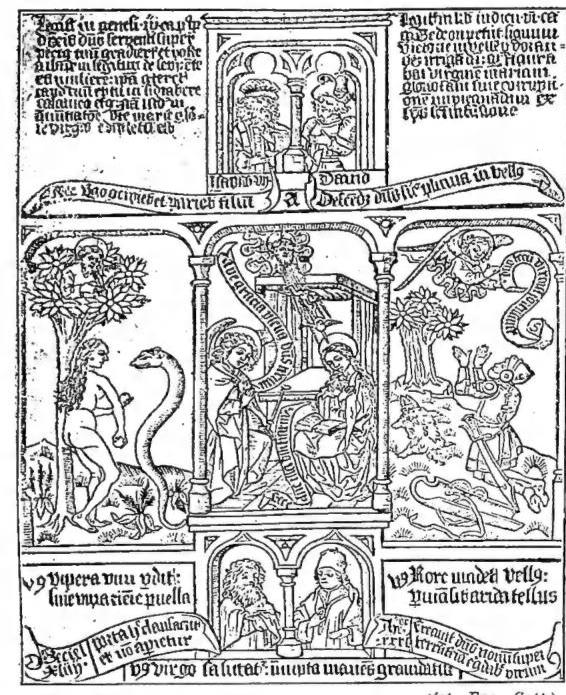
This bibliographical term designates small books composed of woodcut engravings with figures and a brief didactic text, printed on one side of multiple sheets, which are then glued together along the unprinted side and bound to form a kind of illustrated booklet. Sometimes the engravings contain only the figure or, less frequently, only the text; in older specimens, the text (caption) is found written by hand, and for this reason they are called "xylochirographic books." There are also xylographic books with captions printed using movable type.
The xylographic books, also known as tabular printing (a page in a single block), were intended for popular use and were commonly believed to predate the invention of movable type and to be closely connected to the earliest printed books. In reality, they represent an independent, contemporary, parallel, and even later production compared to printed books. The oldest known specimens date to around 1450. Attempts to attribute them to earlier dates are unconvincing, except for isolated sheets, which constitute a similar but structurally different product and cannot be called books. It is also impossible to determine a chronological sequence for them.
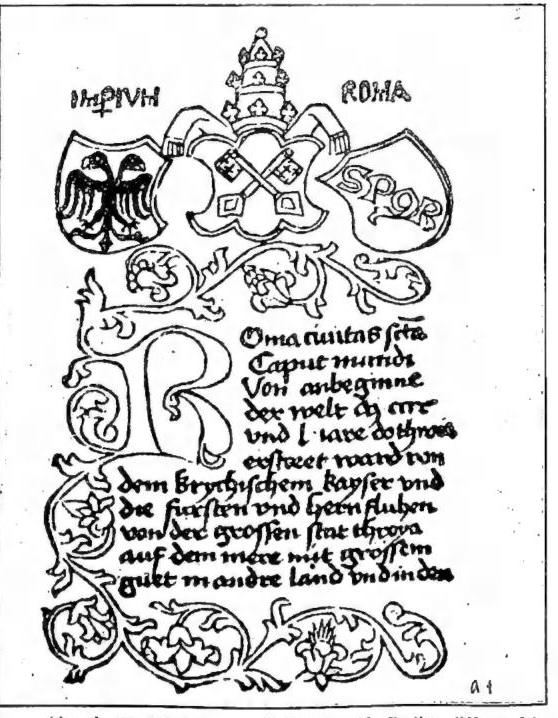
Xylographic books, particularly produced in the Netherlands and Germany, mostly contain sacred imagery, but there are also examples with secular imagery or didactic texts. Among the former, notable works include the *Speculum humanae salvationis*, the *Ars moriendi*, the *Apocalypse*, the *Symbolum Apostolicum*, the *Defensorium virginitatis Mariae*, the *Exercitium super Pater noster*, and, most famous of all, the *Biblia pauperum*, a kind of summary of the Old and New Testaments in 40 or 50 xylographic engravings. The second group includes the *Mirabilia Romae*, the *Danza della Morte* (*Der Totentanz*), some calendars, and a series of
(From annotated edition edited by R. Eheuvel, Berlin 1903, p. 3r)
XILOGRAFICI, LIBRI — *Mirabilia Romae* (second half of the 15th century), German version — Copy from the Gotha Library.
---
FRANCISCO JIMÉNEZ DE CISNEROS (1436–1517). — Born in Torrelaguna, he studied law at Salamanca and theology at Alcalá. After a period of worldly life, he entered the Franciscan Order, where he became a zealous reformer. As confessor to Queen Isabella, he wielded great influence over her and over the government of Castile. With inflexible energy, he set to work, and after being named Archbishop of Toledo in 1495, he continued his efforts to restore the unity of the Franciscan Order, to reinstate discipline and ecclesiastical hierarchy, and to promote education. He founded the University of Alcalá and, with the collaboration of scholars from across Europe, oversaw the preparation and printing at his own expense of the Polyglot Bible. His unyielding intransigence earned him many enemies who sought to harm him at court and before the Pope, but the monarchs defended him against all detractors.
When Philip of Castile died in 1506, Ferdinand was in Italy. Jiménez assumed the regency and raised troops that kept the nobles' rebellious inclinations in check. In 1507, he was appointed Grand Inquisitor, and Julius II made him a cardinal. Jiménez worked strenuously for the conversion of the Moors of Granada. Finally, he became an advocate of a new Crusade. Ferdinand wished for an expedition to India, but Jiménez, invoking the last wishes of Isabella, secured its direction toward Morocco, setting Oran as its objective, while the King aimed for the conquest of Tunis, which would have given Spain a strong strategic base in the Mediterranean. Jiménez led the enterprise himself, accompanying the army commanded by Pedro Navarro in Africa. After the occupation of Oran, conflicts arose between Jiménez and Navarro, and the latter managed to have the cardinal recalled to Spain. However, following a series of victories that brought the Spanish as far as Tunis, a defeat ensued that cost them all the conquered territories except Oran.
In 1516, when Ferdinand died, Jiménez assumed the regency to which he had been designated by the King. During his brief administration, he dedicated all his efforts to preserving the unity of the State, established a national army that enabled him to maintain order, thwarted all the machinations of the nobility, and reorganized the finances. He repulsed an attempt by the Albrets to reconquer Navarre and had all the fortresses of that province razed to the ground, except for Pamplona. An expedition against the pirates of Barbarossa, however, met with an unfavorable outcome.
Although Joanna was still alive, Jiménez, yielding to the will of Charles, had him proclaimed king on May 30, 1516. But the first act of the new sovereign was to relieve Jiménez of his government duties. When Charles arrived in Spain, Jiménez was ill and died before he could meet him. In his ecclesiastical activity, Jiménez anticipated the directives of the Catholic Reformation through his strenuous defense of the faith against heresy and his assiduous work of moral purification and cultural improvement of the clergy. As a statesman, he sought to strengthen the monarchy and the State internally and to secure Spanish predominance in North Africa externally.