

AGATHA, Saint
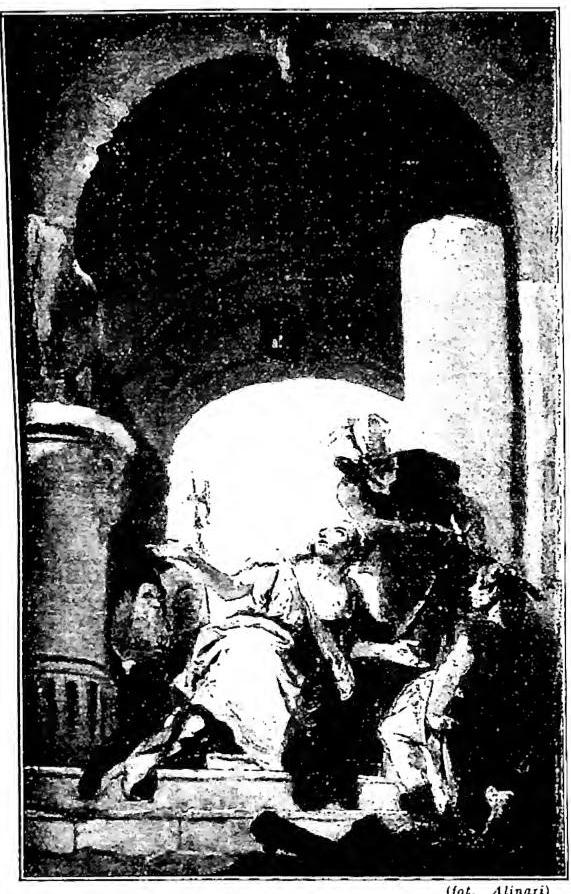
S. A., copy by Luini (16th c.). Rome, Galleria Borghese.
(Not. Attinari)
Palermo, which for a long time contended for the honor of her birthplace, has, in one of the three churches dedicated to her—namely, that “above the walls”—a living rock pointed out by the people as bearing the “footprint” of the saint. In Palermo, in past centuries, a solemn procession took place on February 5, in which penitents, perhaps only barefoot, participated. Yet in this city the cult of St. Agatha was soon supplanted by that of St. Rosalia, whereas in Catania, which venerates her as its patron and protector, it still flourishes. The festivities last three days; in ancient times they included races of Barbary horses, noble cavalcades, and processions in which the academic body, the magistracy, and, again here, the *ignudi* took part. Also noteworthy was the custom, already vanished by the last century, of the “*nutpatedi*” (lit. marionette-snails), namely women who, to avoid recognition, covered themselves up to the waist with a black silk mantle, leaving only the right eye exposed to see and guide themselves; on this occasion they could ask relatives and friends for small gifts, which, by force of custom, could not be refused.
Besides the “fercolo” or bier, with the statue of the saint, dragged by members of the St. Agatha confraternity who replace the ancient *ignudi* and wear the *sacco*, a white ample tunic, characteristic of the solemn procession are the “cerei” or “candelore,” large wooden structures simulating enormous candles adorned with lights, banners, figures, and sculptures; these are borne on the shoulders by the various guilds, foremost among them that of the “rinoti” (a kind of market-gardeners). The illuminations that accompany the procession and blaze forth on all the façades of the houses along the endless route are likewise a salient feature of the feast, which is celebrated twice a year: on February 5 and toward the end of August, since on the 17th of that month the return of the relics of the saint occurred. In some places, such as Catania, the people preserve fragments of the gridiron on which she suffered martyrdom, which, from their shape, are called “minnuzzi di sant’Aita” [St. Agatha’s little breasts]. Very characteristic is the procession held in honor of the saint in the Republic of San Marino, where a mystery play features maidens dressed as symbolic figures such as Faith, Religion, and Science.
Her popular cult is also widespread in France, where she is invoked against lightning and fires, as well as for various women’s ailments.