
AGNESE, saint, martyr. — Of this most famous Roman martyr, probably a victim of the Diocletian persecution, no genuine acts have been preserved; moreover, nothing is known of her family. There is, however, reliable information about her martyrdom in several fourth-century writings: she appears in the Depositio Martyrum of 336, “XII Kal. Feb. Agnetis, in Nomentana” (ed. Valentini-Zucchetti, Rome 1942, p. 17); Ambrose speaks of her in De virginibus, I, 2, and in De Officiis, I, 41; Damasus in the poem still preserved on its original marble (A. Ferrua, Epigrammata Damasiana, Città del Vaticano 1942, no. 37); Prudentius in Peristephanon, 14; and the Ambrosian hymn Agnes beatae virginis (PL 17, 1210–11). From these sources it can be established with certainty that A. was a girl of about twelve years of age, or slightly older, when she was put to death, and that she was a martyr for modesty and faith. Less clear is the manner of her martyrdom: Damasus speaks of fire; one may therefore think either of burning at the stake or of the torches with which the flesh of the victim was burned; according to Ambrose and Prudentius it would have been beheading, whereas for the author of the Ambrosian hymn Agnes beatae virginis it was throat-cutting. Damasus and the hymn just mentioned also emphasize A.’s care to cover her virginal body, the former with her abundant hair, the latter with her garments. The body of the young martyr was then buried in a gallery or hypogeum of the Christian cemetery, which was soon named after her, situated on the left of the Via Nomentana, where the Basilica dedicated to her now stands.
What has been related thus far is the most reliable information available concerning the exceedingly popular Roman martyr; everything further reported by hagiographical sources later than the fourth century belongs to legend. The account of the martyr’s exposure in a place of infamy also has the character of popular tradition, incapable of verification, as Prudentius seems to suggest; it constitutes the central and principal core of his poem, later exploited and expanded by both the Greek and Latin legends.
In the Greek and also the Latin legend, A. is presented in such a way that Fr. Jubaru thought of attributing to another martyr of the same name everything that seems unlikely in the case of our very young martyr. But this second Roman martyr named Agnese never existed, and all the details that the legend, in its two forms, Greek and Latin, adds to the already weak Roman tradition preserved by Damasus and Ambrose do not belong to A.’s true biography. The Greek legend, composed outside Rome, and the Latin one, written by a pseudo-Ambrose and later translated into Greek, belong approximately to the sixth century; as for the Sermo 56 in natali s. Agnetis (PL 57, 643–48) of St. Maximus of Turin, the earliest witness to the Latin legend, its authenticity is doubtful (cf. Tillemont, V, ed. Venice 1732, pp. 345, 723; Pio Franchi de’ Cavalieri, Hagiographica (Studi e Testi, 19), Rome 1908, p. 157, note 1; S. Colombo, in Didashaleion, 1924, fasc. 2, p. 74).
Chapters XIII–XVII of the Latin legend, containing information about the martyr’s burial, the visions of her parents, the martyrdom of St. Emerenziana (v.) and so forth, do not belong to the primitive recension of the legend, as the sermon of the pseudo-Maximus demonstrates; they were nevertheless added before Aldelmo of Sherburn wrote his De virginitate. The problem of the interdependence of the two recensions of the legend has not yet been resolved; in any case, A.’s biography would not benefit from
II. CULT
Prof. R. Herzog (in Trierische Zeitschrift, 13 [1938] pp. 79-120) believed he had demonstrated that A. was a creation of the female ascetic propaganda in Rome at the time of Pope Julius (d. in 352), and that she was a foreigner to the City. Others have responded excellently to such fantasies (cf. A. Ferrua, in La Civiltà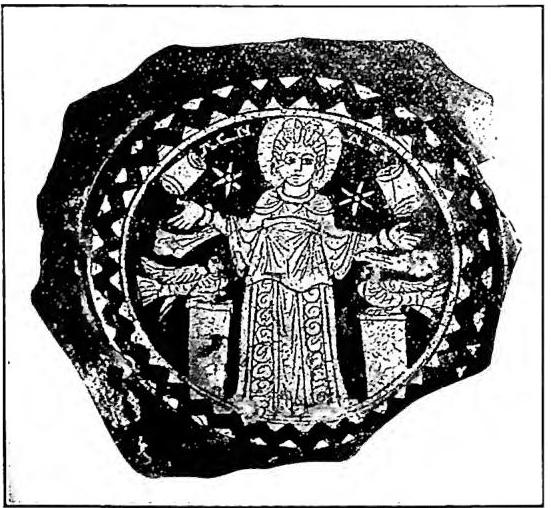
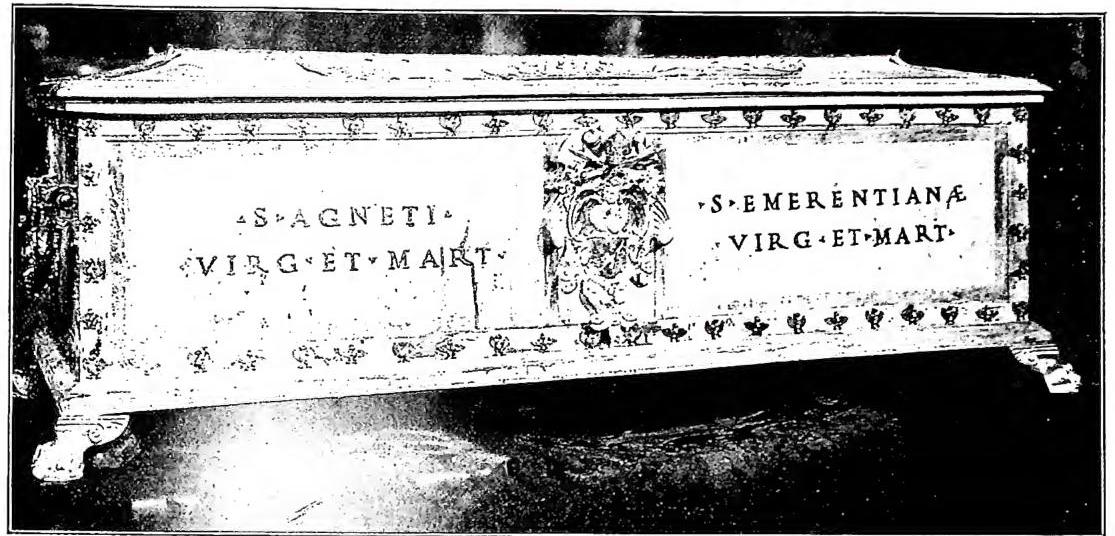
AGNESE, santa - Silver reliquary commissioned by Paul V (1613) (property of the Lateran Canons Regular)
The most celebrated monument of the cult is the small Basilica erected before 349 over the martyr’s tomb by Constantina, daughter of Constantine (wife of Hannibalianus and consequently of the Caesar Gallus), restored by Symmachus (498-514), and completely rebuilt by Honorius I (625-38). The rebuilding under Honorius, with its beautiful apse mosaic depicting A. dressed in Byzantine fashion between the pontiffs Honorius and Symmachus, aroused enthusiastic admiration among contemporaries (cf. Epitome de locis SS. Martyrum, ed. Valentini-Zucchetti, Roma 1942, p. 115).
Afterwards the Basilica underwent various restorations, among which those at the beginning of the 17th century deserve mention: the work of Cardinal Alessandro Ottaviano de’ Medici, to whom the excavation of the northern section (1600) is owed, and of Cardinal Sfondrati (1605), to whom we owe the present coffering and an in-
terior renovation; to him is also owed the examination of the martyr’s relics (1605), which Paul V enclosed in 1615 in a silver reliquary, placed in a small burial chamber beneath the new and sumptuous altar he had built to preserve the sacred pledge. Many centuries earlier, certainly as early as the 9th century, the martyr’s head had been removed from the tomb and placed in the papal treasury, that is, in the Sancta Sanctorum. Now, with the permission of Leo XIII, it is preserved and venerated in the church of S. Agnese in Agone. As early as 1621, the statue of S. Agnese, by the sculptor Niccolò Cordier, called the Franciosino, was placed on the altar table; he added a head, hands, and feet of bronze to the trunk of a classical statue of agatized Eastern alabaster. Pius IX restored the Basilica and renovated its interior in 1855.
At the beginning of the 5th century, the Basilica of S. Agnese was under the jurisdiction of the priests of the titulus of Vestina or of S. Vitale, and toward the end of that same century it seems already to have been entrusted to nuns, as is shown by the discovery in the Basilica of the epitaph of the Abbess Serena (d. in 514).
The location of the brothel where A. was exposed has been identified (Prudentius and the legend provide no topographical information for this purpose) in an archway of Domitian’s stadium, where in the 8th century there was a small church dedicated to the martyr (cf. Itinerario di Einsiedeln, ed. Valentini-Zucchetti, Roma 1942, p. 180; P. Romano-P. Partini, Piazza Navona nella storia e nell’arte, Roma [1944], pp. 25-30), later called S. Agnese in Agone. At the beginning of the same 8th century, there is also evidence of the oratory and monastery of S. Agnese ad Duo Furna, near S. Prassede. Of the Basilica erected at Ostia, there is probably a remembrance in the dedication recorded in the Hieronymian Martyrology on 18 October.
ICONOGRAPHY. - In the 4th century A. is represented in the form of an orans: very young in the transenna
(properly A. P. Frutaz)
of the altar dating from the time of Pope Liberius, and as a young woman in the gold-glass vessels; from the 6th century onward, A.’s iconographic type became fixed: a young woman with a lamb at her feet or in her arms, symbolizing purity and alluding to her name. The oldest representation of this type is found among the company of virgins depicted on the left wall of S. Apollinare Nuovo in Ravenna (beginning of the second half of the 6th century). This type subsequently became common among later artists. See, for example, Giottino (S. Francesco, Assisi); Duccio di Boninsegna (Maestà, Siena); Beato Angelico (Uffizi, Florence); Andrea del Sarto (Duomo, Pisa); Tintoretto (Madonna dell'Orto, Venice); Domenichino (Pinacoteca, Bologna); Dolci (Gall. Corsini, Rome), etc. In the church of S. Agnese in Agone, the statue of the saint is by Ferrata; the bas-relief depicting A. covered by her hair has recently been attributed to D. Guidi. The statue of the saint on the exterior of the cathedral of Milan is the work of A. da Briosco. Among the pictorial cycles of the legend, those of S. Maria di Donna Regina (Naples), from the 14th century, and of the golden cup (British Museum), which Duke Giovanni di Berry intended to offer to King Carlo V of France on the occasion of his birthday, 21 January 1381, deserve mention. But since the latter had meanwhile died, the cup was subsequently offered in 1391 to King Carlo VI of France (cf. C. H. Read, in VetustaMonumenta, VII, III, Westminster 1904, of the Society of Antiquaries of London [description]; L. Delisle, in Journal des Savants, 1906, pp. 233–39; many other precious objects depicting s. A. were offered to King Carlo V).
The 7th-century mosaicist who depicted A. in the apse of the Honorian Basilica, drawing on the Greek version of the legend, represented the martyr in the guise of a matron dressed like a Byzantine empress, holding a book in her hand and with the instruments of martyrdom—the fire and the sword—at her feet.
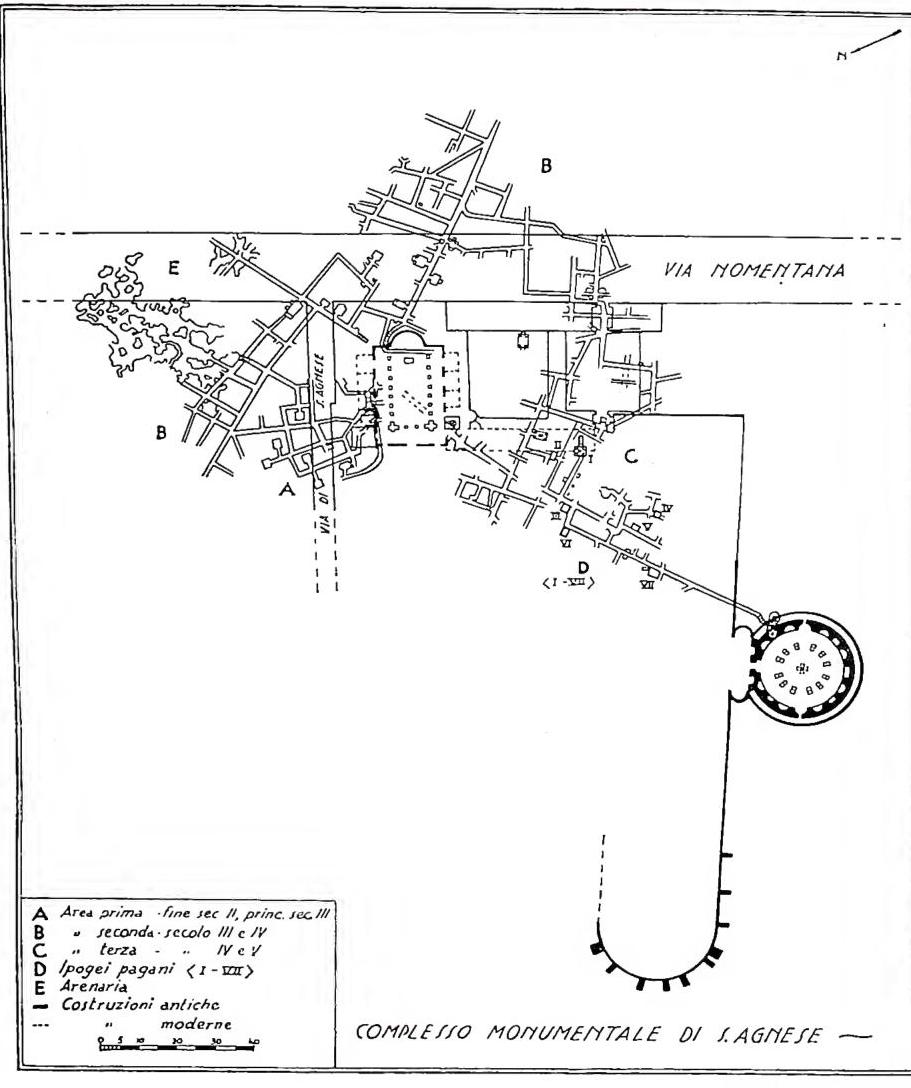
CEMETERY. — A little beyond the 2nd kilometre from Porta Pia, on the left of the Via Nomentana, where the basilica of S. Agnese stands, there existed a Christian cemetery area predating the eponymous martyr. Of the above-ground burial area, nothing remains except the large elliptical enclosure, used for burials in the 4th century, on the northwestern side of Costanza (v.). The hypothesis recently advanced by F. W. Deichmann (Die Lage der constantinischen Basilika der Heiligen Agnes an der Via Nomentana, in Rivista di Archeol. Cristiana, 22 [1946], pp. 213–34), according to which the aforementioned elliptical enclosure represents the remains of the magnificent Constantinian basilica erected in honour of s. A., is groundless.
Of the subterranean cemetery, formerly on three levels and partly destroyed by the Basilica, which was built into the hillside so as to place the high altar above A.’s tomb, three large regions still remain, together with a sand quarry and several pagan cubicula subsequently incorporated into the Christian area. The oldest region is the one on the left side of the Basilica and may date to the end of the 2nd century; the most recent is the one that terminates at the mausoleum of Costanza, from the 4th–5th century. This is a rather poor cemetery, as is also evident from the absence of paintings; it nevertheless preserves several dated inscriptions (the oldest is from 349), the well-known inscription (late 2nd century) of Favor lector, a Constantinian monogram carved in stone, a portrait of a deceased woman in ivory-and-enamel mosaic, several gold-glass vessels, etc. The subterranean cemetery, into which Bosio and others had already penetrated, was accidentally discovered in 1865 and 1866; systematic excavation began in 1869, and Mariano Armellini, the well-known disciple of De Rossi, followed it step by step, enabling him subsequently to provide an accurate description of the entire cemetery in the volume, a model of its kind, entitled: Il cimitero di S. Agnese sulla via Nomentana, Rome 1880. - Vedi Tavv. XXXIII-XXXV.