
ALBI, ARCHDIOCESE OF. – A metropolitan see in south-western France, with its seat at Albi, a city of 30,000 inhabitants situated on the left bank of the Tarn, a tributary of the Garonne, to the north-east of Toulouse, and at the same time the chief town of the department of Tarn (5,780 sq. km. and 297,800 inhabitants). In classical times Albi was the centre of the Celtic tribe of the Albici; it gained importance especially in the Middle Ages, from the Carolingian period onwards, when it became the seat of a county.
The episcopal see probably dates from the 3rd century. S. Claro is honoured as its first bishop, but the first name attested by history is that of Dio-
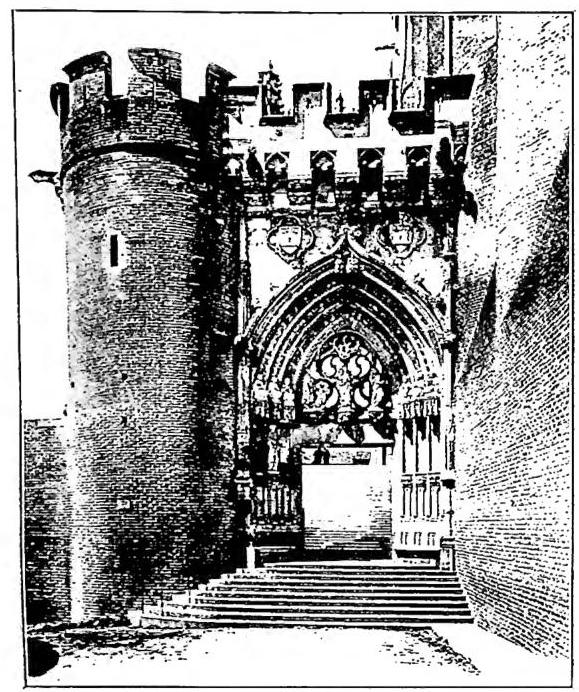
Albi – Cathedral. Door constructed by Bishop Domenico da Firenze (early 15th century).
The heresy of the Albigensians, which had been spreading in Languedoc, was received very badly by the citizens of Albi on 25 June 1145; three days later, St Bernard obtained mass conversions there, but they were not lasting. Moreover, in 1165 Bishop Guillaume Peire convened a synod of numerous bishops from neighbouring dioceses, princes, and people in the hamlet of Lombers, in the territory of Albi, which had become a stronghold of Cathar heresy. The heretics, led by their bishop Olivier, engaged in debate with the synod, which ended in a condemnatory sentence, and whose acts, widely circulated, helped to make the region of Albi the place of origin and the name-giving centre of Catharism. In reality, there may have been an earlier hierarchical centre; already in the 11th century groups of heretics of dualist or neo-Manichaean doctrine are recorded in Aquitaine and in northern France, as well as in Italy.
If the acts of the Cathar Council of Saint-Félix de Caraman (Toulouse) of 1167 are considered authentic, the Albigensian heresy received a doctrinal unification and a hierarchical organisation: its representatives, through the agency of the leader Niceta or Niquinta, who came from the East, adopted the absolute dualism of the Cathar church of Dugnuthia (v. Albanenses) and established the heretical dioceses or churches of Albi, that is, Lombers, Toulouse, Carcassonne, Val d’Aran in Languedoc, and that of ancient France, which included the royal territories of the langue d'oïl. Before 1230 the diocese of Agen was established, and in 1225 that of Razès. The contemporary R. Sacconi (v.) in 1250 lists in his Summa de catharis the three churches of Albi, Toulouse, and Carcassonne; their numbers, together with those of the now-vanished diocese of Agen, totalled 200. They remained faithful to absolute dualism, following the doctrine of the oldest faction of the Albanenses led by the Cathar bishop Balasinaza of Verona. The members of the ecclesia Franciae, that is, of the regions of the langue d'oïl, had been dispersed by the anti-heretical action, especially of St Louis IX, and had gathered in the number of 150 in the Veronese and in Lombardy; as for doctrine, they had adopted the mitigated dualism of the Cathar sect of the Bagnolenses (v.). In the second half of the 13th century we find Cathar leaders and followers from Languedoc exiled or emigrated to Lombardy and Apulia, who, towards the end of the century, on returning to their homeland, brought back beliefs and formulae of mitigated dualism, which were professed alongside the pure dualism of the ancient Albigensians. The action of the Inquisition and the dispersal of the centres contributed to the disappearance of Oncitanic Catharism, which in the 14th century retained only a few noble vestiges, the last ones.
2. THE ARMED CRUSADE AGAINST THE ALBIGENSIANS
From the middle of the 12th century the Catharism or Albigensian heresy in Languedoc organised itself into hierarchical districts, convened large gatherings, carried on an intense campaign of propagation and conquest, openly challenged
711
ALBIGENSIANS – ALBINAGGIO
712
With bold opposition from the magisterium and ecclesiastical institutions. The heretics drew strength from the armed support of great feudal lords and civil authorities; the rigid asceticism of the “perfect” allowed simple believers and sympathizers every kind of excess, while at the same time securing their eternal salvation through the conferral in extremis of the *consolamentum*; the erotic preaching and attacks on ecclesiastical property enabled covetous nobles to plunder without further moral hindrance. The defenseless populations were seduced by the austere life of the Cathar leaders, abandoning churches and sacraments, participating in violence against the clergy and monasteries; there were even ecclesiastical dignitaries and parish priests who not only failed to oppose the heretical invasion but entered into collusion with the enemy and profited thereby. According to repeated alarms, Occitan Catholicism was on the verge of shipwreck; the Church and the Cathar nobility had established a center of threat to the peace of nations and Christian society. In 1177, Raymond V of Toulouse confessed in alarm that spiritual arms were powerless, that his material forces were insufficient owing to the defection of his vassals to the enemy, and that only the intervention of the king of France could alter the situation. Only thirty years later did historical circumstances demand the use of armed force.
Indeed, the missions of the papal legates, accompanied by Cistercian monks as preachers of the faith and protected by small military escorts, in 1178 and 1181, came to nothing. Raymond VI of Toulouse showed himself favorable to the heretics. Innocent III, who regarded heresy as a crime of lese-divinity to be punished like lese-majesty, augmented the powers of the legatine inquisition, which operated with ordinary jurisdiction in matters of heresy, deposing the unworthy from ecclesiastical office, requiring magistrates and lords to swear an oath of Roman faith and to provide the secular arm for the proscription of heretics and the confiscation of their goods, under penalty of incurring the same sanctions themselves. To assist the legates Peter of Castelnau and Ralph, discouraged by failure, from 1203 onward Diego, bishop of Osma, and Dominic of Guzmán with his first companions set to work; they proceeded by the example of an austere life, evangelical preaching, and public disputations, but achieved only partial successes. The count of Toulouse, with duplicitous conduct, kept the legates at bay; on 5 January 1208 one of his subjects, unpunished, assassinated the legate Peter of Castelnau, creating the *casus belli*; Innocent III then preached a crusade against the heretics of the South, absolving subjects from their oath of fealty to Raymond VI, who had been excommunicated.
King Philip Augustus of France held back; he permitted only his vassals to take the cross. The legate Arnold of Cîteaux marched from Lyons with a makeshift army and on 22 July 1209 captured Béziers, and on 15 August Carcassonne. The crusade acquired a leader: Simon of Montfort, created viscount of the two cities; the religious aim became entangled with political ambition, as the lesser nobility of the North sought to seize the southern fiefs. The crusaders were animated by sincere faith and displayed indomitable courage, but they conflated their own interests with those of religion and gave themselves over to the cruelties of war. The ecclesiastical authorities renewed the local hierarchy and purged the regions of the heretical infection. Simon, however, intended to supplant Raymond VI in the county of Toulouse; Innocent III, inclined to mercy, ordered the suspension of the crusade. It nevertheless continued under a political aspect.
Peter, king of Aragon, allied with Raymond VI, formed a league with the intention of negotiating with the Pope against the crusaders; the plan failed when Simon won a great victory at Muret on 12 September 1213. The Council of Montpellier in 1215 assigned the city of Toulouse to Simon; Innocent III, at the Fourth Lateran Council, through a compromise, reserved to Raymond VII, son of the count of Toulouse, the lands not yet occupied, and compelled Simon of Montfort to seek from the king of France the investiture of the conquered fiefs. The campaign against heresy continued in conformity with ecclesiastical and civil legislation; but the military campaign suffered alternating fortunes until Louis VIII, son of Philip Augustus, intervened with his own army to reap its fruits, taking possession of the entire country. At his death in 1226, however, the Albigensians rallied and the war continued until 1228, when Raymond VII, now discouraged, expressed a desire to negotiate peace. The Treaty of Meaux in 1229, between representatives of the regent Blanche of Castile and Raymond VII, secured for the French crown the lands of the Midi: the lower Languedoc, forming the seneschalsy of Carcassonne and Beaucaire, was ceded to II. Raymond gave his daughter Joan in marriage to Alfonso of Poitiers, brother of Louis IX, thereby ensuring the succession of the Capetians in the domains that remained to him. This took place in 1271. The count of Toulouse also subscribed to measures for the defense of the faith.
It cannot be denied that the crusade against the Albigensians was a decisive means of breaking the armed protection of heresy and the complicity of civil powers, so dangerous to the common good itself; Innocent III, with superior integrity, sought to curb the unforeseen deviations of political passions. It must also be recognized that the crusade served the integration of northern and southern France, marking a stage in the country’s unity. The ever-grave threat of the heretical infection prompted Gregory IX to establish the papal inquisition (v.), which his successors systematized and which continued in France, as elsewhere, in the repression of various heretical sects.