
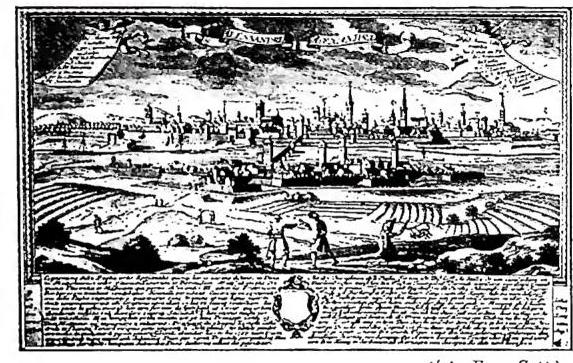
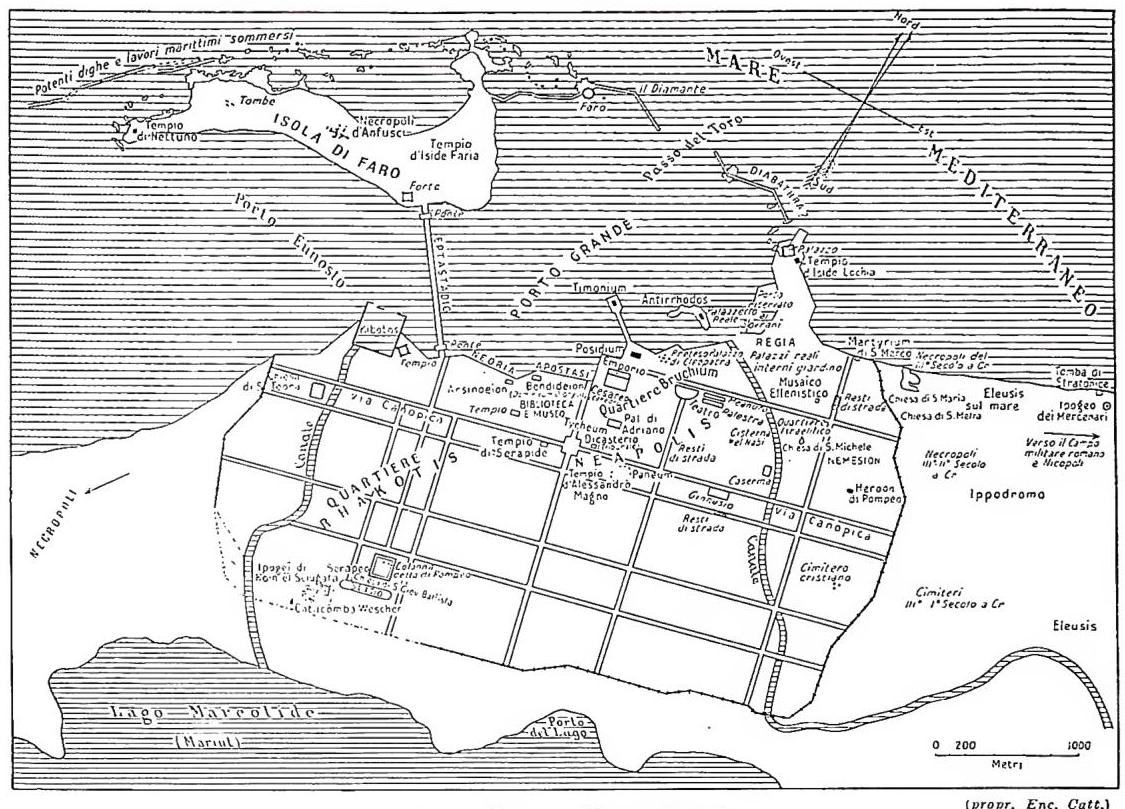
ALESSANDRIA D’EGITTO. – City in Egypt, founded by Alexander the Great in 332 BC, 14 km west of the Nile branch called Canopus on the Mediterranean coast opposite the island of Pharos (which provided two excellent harbors).
SUMMARY: 1. A. in Holy Scripture. –
2. The school of A
3. History of the patriarchate of A
4. The Councils of A
5. The Alexandrian rite
6. The military diocese of A
7. A. of the Copts. – 8. Archaeology.1. A. IN HOLY SCRIPTURE. – Situated at the crossroads of Europe, Africa, and Asia, A. became, under the far-sighted rule of the early Ptolemies, one of the greatest metropolises of the ancient world. In the realm of the spirit it was the heir of Athens, in commerce the heir of Tyre, Sidon, and Carthage. Of this latter fact a faint trace remains in the New Testament, where we read that St Paul was traveling on an Alexandrian ship when it was wrecked off Malta (Acts 27:6 ff.); it was also an Alexandrian ship that carried him from Malta to Puteoli (Acts 28:11–13).
The name of A. itself never occurs in the original text of the Bible. The five mentions of A. in the Vulgate (Jer 46:25; Ezek 30:14–16; Nah 3:8) are due to a misunderstanding by St Jerome, who, believing the city to be founded on the site of ancient No (Thebes), substituted the name No in the Hebrew text with that of A. (cf. AMMON). However, the noun “Alexandrian” (ἀλεξανδρεύς) appears twice in Acts 6:9 (the Alexandrians formed a distinct group in the synagogue of Hellenist Jews in Jerusalem) and 18:24: Apollos (cf.) was a Jew, an Alexandrian by birth (Ἀλεξανδρεύς τῷ γένει). This fleeting mention indicates the true importance of A. for the Bible.
It was the city where, more than anywhere else, a very large group of Jews, in the best economic and political conditions, lived in constant close contact with the new center of the Hellenic world, where around the vast library of the Mouseion an intense intellectual activity flourished in every field of knowledge from 111 BC onward. From its foundation, the number of Jews in A. was considerable and grew to the point that two of the five districts were considered and called Jewish quarters. Favored first by the Ptolemies and, after the Roman conquest, also by the emperors, the Jews lived as an independent and autonomous political community in their internal affairs, faithful to the Law and the traditions of their fathers. Despite this, the constant contact with the dominant Hellenistic population was such that by the first century of their residence in A. the majority of Jews had forgotten their sacred language and their spoken tongue (Aramaic). Greek became the everyday language, even in the synagogue, and this made it necessary to translate the Bible into Greek.
This version, known as the Septuagint (cf.), bears the unmistakable imprint of a mentality strongly influenced by the Greek philosophical environment. The translators show a tendency to remove, or at least mitigate, many anthropomorphic expressions in the original text that jarred the sensibilities of minds formed in the schools of Pythagoras, Anaxagoras, Plato, or even the Stoa. The Greek influence on Alexandrian Judaism also penetrates the very orbit of the Word of God. In 2 Maccabees, the Word of God is clothed in all the rhetorical artifices of contemporary historiography. 2 Maccabees is the only work, preserved in its entirety, of Hellenistic-Jewish historiography before Christ. Of other authors, we know only their names and more or less extensive fragments. The most important are the dry and concise Demetrius (c. 210 BC), the fabulous Eupolemus (c. 155), and the fantastic Artapanus (c. 100). More than elsewhere, within the scope of the Bible, the influence of the Alexandrian environment is evident in the Book of Wisdom (cf.). Although the author remains faithful to the beliefs of his people, the remarkable force—unmatched in the Old Testament—with which in the first part of his book he emphasizes the afterlife may also be attributed to the Hellenized and Hellenic environment for which he wrote. In the second part of the book (chs. 6–9), the author’s Greek erudition is especially evident. In 7:17–20, he reveals himself open to all the sciences that were so fervently cultivated in the metropolis of Hellenism. Divine Wisdom (7:22–8:1) is described using the terms employed by the Greeks for the “Nous” of Anaxagoras, the “Logos” of the Stoics, and the “World Soul” of the Platonists, with the evident intention, through this “polemical parallelism,” of making it clear that the Wisdom of God is the true Nous, the true Logos, the true World Soul. At the same time, the terminology of popular philosophy allowed these terms to be taken in a broader sense, making it possible to disregard the errors originally associated with them: Platonic dualism and Stoic materialism. In the third part (chs. 10–19), which shows the work of Divine Wisdom in the history of Israel, there are two significant digressions. The first speaks of a God who is merciful even in punishing the adversaries of His people, because even they are “men,” a sign that in the Alexandrian Jew the idea of the Creator of all mankind seeks to overcome the barrier of national particularism and to align with the Hellenistic-Stoic idea of the unity of all men. The second digression is directed against idolatry and constitutes another document of the new mentality that grew in the intellectual and cultural climate of A. In the polemic against the gods of the philosophers, the author investigates the reasons for error, acknowledges the aesthetic sense of the Greeks, their goodwill, and their search for truth.
Yet the Bible not only underwent influences from the Alexandrian environment but also, in turn, influenced it and the Hellenistic world. Many pagans conformed their lives to Jewish customs, and the commemorative feast for the Greek version of the Septuagint was also celebrated by pagans. Thus, just as the Alexandrian version infused new ferment into the idolatrous environment, preparing the way for the Gospel of Christ among the pagans, so too did it open the path to Christ even in the hearts of the Jews themselves, to the point that in later centuries the translation of the Bible was considered in Judaism a disaster worthy of being commemorated with a day of national mourning.
A large part in this “evangelical preparation” was played by the allegorical interpretation of the Bible, a fruit not new but typical of the close coexistence between Jews and Greeks in Alexandria. From the certainty of having in the Law of Moses the sole source of every religious and ethical truth and from the surprise of finding in Greek philosophy concepts of high spirituality and a very elevated morality, there arose the desire to show that all the apparent crudities in the Bible were pregnant with spiritual truths, and that all the good of Greek philosophy was also to be found in the Law of Moses; indeed, considering the antiquity of this law, it was the source from which the ancient priests and philosophers, especially Plato, the great traveler, drew. The infallible means of demonstrating the identity between Greek philosophy and the Law of Moses was precisely allegorical interpretation. With this method, the Greeks also saved their “Bible,” Homer, by modernizing him and finding in him, allegorically hidden, the deepest ideas of philosophy. The father of the allegorical interpretation of the Bible in Alexandria is considered to be Aristobulus (v.) around 160 B.C. But he who in this field comprehended and far surpassed all his predecessors was Philo (v.) of Alexandria, a contemporary of Jesus. The almost complete preservation of his voluminous work still today bears witness to the high esteem in which this most celebrated among the Alexandrian Jews was held by the Christians of the first centuries and especially in that first catechetical school (Pantaenus, Clement, Origen) which became the immediate heir of the Alexandrian Jewish school and of its method of allegorical interpretation of Holy Scripture.
2. THE SCHOOL OF ALEXANDRIA
In a city like Alexandria, rich in so many scientific institutes and philosophical schools, it was natural that there should also be felt the need to establish an advanced school of religion, which aimed less at catechetical exposition than at the scholarly deepening and defense and illustration of II. According to Philip of Side, Athenagoras is said to have been its first teacher, but common opinion attributes its foundation to St. Pantaenus (v.), the Sicilian bee, around 180. He was succeeded by Clement of Alexandria (v.), the philosopher of practical rather than speculative life (from about 200 to 202), then by Origen from 203 to 231, a profound scholar and bold philosopher, a most prolific writer and youthful speaker, the greatest luminary of the school. Deprived of his position because of his bold and unorthodox conceptions, he was succeeded by Heraclas and Dionysius (v.), his disciples, and others including Pierius, Achillas, Peter the Martyr (v.), and especially Didymus the Blind (v.), who for more than 50 years attracted an extraordinary number of disciples (among them Rufinus, Jerome, Palladius) who admired his doctrine and piety. After him, the school was still held for some years by Rhodon (v.), who at the time of Theodosius transferred it to Side in Pamphylia.
Little is known about the organization of the school. It mostly had only one teacher, and it does not seem to have had a fixed location. The school was public, with a free audience of every age and condition; thus it was difficult for there to be a fixed program, let alone a method of instruction. It consisted essentially of lectures on religious and apologetic subjects. Although the school was under the supervision of the bishop and the teachers were appointed by him, there nevertheless appears to have been a wide freedom of thought. The two most famous teachers, Origen and Didymus, were laymen. Under the influence of the Jewish environment (one need only think of Philo) and of the two great first teachers, Clement and Origen, the school’s approach was twofold: philosophical and scriptural. In philosophy, an attempt was made to penetrate as far as possible into the Christianity of the eclecticism then dominant with a Neoplatonic background, in order to make it more modern and acceptable to educated pagan minds; as for the Bible, it was always held firmly to its total divine inspiration and inerrancy, and therefore, in order to have it accepted as such even by learned pagans, allegorical interpretation was practiced on a large scale, in the same way that pagan philosophers and lecturers then did with mythology and the American books, even though Origen himself inaugurated biblical studies on a very broad basis of textual criticism, an example which, however, was not followed.
Serious consequences of this philosophical contamination and of unbridled allegorism manifested themselves both in the so-called original errors and in the mystical tendency to deny the fact of the human nature of the Redeemer. Nevertheless, great minds formed in this school (such as Athanasius, Didymus, and Cyril) knew how to restrain these tendencies within limits compatible with dogma. Indeed, through the branch of Caesarea founded by Origen, the great Cappadocians can in part be considered fruits of the Alexandrian school as well. Through it, the first attempts at a theological synthesis were made, and especially an outline was sketched of a demonstration of the agreement of reason with faith beyond the narrow limits within which the proper apologists had confined themselves.
3. HISTORY OF THE PATRIARCHATE OF ALEXANDRIA
Here we are dealing with the Greek patriarchate which, after the Council of Chalcedon (451), was designated by the name Melkite (imperial) in opposition to the Monophysite bodies which did not adhere to the Byzantine emperor, the supporter of that Council; today, however, the term Melkite is used for the Catholic Christians of the Byzantine or Greek rite and of the Arabic language wherever they may be found.
From the introduction of Christianity to the Council of Nicaea (325). According to the reliable testimonies of Eusebius, Epiphanius, and St. Jerome, the Church of Alexandria was founded by St. Mark, a disciple of St. Peter; Eusebius recounts that under Emperor Septimius Severus (193–211) there were numerous martyrs in Alexandria and in the Thebaid, that is, in southern Egypt. Christian communities already existed in Egypt before the Council of Nicaea, spread across 50 nomes (administrative districts), including Cyrenaica, and more than 40 episcopal sees are listed. At the Synod of Alexandria in 320 (or 321), about one hundred bishops were present. Even in the villages, Christianity had taken root, as we know from patristic discoveries and later martyrological documents. Egypt must be counted among those countries of the empire in which Christianity was professed by a large part of the population. Cyrenaica, the Pentapolis west of Egypt, had contributed some of its earliest faithful (Symeon, Lucius, the converts of Pentecost) as reported in the Gospels and the Acts of the Apostles. In the second half of the third century, each of the five cities of Cyrene, Ptolemais, Berenice, Arsinoe, and Sozusa had a bishop dependent on the bishop of Alexandria. Under Emperor Philip the Arab (244–49), the virgin and martyr St. Apollonia died in Alexandria.
If the persecution of Decius in 250, as is certain, recorded apostates in Egypt, there were also many martyrs, not a few of them soldiers, as well as others of various ages and social conditions. Other Christian heroes are known from the persecutions of Valerian in 257, of Diocletian in 304, and of Maximinus Daia (310–12). Alongside the martyrs, the Church of Alexandria has the glory of having promoted monasticism (v.), whose principal representatives are Sts. Paul, Pachomius, and Anthony (d. 365). The vitality of the Church of Alexandria is also shown in the fact that it was able to overcome heretical crises (Gnosticism, Sabellianism, Arianism) and the Meletian schism (Meletius of Lycopolis); the Synods of Alexandria, the catechetical school, and especially distinguished bishops such as Dionysius of Alexandria the Great (264–65), Peter Martyr (300–311), St. Alexander (312–28), and later St. Athanasius, contributed to the victory over these errors.
From St. Athanasius (328–73) to the death of St. Cyril of Alexandria (444). The towering figure of St. Athanasius, the most celebrated of the Alexandrian bishops, ranks among the most eminent personalities of ancient Christendom; he was the intrepid defender of the Nicene faith and ecclesiastical freedom against the imperial power, which favored Arianism. He refused to readmit Arius to the Church; for this steadfastness he was deposed by the Synod of Tyre (335) and exiled, beginning his most troubled life, and he had to be absent from his flock no fewer than five times (v. ATHANASIUS). Egyptian writers of the fourth and fifth centuries (up to the Council of Chalcedon), besides the great Athanasius, include Serapion (after 362), rector of a monastery and later bishop of Thmuis in Lower Egypt, Didymus the Blind, a layman blind from the age of four, teacher of St. Jerome and Rufinus, Synesius of Cyrene (370 or 375–413 or 414), bishop of Ptolemais (c. 410), Nonnus of Panopolis in the Thebaid, Ammonius of Alexandria, and above all St. Cyril, nephew of Patriarch Theophilus, who opposed St. John Chrysostom. St. Cyril (v.) is also a towering figure in ecclesiastical history, like St. Athanasius; his activity extended beyond the limits of his patriarchate (412–44) especially because of his struggle against the heresy of Nestorius.
Regarding the ecclesiastical status of the patriarch of Alexandria, it should be noted that at the Council of Nicaea the privileges of Alexandria were confirmed in canon 6, namely the authority of the bishop of Alexandria over Egypt, Libya, and the Pentapolis, which was also highlighted, though without denying the primacy of the bishop of Rome, in canon 2 of the Council of Constantinople. Nevertheless, the rivalry between Alexandria and Constantinople persisted even after this council; Alexandria remained a great center of culture; the bishops of Egypt could intervene in municipal affairs (appointment of officials, review of finances, maintenance of public buildings, etc.). Exceptional circumstances enhanced the influence of the patriarchs, for example, that of St. Cyril, in civil and political matters. The honorary title of pope, which remained with the patriarchs of Alexandria, dates back at least to the third century; the title of patriarch is attested at the end of the fourth century; the title of judge of the universe appears for the first time in the sixth century; the claims of some modern authors that it dates back to the fifth or even the eleventh century do not withstand critical scrutiny; the title of archbishop is used in the fourth century by St. Athanasius.
From Patriarch Dioscorus to the Arab conquest (638). Patriarch Dioscorus (444–51), who sided with Eutyches (Council of Ephesus, 449, under his presidency) and was deposed by the Council of Chalcedon (451), was exiled by Emperor Marcian to Gangra (Paphlagonia), where he died in 454. But many Egyptians, unwilling to accept the dogmatic “Tome” of Pope Leo I and the decisions of the Council of Chalcedon, which were supported by the Byzantine emperor, separated from the Catholic Church out of stubbornness, political motives, and even in the belief that they were thereby preserving fidelity to the doctrine of St. Cyril, and formed a new Church known as the Coptic Church, while they contemptuously called Catholics “Melkites.” The first Coptic and Monophysite patriarch was Timothy Aelurus, the second Peter Mongus (v. COPTI). The Greek patriarchate remained faithful to the Council of Chalcedon. Its history, however, from 452 to the present day, is very meager because Monophysitism had inflicted a severe wound on the Catholic Church, and the number of faithful was very limited. Of the Melkite patriarchs before the Arab invasion, three saints deserve special mention: Proterius (452–57), Eulogius (580–607), and John III the Almoner (609–619).
Proterius sent his profession of faith to Pope Leo the Great and received encouragement from him; he held a synod in Alexandria where he condemned the leader of the Monophysite party, at that time merely a priest, Timothy (the future patriarch), who after the death of Emperor Marcian (457) took the opportunity to have himself consecrated bishop by two heretical bishops. A few days after this consecration, Proterius was massacred by a hostile mob. Eulogius, a Syrian by birth, ordained a priest in Antioch, had met Gregory the Great in Constantinople when the latter was apocrisarius, and formed a close friendship with him. Having received, like one of his predecessors, Apollinaris (551–570), such powers as raised him to the rank of viceroy, he expelled the Coptic patriarch Damian from Egypt; he preferred, however, to combat the Monophysites with his writings, in which he defended the “Tome” of Leo the Great. He is credited with the conversion of some Monophysites and the founding of new Catholic churches. Although his influence was nil in Upper Egypt, he was able to exert a salutary influence in the city of Alexandria, where Greeks—officials and notables—dominated. He held a synod in Alexandria in 589 against the Samaritan heretics; in his writings he defended Catholic doctrine also against the Novatians and others. He maintained frequent correspondence with Gregory the Great, as is shown by the register of letters of that pope. While his immediate successor, Theodore, was assassinated during the revolution against Emperor Heraclius, St. John the Almoner, who succeeded him, was able to exercise great charity during a severe famine.
Leontius of Neapolis in Cyprus, his friend and fellow countryman (for JOHN was born in Cyprus), wrote a biography of him that was highly esteemed. When the Persians invaded A., the patriarch, who did not derive the advantages granted to the bodies, withdrew around 619 to Cyprus. As the patriarch of GEORGE (620-30) was distressed by the Persian occupation of Egypt (617-27), which caused the destruction of churches and monasteries and the deportation and martyrdom of Christians, so too was the patriarch of CYRUS (630-43) unhappy. During this period, Arab rule was established in A. (638); then came the new movement of Monothelitism, which, through the person of CYRUS, protected by his colleague SERGIUS of Constantinople, seriously threatened to win others over to his heresy. In A., two saints, great champions of Catholic orthodoxy, SOPHRONIUS and MAXIMUS the Confessor, vigorously opposed the nefarious doctrines of the patriarch. To understand the situation of the Greek Church in A. on the eve of the Arab occupation, which was to last nearly nine centuries, we can consider that this Church, once so flourishing under ATHANASIUS and CYRIL, after the formation of the Monophysite Coptic Church and the Persian invasion, had barely 200,000 faithful belonging to the circles of officials, soldiers, and merchants, i.e., the "foreigners," while the "indigenous" Coptic Church had the imposing number of about 5-6 million (almost the entire indigenous population). Even Ethiopia, which had received its first bishop FRUMENTIUS from ST. ATHANASIUS, had withdrawn from the Greek Church of A. and submitted to the Monophysite Coptic patriarch. The external union, at least, between the followers of Patriarch CYRUS and the Monophysites on the basis of Monothelitism remained sterile.
IV. From the Arab occupation (638) to the Turkish conquest (1517)
While the Copts greeted the Arabs as liberators and soon received a status of public law, the Melkites, as friends of the Greek troops, suffered under the new rulers. Moreover, as already mentioned above, their patriarch was a Monothelite, as was his successor PETER II (643-52); after his death, the patriarchal see remained vacant for 75 years. The faithful, greatly reduced in number due to emigration or flight, had as their shepherds only simple bishops subject to the metropolitan of Tyre or, more precisely, consecrated in Tyre. Almost all their churches passed into the hands of their adversaries, who turned them into mosques and Monophysite temples. Under Caliph HISHAM (724-43), the Greek Church of A. was able to be reorganized; the illiterate COSMAS became patriarch (727-67), followed by the physician POLITIANUS. Consoling was the abjuration of the Monothelite heresy made by Patriarch COSMAS in 743, the participation of the Church of A. in the Sixth, Seventh, and Eighth Ecumenical Councils, and the Church of A.'s struggle against Iconoclasm. In the Photian controversies, the patriarch of A., MICHAEL I (859-71), followed the various events; he received a letter from Pope NICHOLAS I (written March 18, 862) and shared the viewpoint of the Byzantine patriarch IGNATIUS during the Eighth Council through a legate; however, in 879 his successor MICHAEL II, in another legation, supported, after Ignatius' death, the cause of PHOTIUS, who in the meantime, according to a very probable opinion, had come to an agreement with Pope JOHN VIII. It is not known what part the patriarch of A. played in the struggle of Patriarch CERULARIUS, but it seems that from the 12th century the Greek Church of A. drew quite close to the Byzantine Church separated from Rome, since Patriarch MARK II (c. 1195) had addressed a series of canonical questions to the patriarch of Antioch (resident in Constantinople) THEODORUS BALSAMON. We do, however, have a letter from Patriarch NICHOLAS I (c. 1210) to Pope INNOCENT III in which he sets out the very sad situation caused by the persecution inflicted on his Church at the time of the Crusades by the Muslim rulers; the Pope replied with consoling letters. In 1367, Patriarch NIPHON, together with his colleagues from Constantinople and Jerusalem, wrote a peaceful letter (union?) to Pope URBAN V, who replied with great charity. On the occasion of the Council of Florence, Patriarch PHILOTHEUS adhered to the union at least until the year 1443. In the 15th century, the Church of A. under Mamluk rule was very small, but neither did the Coptic Church have many faithful in Egypt. Had it not been for the so-called fondaci with consular protection in some cities of Egypt, the Christian citizens of the various Western powers and the Byzantine Empire residing in Egypt would have been even more harassed. From 1517 onward, the fate of the Greek patriarchate of A. worsened with regard to its independence from the Greek patriarchate of Constantinople, but in some respects there was an improvement in relation to the new Turkish power, the new master of Egypt. However, it would take the political action of MUHAMMAD 'ALI, the founder of modern Egypt (1806-49), to see the Greek patriarch of A. begin to free himself from the predominant influence of the Phanar.V. From the Turkish conquest (1517) to the present day
The patriarch Joachim Pany (1487–1567), who under the Mamluks had often faced tragic difficulties, was able to begin a new, less unhappy phase of life under Sultan Selim. Born in Athens, he had fled the city when it was taken by the Turks and had retired to the monastery of Mount Sinai. Elected patriarch, he resided in a monastery in Cairo; at that time there were four Christian churches in A., probably all or largely dependent on him. After the capture of Cairo, which cost the lives of many citizens, he was able to help improve the situation due to the changed political circumstances and his relations with the Russian court. According to a marginal note that seems accurate, he is said to have reached the age of 119 years. His successors Sylvester (1569–90), Meletius Pegas (1590–1601), and Cyril Lucaris (1602–20), being Cretans, were subjects of the Republic of Venice and thus could secure protection for themselves and for the good of their patriarchate through this then-powerful state. During their ecclesiastical governance, the latter two exerted influence especially against the union of the Ruthenians with the Catholic Church. Cyril Lucaris became patriarch of Constantinople in 1620. The relations with Russia, begun under Patriarch Joachim Pany, were developed in the 17th and 18th centuries; the relations of the patriarchate of A. with other Churches (Anglican, etc.) and with the Catholic Church will be discussed later. Particular relations with Russia were maintained by the patriarchs Gerasimus Spartaliotes (1620–39), who sent his protonotary Joseph to Moscow to translate Greek works into Russian; Paisius (1657–77), who participated in the Moscow Synod that deposed Patriarch Nikon and promoted higher studies in Russia; and others who sought alms from the wealthy tsars. When at the beginning of the 19th century the struggle for Greek independence began, the patriarchs of A., Theophilus I (1805–25) and Hierotheus (1825–45), dared to interfere in this politics. It should be noted that the patriarchs of this period established their residence in Constantinople, and this contributed to making the patriarchate of A. very exposed to the influence of the Phanar. This abnormal situation ended in 1846; the Church of A. then had only ten churches and two monasteries. Patriarch Sophronius IV (1870–99), formerly patriarch of Constantinople, earned great merit for reorganizing church finances and for the construction of new churches, chapels, and charitable institutions. Patriarch Photius (1900–1925) founded the two journals *Ekklēsiastikos Pharos* and *Pantainos*; Meletius IV (1922–33) published in 1934 statutes on the election of the patriarch, founded a theological seminary, and had the monasteries and the books of the library in Cairo transferred to the patriarchal library in A. It is worth noting that in 1937 an agreement was concluded between the patriarch and the Ministry of Nahas Pasha regarding the election of the patriarch. A very difficult problem remains for A., namely to eliminate the rivalry between the recently immigrated Greeks and the likewise recently immigrated Syrians, since the new immigration of both groups has completely changed the situation of the Greek patriarchate.VI. Relations of the patriarchs of A. with Anglicans, the "nonjurors," and other non-Catholics. — Patriarch Cyril Lucaris sent Metrophanes Kritopoulos to Archbishop Abbot of Canterbury in 1616 with a letter requesting studies in letters and theology in that kingdom; on another occasion, when he was no longer patriarch of A., he wrote again, sending along with it a precious gift for King Charles I: the famous codex of Holy Scripture known as the "Alexandrinus," now in the British Museum. After studying at Oxford, Metrophanes Kritopoulos, on his return, visited several Protestant universities in Germany and composed on that occasion the well-known *Homologia* ("Confession of Faith"), which in some points approaches the