
ANCHOR. — G. B. De Rossi defined the anchor as a solemn and fundamental symbol of Christian symbolism (Bull. arch. crist., 2nd series, 2 [1871], p. 65). As a symbol of the sea, the sailor, navigation in general, and Neptune, the anchor was also used in pagan monuments. In Christian monuments it expresses hope, according to the teaching of St. Paul: “that we may have the strongest consolation, who have fled for refuge to hold fast the hope set before us, which we have as an anchor of the soul, both sure and steadfast” (Heb. 6:18-19). See also St. John Chrysostom (Expos. in psal. 9: PG 55, 129; in psal. 123: PG 55, 355) and St. Augustine: “Take away hope... in the living God. Fix your hope there, anchor your heart there, so that the storm of the world may not tear you away from it” (Serm. 177: PL 33, 958).
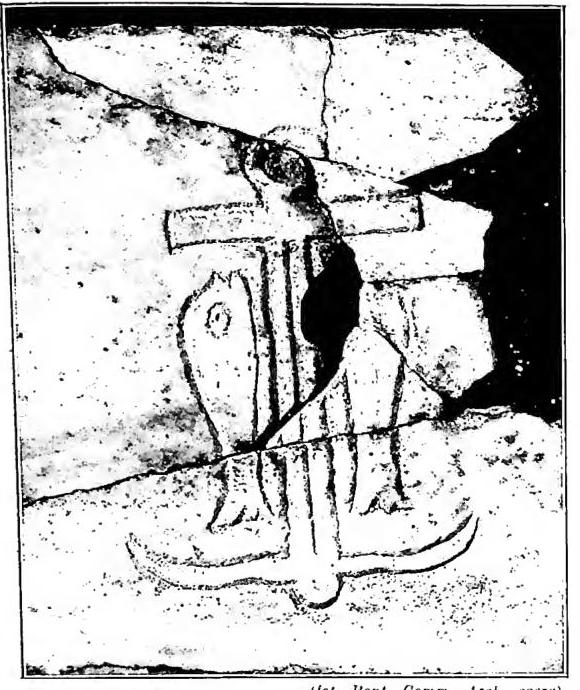
This symbol of Christian faith and hope appears in funerary monuments from the second half of the 2nd century and becomes frequent in the 3rd, while it rapidly disappears thereafter, remaining only in domestic objects, especially in rings and gems (Clem. Alex., Paedag., 3, 11, 59; O. Wulf, Kunst, tav. 56, 1135). The anchor is used in epitaphs either alone or together with other symbols; it signifies hope in Christ in a marble from the Coemeterium of Praetextatus in which a P is inserted horizontally into the anchor, thus forming the monogram cross (v.). It is also found together with the Good Shepherd, or with the fish, a symbol of Christ. Sometimes it appears to display a concealed cross, in accordance with St. Paul, who calls himself “an apostle of Jesus Christ our hope” (1 Tim. 1:1); in cases where the anchor is between two fishes, these should be recognized as the faithful, *pisciuli* according to Tertullian (de Bapt., 1: PL 1, 1306).
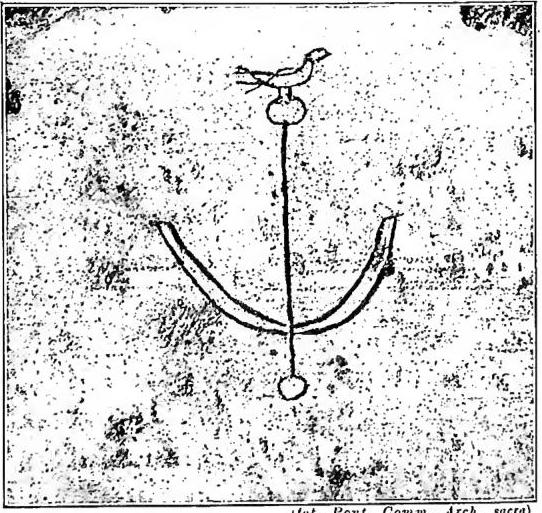
It is often combined with the dove (v.), which sometimes appears together with the tree, the dolphin, the sheep, the lamb; less frequently with loaves, the ship (v.), stars, the so-called gamma cross (v.), the palm; once each with Noah in the ark, the Good Shepherd, the lion, and Jonah. It was used in above-ground monuments: cippi, sarcophagi; and in underground ones: inscriptions and sarcophagi. It is most frequent in the older regions of the Roman cemeteries of Priscilla, Praetextatus, Callistus, Domitilla, then in Pamphilus and the Giordani; rare in St. Agnes and St. Lawrence; sporadic outside Rome, in Gaul; and rare examples in Africa.
ANCHOR — Tomb slab with anchor surmounted by a dove (3rd century). Rome, Coemeterium of Praetextatus.
Again — Tomb slab with anchor between two fishes (4th century). Rome, Coemeterium of Priscilla.