
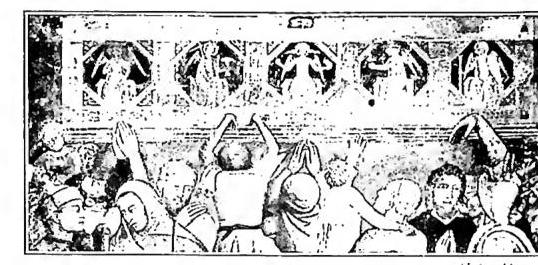
ANDREA di FIRENZE — Florentine painter, according to Bonaini identical with Andrea Ristori of the parish of S. Pancrazio (1333–92), but identified by Milanesi, Berenson, van Marle, and Toesca with Andrea di Buonaiuto or Bonaiuti; who, enrolled as early as 1343 in the guild of doctors and apothecaries, contracted in 1365 for the frescoes of S. Maria Novella, participated in 1366 in the commission for the construction of the Cathedral, and received payments in 1377 for paintings in the Campo Santo of Pisa; his will is dated 2 November 1377.
Sircn attributed to the master, as a youthful work, the panel with St Mary Magdalene, formerly in the Beckerath collection in Berlin, which, however, criticism does not unanimously recognize as his. The great cycles of A. in the Spanish Chapel at S. Maria Novella in Florence and in the Campo Santo of Pisa show how, in the second half of the fourteenth century, A. in particular was sensitive to Giottesque heritage under Sienese influence. Nevertheless, A. succeeded in creating a style of his own, decorative and pleasing for the vivacity of colour.
Beginning around 1365 the work at S. Maria Novella, A. was certainly a well-known and mature master. The Chapel, of simple square form, was entirely decorated by A., though probably with the help of pupils, as inferior parts demonstrate. The design is of unified style; the subject represents the glorification of the Dominican Order, and is influenced by the *Specchio di vera penitenza* of the convent’s prior Jacopo Passavanti (d. 1357), in accordance with the scholastic ideas of St Thomas Aquinas and with reminiscences of Dante’s *Paradiso*. The wall of the altar is decorated with the *Way to Calvary*, the *Crucifixion*, and the *Descent into Limbo*. At the entrance wall are scenes from the *Life of St Peter Martyr*. On the right wall the *Activity and Triumph of the Dominican Order*; on the left the *Triumph of St Thomas Aquinas*; in the vault of the chapel, the *Resurrection*, the *Ascension*, the *Navicella* (after Giotto’s mosaic in St Peter’s, Rome), and the *Pentecost*.
The three frescoes in the upper tier, with the stories of St Ranieri in the Campo Santo of Pisa—now much damaged—surpass those of the Spanish Chapel in decorative and chromatic richness. The surface becomes even more crowded with figures, without any order among the personages. It seems that the artist died after completing the three scenes, since the pictorial cycle was finished by Antonio Veneziano. — See Pl. CII.