
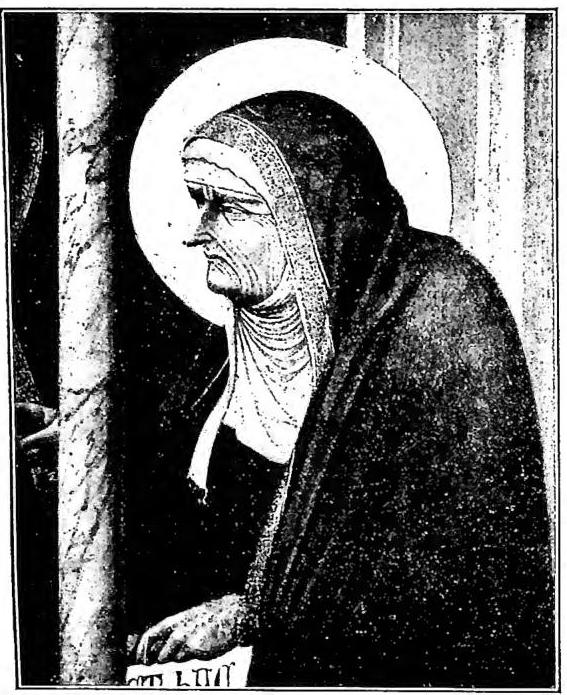
ANNA, prophetess — The prophetess A. Particular of the Presentation in the Temple by Ambrogio Lorenzetti (14th century). Florence, Uffizi.
“Give to your servant a male child” (1 Sam. 1:11), with perpetual naziriteship (v.). While praying in a low voice, she was rebuked by the high priest Eli, to whom she explained herself and obtained his priestly blessing. She received the grace she sought and became the mother of Samuel (v.). When she had weaned him (at about three years of age, according to Hebrew custom: 2 Macc. 7:27) or reared him (the Hebrew gàmal has both meanings), she took him to Shiloh and presented him to the Lord, offering sacrifices of thanksgiving. She then uttered the sublime inspired canticle, in which she praises the power, justice, and goodness of God and expresses the hope of messianic salvation (1 Sam. 2:1–10); this canticle is Magnificat (v.) of the Blessed Virgin Mary (Lk. 1:46–55). A. is regarded as a figure of the Mother of Jesus because of her miraculous fertility, and of the Church, persecuted in its origins yet later fruitful and glorious. Her patience with her son is a figure of the Synagogue, once fruitful but later repudiated. St. John Chrysostom devotes five homilies to the moral lessons drawn from the motherhood of A. (PG 54, 631–75).
2) ANNA, wife of Tobias (v.), of the tribe of Naphtali, mother of Tobias the younger. She remained faithful to her husband during the captivity in Nineveh, even amid the persecutions provoked by her acts of charity. Her irascible temperament showed itself in a quarrel with her blind husband, who, hearing the bleating of a kid that A. had received as wages, feared it was stolen (Tob. 2:19–23), and again when their son set out for Rages (Tob. 5:23–25; 10:4–7). Her sorrow turned to joy when, from the hill where she often went to gaze at the horizon, she saw her son returning (Tob. 11:5–6). In the Septuagint the meeting is described in greater detail. Surviving her husband, A. was cared for by her son and daughter-in-law until her death (ibid. 14:14).
This follows the pattern of the Presentation of Jesus, as in the mosaic by P. Cavallini in S. Maria in Trastevere, and later it is enriched by works of Ghirlandaio and Andrea del Sarto with incidental motifs foreign to the scene, depicting people and settings contemporary with the painting. Episodes from the childhood of Mary, in which A. appears as a leading figure, are also fairly frequent; this begins with fourteenth-century musical compositions from the Kahrié giamì of Constantinople and extends to the composition of A. teaching Mary to read, which was quite widespread in the Baroque period. With the International Gothic style, a type of Holy Family with A., the Madonna, and Jesus became widely diffused; fairly common also north of the Alps, in Italy it reaches high expressive values, for example in the painting by Masaccio at the Uffizi, in the marble group by A. Sansovino in S. Agostino in Rome, and in the two different versions by Leonardo in London and Paris.
In popular traditions and poetry. — In their anxious hope for a child, mothers of the people invoke St. A., asking her assistance and a happy outcome to childbirth; to this end they keep her image above the bed. She is also the patroness of embroiderers, who on her feast day (26 July) refrain from embroidering, believing that if they contravene this rule the loom will fall and their work will be ruined. And since legend says that A. worked as a washerwoman in her youth, it is the custom in some places to abstain from laundry on that day as well. In France the pilgrimage of women to Sainte-Anne d’Auray is famous. The fact that A. was an “aged mother” has given rise to several popular sayings. A. appears in many lyric-narrative songs that, within the compass of a single stanza, depict her in tender attitudes of care and affection toward the child Mary; these are mostly graceful lullabies rich in poetic imagery and lively feeling. There are also widely diffused short prayers-invocations of a lyrical character: one, very old since it is found in a manuscript of the Guarnacci Library in Volterra dating to the fourteenth century, is still repeated by women of the people to obtain the grace of a child. — See Pl. CXV.