
### ANSELLMI, MICHELANGELO
Painter, born in Lucca around 1491, died in 1555 or 1556. He was first influenced by Sodoma, then (1520) by Correggio; he also drew near to Pordenone and Parmigianino.
He left his principal works in Parma, in the church of S. Giovanni Evangelista, in the Cathedral, in the oratory of the Concezione, and in the church of the Madonna della Steccata (eastern apse), where, among other works, he painted the Coronation of the Virgin on a design by Giulio Romano.
---
### ANSELM OF AOSTA, Saint and Doctor of the Church
**I. Life.** — Born at Aosta, in Piedmont, in 1033 or early in 1034, of noble family. His father, Gandolfo or Gondolfo, of Lombard origin, a man of somewhat prodigal and somewhat stern character, though he too was to end his days as a monk, left no particularly grateful memory in Anselm’s mind. His first educator, however, was his mother Ermenberga, of Aosta, a very pious woman, who later entrusted him to the Benedictines, who had a priory in Aosta dependent on the abbey of Fruttuaria. Though he was only fifteen, he asked to become a monk, but his request was apparently refused, it seems, because of his father’s opposition. Anselm then gave himself over to a worldly life and, forced to leave home because of family dissensions and poor relations with his father, wandered for three years through Burgundy and central France. He then went to Normandy and made his way to the monastery of Bec, drawn there by the fame of Lanfranc of Pavia, prior of the monastery, to which many young men eager for learning flocked. His extraordinary intelligence and his passion for study soon made him stand out in this new environment. In that atmosphere, enthusiastic for spiritual things and under Lanfranc’s beneficial influence, his desire for the monastic life rekindled. After some hesitation about which monastery to choose, he finally decided on Bec (1063).
Three years later he succeeded Lanfranc as prior and director of the school, which he improved and imbued with his own spirit. In 1078 he was elected abbot of the monastery. The keenness of his intellect, the extraordinary sweetness and affability of his character, and the holiness of his life won him immense influence within the monastery and beyond. His relations with Lanfranc, who had been appointed Archbishop of Canterbury, and his organization of monastic life in some English monasteries, compelled him to go to England several times, where he was known and appreciated at the London court. In 1093, despite his extreme reluctance, he was raised to the archiepiscopal see of Canterbury as Lanfranc’s successor (d. 1089).
The situation of the English Church at that time was tragic: complete moral decay and the unchecked encroachment of lay power upon ecclesiastical authority. Anselm’s programme was to remedy these two evils: a programme, moreover, that was in line with that of the Papacy itself. It is therefore not surprising that, soon afterwards (1095), a bitter conflict broke out between the archbishop and King William Rufus over the question of recognizing Pope Urban II. After many difficulties Anselm was able to go to Rome to consult the Pope himself, who received him with great marks of esteem. In 1098 he attended the Council of Bari, convened by Urban II to bring back to the unity of the Church those who adhered to the schism of Cerularius, which was then widespread in southern Italy. In the discussions with the schismatics, Anselm was the great exponent of the Catholic side. He then set out for Lyons, where he had to stay, since the king would not allow him to return to England. But in 1100 Henry, who had succeeded his brother William, earnestly begged the archbishop to return to his see. The new king, however, had no intention of changing his brother’s ecclesiastical policy, and so, before long, the conflict with Anselm flared up again, so much so that in 1103 he had to go into exile a second time, again making his way to Rome. But the political situation in England did not allow Henry to remain indefinitely at odds with the archbishop. After many attempts, reconciliation was achieved, and Anselm was able to spend the last years of his life in peaceful and intense pastoral work. He died on 21 April 1109; he had been venerated since the 13th century. Alexander VIII, on 21 January 1690, enrolled him in the universal calendar with the rank of semidouble, assigning him the Mass of the feast of St Hilary; Clement XI then, on 8 February 1720, at the instance of James III of England, raised the rite to a double with a Mass and Office of the Dead. From that time St Anselm bore the title of “Doctor” (cf. Decreti S. R. Congregationis ad an. 1690, fol. 71-73; ad an. 1720, fol. 124; Martyr. Romanum, p. 148). Feast, 21 April.
**II. Works.** — A) Principal works, in chronological order, according to the researches of F. S. Schmitt, *Zur Chronologie der Werke des hl. Anselm von Canterbury*, in *Revue bénédictine*, 44 (1932), pp. 232-50; *S. Anselmi Cantuariensis Archiep. Opera omnia*, critical ed. by F. S. Schmitt, vols. I and III, Edinburgh 1946, vol. II, Rome 1940.
1. *Monologion* (1076; ed. Schmitt, I, 1-87; *Florilegium patristicum* of Bonn, fasc. 20, 1929; PL 158, 141-224).
It was first published anonymously under the title *Exemplum meditandi de ratione fidei*. It is a vigorous treatment of God as one in nature (chaps. 1-28) and three in persons (chaps. 29-78). It first demonstrates the existence of God from creatures, that is, from the concepts of good, greatness or perfection, being or cause, and the degrees of being, whence it concludes that there exists “the highest good, the highest greatness, the highest being or subsistent, that is, the highest of all things that are” (chaps. 1-4). It then proceeds to the attributes of God: simplicity, which belongs to Him alone (chaps. 5-6), while all else has its origin from Him alone and *ex nihilo* (chaps. 7-14). The other attributes follow: first in general (chaps. 15-16), inasmuch as they all belong substantially to God, whence He is the highest essence, the highest life, etc.; then in particular: simplicity, eternity, immensity, omnipresence, immutability (chaps. 17-28). It then turns to God as three in persons, first treating of the Son, the creative Word and eternal Word of the Father (chaps. 29-48), then of the Holy Spirit, proceeding from the Father and the Son by way of love (chaps. 49-58), and finally of the three persons together (chaps. 59-65). It then treats of the Trinity as the object of our knowledge (chaps. 64-67), of our love, of our blessedness (chaps. 68-74), of our hope (chap. 75) and of our faith (chaps. 76-78). The last two chapters deal with the manner of speaking of the Trinity of persons (chap. 79) and the unity of nature (chap. 80).
In the whole history of human thought it’s hard to find another work so dense with thought and so lucid about God.
2. *Proslogion* (1077-78; ed. Schmitt, I, 89-122; *Florilegium patristicum* of Bonn, fasc. 29, 1931; PL 158, 223-42).
Its first title was *Fides quaerens intellectum*, and it was conceived as a complement to the *Monologion*. This, in Anselm’s view, had the drawback of being “a tissue of arguments that shake the feeble-minded.” He therefore wished to rework the same material, but basing the entire development on “one single argument, which needed no other proof than itself, and was sufficient alone to demonstrate that God truly is... and whatever we believe about the divine substance” (preface).
This “unum argumentum” is the concept of God as that than which nothing greater can be conceived, and hence the famous “argument of St. A.,” by which the author proves the existence of God in chapter 2. Throughout the entire work, while maintaining its character as a rational and philosophical deduction, it is framed within the broader endeavor of a mystical ascent toward the contemplation and fruition of God. This effort, which lends the treatise an extraordinary power, unfolds in two phases. The first, from chapter 1 to 18 (*Adiecta me propter bonitatem tuam*), is the initial attempt—one that does not reach its goal—at the fruition of God. It consists of: prayer (beginning of chapter 1), logical inquiry (chapters 1–14), and an attempt at fruition that falls short (chapters 14–18). The second phase likewise begins with a brief prayer (chapter 18: *Adiecta me Domine...*) and a new logical inquiry (chapters 18: *Certe vita es...*, 23), which, succeeding, finally brings forth the joy of contemplation in God (chapters 24–26).
The logical inquiry first treats of the existence of God, both in fact (chapter 2) and in manner—that is, necessary existence (chapters 3–4)—and then of God’s other attributes, in general (chapters 5–11) and in particular (chapters 13–22). Chapter 23 briefly treats of the Trinity. The entire development is truly derived with extraordinary deductive power from the concept: that than which nothing greater can be conceived.
Chapter 2 of the *Proslogion*, which is the hinge of the entire treatise, has given rise, down to our own day, to the most varied discussions. The first opponent of A. was the monk Gaunilo, who contested the legitimacy of his deduction (*Quid ad haec respondeat quidam pro insipiente*, ed. Schmitt, I, 125–29; PL 158, 241–48). But A. maintained his position (*Quid ad haec respondeat editor ipsius libelli*, ed. Schmitt, I, 130–39; PL 158, 247–60).
3. Belonging to the years 1080–85 is a group of treatises, all in the form of dialogue and of a strictly philosophical nature, consisting of *De grammatico*, *De veritate*, and *De libertate arbitrii*. They are to be considered together, as A. himself intends (preface to *De veritate*).
a) *De grammatico* (ed. Schmitt, I, 141–68; PL 158, 561–62) treats the question debated among the dialecticians of the time: whether the grammarian is a substance or a quality. It is an exercise in dialectic or formal logic, conceived as an introduction to Aristotelian categories, with the primary aim of training the student to distinguish the meanings of words and to clarify concepts. Not without reason, though not all share this view, *De grammatico* may be regarded as a small model of pedagogical art that irresistibly recalls the Socratic method of Plato’s dialogues, although there is no evidence that A. knew these dialogues.
b) *De veritate* (ed. Schmitt, I, 169–99; PL 158, 467–86) addresses the more substantial question: what is truth, and of what is it predicated? After an introductory chapter on the absolute value of truth, it explains in what sense truth is predicated of speech and thought (logical truth), of the will and actions (moral truth), of the senses and the essence of things (ontological truth), and of God, arriving at the definition of truth: “rectitudo sola mente perceptibilis.” In chapter 12 justice is treated because it too is a “rectitudo,” namely: “rectitudo voluntatis servata propter se.” Although the structure of the dialogue presents certain defects, its content is of the highest importance for medieval thought.
c) *De libertate arbitrii* (ed. Schmitt, I, 201–26; PL 158, 489–506) subjects the concept of freedom to analysis. A. defines it as: “potestas servandi rectitudinem voluntatis propter ipsam rectitudinem” (chapter 13). In this notion the power to sin is not included (chapter 1). It is then demonstrated how such freedom befits man (and the angel) both before and after sin, and how it persists even under temptation and in the very servitude to which one is reduced when obeying sin. Finally, the definition and division of freedom are given.
Here too A. opens wide vistas of insight, though he is reproached for not having sufficiently distinguished the free from the merely voluntary.
4. *De casu diaboli* (1065–90, ed. Schmitt, I, 227–76; PL 158, 325–60) studies the question of how the angels could have fallen and been guilty of sin, even though, lacking the gift of perseverance—which they did not receive from God—they could in a sense not persevere. The work treats this question at length and in depth, examining how the angels, though created good, could have sinned through pride.
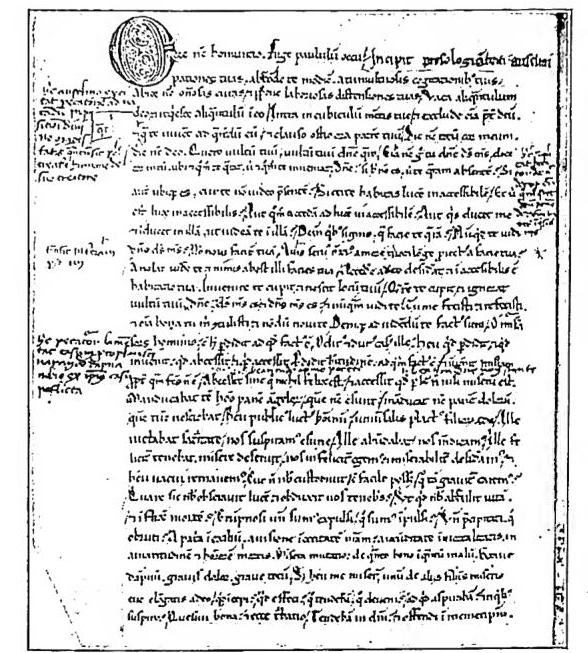
Anselm, saint – Incipit of the *Proslogion*. Cod. Vat. lat. 532, fol. 219² (12th cent.) – Vatican Library.
PL 158, 350–432). The purpose A. sets himself in this work is to prove with “necessary reasons,” abstracting methodologically from what faith teaches, concerning the Incarnation and Redemption, that man, who must necessarily attain the ultimate end assigned to him by God, can do so only through the work of a God-Man, and that therefore all that faith teaches about the Incarnation and Redemption has “necessary” value. A.’s entire reasoning may be summarized thus: after sin, God “could not” leave man to himself but “had to” raise him up in order to replace in heaven, as He willed, the fallen angels. Nor “could” God forgive man without worthy satisfaction. Now, since sin is in a sense infinite, it could not be adequately expiated except through an infinite satisfaction. But this could not be rendered by a man, nor even by God, who cannot expiate. It was therefore “necessary” that a God-Man should accomplish II.
The work is divided into 2 books. In the first, addressing unbelievers, A. seeks to prove that man cannot save himself. Chapters 1–2 are general preambles. Then (chapters 3–10) a series of objections is answered in order to clarify certain necessary points, e.g.: that no angel could save man; that the devil, even after sin, had no right over man (contrary to a theory common among the Fathers). This is followed by the proof of the necessity of satisfaction for guilt (chapters 11–19), and finally that of man’s inability to offer such satisfaction to God for sin (chapters 20–25). The second book seeks to prove that, since man’s end must in every way be attained, the satisfaction for his sin must necessarily be paid by a God-Man. Chapters 1–3 treat of the end that man must attain. It is then established that this cannot be attained except through the God-Man, whose necessary qualities for this purpose are described (chapters 6–9). The efficacy and manner of his redemptive work are then illustrated (chapters 10–11). Chapter 22 is the conclusion.
*Cur Deus Homo* is the first true treatise on the Redemption and, despite certain weaknesses, is justly regarded, together with the *Monologion*, as A.’s masterpiece and the most original and profound work—if not definitively so—on this subject.
7. *De conceptu virginali et de originali peccato* (1099–1100; ed. Schmitt, II, 135–73; PL 158, 431–64), in order to resolve the question of how Christ, being born of a virgin, did not contract original sin, treats of the nature (chapters 1–6) and mode of propagation (chapters 7, 9, 10) of this sin. Then it explains how this sin could not pass to Christ, born of a virgin (chapters 8, 11–15). Chapters 18–21 deduce certain consequences of the preceding doctrine. A. then treats of the gravity of original sin (chapters 22–23); whether and how the sins of our first parents are transmitted (chapters 24–26); the effects of original sin in this life (chapter 27) and in the next (chapter 28).
Historically, this treatise represents a great advance in the theology of original sin.
The *De processione Spiritus Sancti* (1102; ed. Schmitt, II, 175-219; PL 158, 285-326) deals with the procession of the Holy Spirit from the Father and the Son, a question on which A. had already expounded at the Council of Bari. Chapter 1, after an introduction, establishes the points of faith common to both Greeks and Latins, from which A. then derives the fundamental principle in this matter: «quatenus nec unitas amittat aliquando suum consequens ubi non obviat aliqua relationis opposito, nec relatio perdat quod suum est, nisi ubi obsistat unitas inseparabilis». Various applications of the principle are then shown, and it is demonstrated above all how from it derives the procession of the Holy Spirit also from the Son. Chapter 2 responds to the objections of the Greeks against the aforementioned principle. Chapters 3-7 confirm the Catholic doctrine with texts from Holy Scripture, while in chapters 8-13 the various objections of the Greeks against Catholic doctrine itself are answered, and in chapters 14-16 a summary is made and the manner of being of the three Persons considered in relation to one another is examined.