
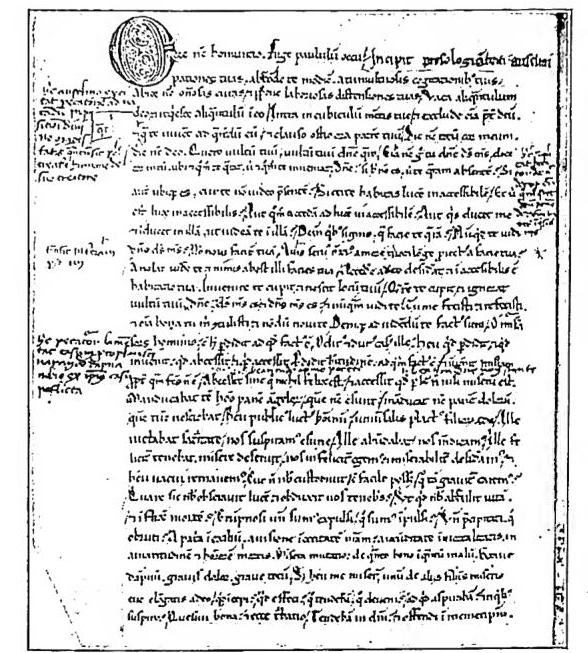
5. The *Epistola de Incarnatione Verbi*. (It has come down to us in two recensions: the first, shorter, written before September 1092, ed. Schmitt, I, 277-90; the second, written at the beginning of 1094, ed. Schmitt, II, 1-35; PL 158, 259-84; *Florilegium patristicum* of Bonn, fasc. 28, I, 1931). It is a polemical treatise against Roscelin, who, a nominalist in philosophy, taught tritheism in theology, arguing that otherwise one would have to admit that the Father and the Holy Spirit were incarnate together with the Son.
A. prefaces his treatise, dedicated to Urban II, with an important declaration of principles on the role of dialectic and reason, as well as of Holy Scripture and tradition, in theology. He then proceeds to refute Roscelin, clarifying the concepts of nature and person, and distinguishing in God what is absolute from what is relative, thereby demonstrating to his opponent that his assertions have no value even from a purely dialectical point of view.
It is an important contribution to the theology of the Trinity, while the Incarnation, despite the title, is only touched upon in relation to the state of the question as posed by Roscelin.
6. *Cur Deus Homo* (completed in 1098; ed. Schmitt, II, 37-133; *Florilegium patristicum* of Bonn, fasc. 18, 1929).
A.’s work is the first great true treatise written by Catholics against the Phontian doctrine. Subsequent theology had little to add to II.
9. The *Epistola de sacrificio azymi et fermentati* and the *Epistola de Sacramentis ecclesiae* date from 1106-07 (ed. Schmitt, II, 221-32; 239-42; PL 158, 541-43; 551-54).
The first letter addresses two other issues debated between Latins and Greeks: namely, the use of unleavened bread in the Mass—which A. here defends as legitimate, indeed with greater justification (ch. 2) than fermented bread, against the accusations of the Greeks (chs. 3-6)—and that of marriage after the sixth degree of consanguinity (ch. 7). The second letter explains the legitimacy of a reasonable diversity of secondary liturgical usages even in the celebration of the Mass.
10. *De concordia praescientiae et praedestinationis et gratiae Dei cum libero arbitrio* (1107-1108; ed. Schmitt, II, 243-88; PL 158, 527-42).
It is A.’s last work and successively treats the difficult questions of the relations between free will and divine foreknowledge, free will and predestination, and free will and grace. First question: the point of difficulty is clarified (ch. 1); God’s foreknowledge does not remove freedom in general (ch. 2), nor does the foreknowledge of sin (ch. 3). Confirmation of the two previous assertions: theological (ch. 4), scriptural (ch. 5). Definition of freedom (ch. 6). God’s foreknowledge is the cause of things, except for free will, but is not the cause of sin (ch. 7).
Second question: the difficulty (ch. 1). God does not predestine to evil, except in the sense that He permits it (ch. 2). Predestination leaves free will intact (ch. 3).
Third question: apparent difficulties of Scripture against free will (ch. 1). General principles of the solution (chs. 2-4). Response to scriptural difficulties (ch. 5). Secondary questions and difficulties (chs. 6-13). General conclusion (ch. 14).
11. *De potestate et impotentia, possibilitate et impossibilitate, necessitate et libertate* is a work sketched after the *De concordia* and left unfinished. (It was discovered and published by F. S. Schmitt, *Ein neues novellendetes Werk des hl. Anselm von Canterbury*, in *Beiträge zur Geschichte der Philosophie und Theologie des Mittelalters*, Münster 32 [1936], 111).
The work, which for its subject matter belongs to the group of the *De grammatico*, *De veritate*, *De libertate arbitrii*, was intended to be a logical, systematic, and complete analysis of the concepts expressed in the title in the manner that later became so fashionable among the Scholastics. As it stands, it is still useful for a better understanding of the philosophical foundations of A.’s theology.
B) Prayers and Meditations. - Of the *Orationes et Meditationes* attributed to A. and reproduced in PL 158, 709-1016, only a part is authentic: that published by Schmitt (III, 1-91). For the related critical questions V. the studies of A. Wilmart, especially those collected in his work: *Auteurs spirituels et textes devots du Moyen âge latin*, Paris 1932, and also: *La tradition des prières de s. Anselm. Tablets et notes*, in *Revue bénédictine*, 36 (1924), pp. 52-71. See also the studies of F. S. Schmitt: *De s. Anselm vs. C. Gebet zum hl. Benedikt. Zur Wesensart der anselmianischen Gebete und Betrachtungen*, in *Studia Anselmiana*, fasc. 18-19 (1947), pp. 297-313, and in *Miscellanea Giovanni Mercati*, II, Città del Vaticano 1946, pp. 158-78.
C) The letters are reproduced by Migne in 4 books: PL 158, 1059 ff.; II, 1 and 2; 159, 9-272; II, 3 and 4. Those of the first two books and part of the third are authentic, with few exceptions. Vol. III of the Schmitt edition also contains Bk. I of the letters. (A. Wilmart, *La tradition des lettres de s. Anselm. Lettres inédites de s. Anselm et des correspondants*, in *Revue bénédictine*, 43 [1931], pp. 39-54; F. S. Schmitt, *Zur Überlieferung der Korrespondenzen des Anselm von Canterbury. Neue Briefe*, ibid., pp. 224-38; *Zur Entstehungsgeschichte der handschriftlichen Sammlungen der Briefe des hl. A. V. C.*, ibid., 48 [1936], pp. 300-17).
D) Works of doubtful or spurious authorship are to be considered those not listed here. It is unnecessary to review them all. Only the following should be noted among the spurious works: *De voluntate* (PL 158, 487), *Hymni et Psalterium Beatae Virginis (Mariae*; ibid., 1035-1050), the Homilies (v. Wilmart, *Les Homélies attribuées à s. Anselm*, in *Archives d'histoire doctrinale du Moyen âge*, 1927, fasc. 2, pp. 5-29). The opuscule *De beatitudine coelestis patriae* (PL 159, 587-606) is the reconstruction of a conference held by A. at Cluny in 1104 and recorded by his disciple and biographer Eadmer. The *De similitudinis* or *Liber similitudinum* (ibid., 605-708) is the work of the monk Alexander of Canterbury. The *De Conceptione Beatae Virginis* is the work of Eadmer (PL 159, 301-18. B. del Marmol, *La Conception immaculée de la V. M. par Eademer*, [Pax, 14], Maredsous 1923, with introduction and translation).
III. SOME POINTS OF DOCTRINE
A. is essentially a theologian. His importance in the history of thought lies even more in the method by which he treated theology than in the profound traces he left on the numerous questions he addressed.The novelty of A.'s method lay not in his use of reason or even dialectic to elucidate the data of faith—for this, without which theological science could not exist, had already been done by the Fathers, both Greek and Latin—but rather in the specific proportion he assigned to reason and dialectic, particularly of an Aristotelian type, in the theological elaboration of revelation. For A., the subject matter of theological labor—the data of faith—is supplied by the Church's belief, Scripture, and the Fathers, especially Augustine, of whom A. is thoroughly imbued. This data is conceived as an unshakable foundation and infallible norm, antecedent to any rational justification and against which no dialectical conclusion can ever prevail. Indeed, if a dialectical conclusion were contrary to the data of faith, it would be a clear sign that it is erroneous. Here A. stands in perfect opposition to Roscelin and the rationalistic tendency of the dialectic he represented.
Yet for A., the effort of theological labor does not primarily concern the proposition of the revealed datum itself. Unlike the earlier patristic tradition, this is more presupposed than discussed or elucidated in itself. Instead, theological labor concentrates almost exclusively on the subsequent metaphysical and dialectical treatment of this presupposed content of revelation. Thus, theology becomes, in the first instance, the metaphysical elucidation of the concepts proposed or included in revelation, the logical deduction of their implications, the systematic connection of its various parts, and the dialectical refutation of objections raised—especially in the name of dialectic itself. In all this, A. does not share the viewpoint of the more or less absolute dialecticians, of whom Peter Damian was the leading exponent in the 11th century and who showed excessive aversion to the use of philosophy and dialectic in theological matters. If anything, A. is the brilliant and highly personal pupil of Lanfranc of Pavia—or, better still, the disciple of Augustine—and from him he draws the inspiration to achieve a new equilibrium in the question of the relationship between reason and faith. This is the sense of A.'s *fides quaerens intellectum*, his *credo ut intelligam*. It is therefore fitting that A. has been rightly described as the philosopher-theologian, or even the first metaphysical theologian. One can thus understand to what extent he conceived of theology as a science in an essentially Aristotelian sense, how philosophy and theology are intimately united in him, and why he is credited with the title of "father of Scholasticism." Recent attempts to contest this (cf. A. Stolz, *Anselm von Cant.*, Munich 1937, pp. 32ff.) lack serious foundation.
In practice, and despite the limits he imposed, did A. not sometimes place excessive confidence in the demonstrative power of reason, even when applied to the mysteries of faith? While some may wish to excuse him, the fact seems undeniable. More than the expression of *rationes necessariae*, with which he seeks, for example, to demonstrate the *quia* of the Trinity (Monologion, ch. 64) and the "necessity" of the Incarnation—an expression some would interpret merely as a matter of great suitability or even convincing reasoning, regardless of whether it is philosophical or theological in nature (cf. M. A. Jacquin, *Les rationes necessariae de s. Anselme*, in *Mélanges Mandonnet*, II, Paris 1930, pp. 67ff.)—this excessive confidence seems to arise from the very manner in which A. frames and develops these questions. Even the mystical side, so notable in him (Proslogion, Meditations), which cannot be neglected in a fair assessment of his work—since it is in him a genuinely patristic, especially Augustinian, inheritance—does not weaken or alter the nature of his philosophical and dialectical reasoning; rather, it largely supports and nourishes II.
A. addressed nearly all the major theological—and consequently many philosophical—problems in a series of monographs of great completeness and depth, whose beauty remains fresh even today. His "realism" in philosophy has been noted, though it must be understood with considerable qualification.
A. proves the existence of God in the *Monologion* essentially by following, though with a personal imprint, the old Platonic way of the degrees of being, so dear to Augustine; but in the *Proslogion* he attempts a new path. This is the so-called "argument of St. A." (sometimes also called the a priori argument, and, though with much disputable justification, the ontological argument), celebrated in the history of philosophy. It consists in attempting to prove the real existence of God by deducing it directly from His very definition, from the concept one has of Him. "God is that than which nothing greater can be thought; the concept of such a being exists in our mind; but such a being must also exist in reality, outside the mind, because if it existed only in the mind, one could think of another being greater than it—one, that is, which existed not only in the mind but also in reality" (*Proslogion*, chs. 2, 3). The value of this reasoning has engaged many great minds from A. onward: some accept it with more or less profound modifications of form and substance (Scotus, Descartes, Leibniz), while others reject it for entailing an illicit leap from the ideal to the real order. The argument does indeed show that the being than which nothing greater can be thought must be thought of as existing, i.e., with the note of existence, but it does not follow that this existence is also really extra-mental, since real existence adds nothing to the constitutive perfection of being but is merely its act (Gaunilo, St. Thomas, Kant). A. certainly seems to have overestimated the value of his discovery. Recent attempts to claim a strictly theological or even mystical nature for, and to deny the philosophical validity of, chapters 2 and 3 of the *Proslogion* lack substantial merit (cf. on this question A. Kolping, *Anselms Proslogion-Beweis der Existenz Gottes*, Bonn 1939, with related bibliography). Notable, moreover, for the depth of thought and logical rigor of its deductions, is A.'s explanation of the divine attributes in both the *Monologion* and the *Proslogion*. Thus he laid down the essential outlines of later treatises *De Deo uno*.
On the Trinity, A. systematizes and perfects Augustine's psychological theory, giving the clearest expression to the doctrine of relations and the deductions that follow from II. Later treatises on the Trinity in the West remained within the wake of A.
A. also effectively addressed the major anthropological problems. Thus in his explanation of the state of original justice, and likewise in his conception of original sin as the sin of nature, which was infected in Adam and through Adam, and transmitted to all of us in this state—not only infected but also guilty.
Although some of A.'s opinions on such matters have had to be supplemented and corrected (e.g., a clearer distinction between natural, preternatural, and supernatural gifts; a better explanation of the effects of Baptism even in children), they nonetheless opened wide avenues of light for subsequent theology.
In his explanation of Redemption, A., by delivering the deathblow to the theory of the "rights of the devil," linked his name to that of vicarious satisfaction. Based on the concept of sin as an offense, in some way infinite, against God; on the sinner's duty to make reparation; and on the sinner's inability to do so adequately, this theory provides a profound and strongly systematic explanation of Christ's redemptive work, which became classical in the West.
A.'s influence was immense, but—curiously enough, and demonstrating that A. was a fruit ripened more by his own vigor than by the force of his environment—it was not immediate. It only began to be felt from the 13th century onward, with the full flowering of Scholasticism. Even if this influence was more general in character than discernible in individual questions, it in no way diminishes his importance, for without him the history of Western thought from the Middle Ages onward would be scarcely conceivable. Even today, his personality exerts a powerful attraction upon those who approach it: so modest without affectation, so full of goodness, so complete and human. His works, which are in no way inferior in depth of thought and vigor of exposition to those of the greatest 13th-century Scholastics, are in many respects far closer to modern taste. In them, far more than the concern for manualistic-didactic exposition, there appears that vital effort in the search for truth which so delights us today.
ANSELMO D'AOSTA — ANSELMO DI HAVELBERG
fede, *Il Monologion* with extracts from the *Proslogion* and the *Liber Apologeticus*, Trapani 1941. Ancient prayers and meditations in A. Castel, *Méditations et prières de s. A.* (Pax. 1), Mansou 1923. Since 1929 studies on St. A. have been listed and reviewed in the *Bulletin de Théologie ancienne et médiévale*, published in *Recherches de théologie ancienne et médiévale* of Louvain. — Studies: Almost the entire bibliography on St. A. will be found in the following works, which complement one another: U. Chevalier, *Répertoire des sources historiques du Moyen âge*, Paris 1905, pp. 256-59; B. Geyer, *Die patrist. und scholastisch. Philosophie*, in F. Ueberweg-B. Geyer, *Grundriss der Geschichte der Philosophie*, II, 11th ed., Berlin 1928, pp. 608-700; M. Grabmann, *Storia della teologia cattolica*, trans. II, Milan 1939, p. 420 seq. — For a general overview of A.'s doctrine, noteworthy is J. Bainvel, s.V. in *DThC*, I, cols. 1327-60. Cipriano Vaggini.