
ANTESTERIA (*Ἀνθεστήρια*). – Festivals common to all the Ionic tribes; naturally, we are best informed about the Attic ones. They lasted three days and took place on the 11th, 12th, and 13th of the month Anthesterion (late February to early March).
The first day was called *pythoî gala* and celebrated the opening of the “doloi,” terracotta jars half-buried in the ground in which the wine had completed its fermentation. All participated in the merry festival of the broaching of the wine, with dances and songs, including slaves and children; nor was there lacking a practical aspect, consisting in the sale of the new product. This part of the festival was essentially private and undoubtedly dates back to the time when Athens was purely an agricultural center.
The second day was called *choes*, meaning “jugs,” and was a public festival. The most important cultic act was replaced by the sacred marriage of the basilissa, that is, the wife of the archon-king (originally, of course, the true queen), with Dionysus. Fourteen women, chosen from the most noble families and called *gerarai*, the venerable ones, accompanied the basilissa to the *Boukoleion*, originally the king’s residence, where they shut her in for a night with the ancient wooden effigy of the god. This was the survival of an ancient magical rite intended to ensure the fertility of the soil with the imminent rebirth of nature. The procession set out from the old temple of Dionysus in the marsh (*alōgūros eg lúknō*), where the *gerarai* and the basilissa had performed various ceremonies at the “fourteen altars” of the sanctuary. It took on—through the crowd accompanying the idol and the basilissa as if they were accompanying a bride and groom to their home—all the characteristics of a carnival. Such were the presence of people ritually disguised, the use of jests and jokes among the people following the procession in carts and those following on foot, and finally the particular detail—revealed by vase paintings—of transporting the effigy of the god on a ship placed on a cart.
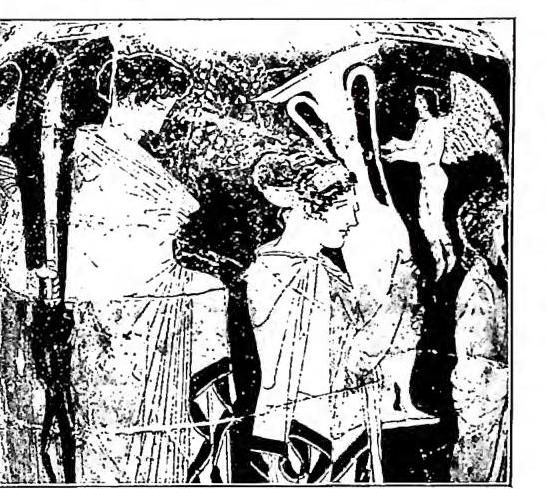
But even within the private sphere, the day of the *choes* held great importance. Children who had reached their third year received small gifts: many tiny vases depict them playing with the gifts they had received. The ancient people associated with the ritual use of the god of the *choes*—that each person should drink from his own jug, with a prohibition against sharing it with others—and with the fact that on that day all temples were closed—a myth: Orestes, still stained by the guilt of matricide, had chanced to arrive in Athens on the very day of the *choes*, and to prevent the ritual impurity of the unexpected guest from hindering the continuation of the festival, recourse was had to these two customs. But the true reason is to be sought in the dual nature of the Antesteria, which were sacred not only to the forces of nature but also to the spirits of the departed. On the day of the *choes*, it was said that the spirits of the dead wandered among the living.
Exclusively funerary was the third day, called *chytroi*, meaning “pots,” from the vessels in which offerings were made to Hermes of the underworld (Hermes Chthonios): seeds of every kind of legume, which were not to be touched by anyone, evidently because they were intended for the dead. At the end of the Antesteria, the dead, who had now been satisfied, were entreated to depart with the formula: “Depart, O Spirits, the Antesteria are over!”
From all the details of the festival, it is evident