
ANTONIO IL GIOVANE (A. known as Cordini). — Nephew of the two preceding figures (the son of a sister), b. in Florence in 1484, d. in Rome in 1546. His artistic training and the beginnings of his activity remain unknown to this day; his contacts with Bramante, in whose circle A. undoubtedly entered while still very young, appear probable. Direct Bramantesque inspiration can in fact be recognized in his first work, S. Maria di Loreto in Rome (1507), in which elements drawn from classical thermal constructions are ingeniously fused with others typically Lombard. The same scheme is adopted in S. Maria Porta Paradisi (1520), where the architectural organism is simplified. The tomb of Pietro de’ Medici in the abbey of Montecassino (1531–32) likewise belongs to the same centralized plan.
With the establishment of the Duchy of Castro, a vast field of activity opened up for A. in northern Latium, as architect to the Farnese; but with the destruction of the capital of the Duchy, the architectural complex he created, one of the greatest of the Renaissance, disappeared. Among his other works, there remain the so-called « Rocchina » on the island of Bisentina and the strange church of S. Maria di Montemoro near Montefiascone; while the church of S. Tolomeo at Nepi, which, by its intermediate arrangement between the centralized and longitudinal plans, would have marked the prelude to the project for the Vatican Basilica, was completed in a much more modest form by others. The artist also devoted his activity to minor, though no less significant, works: in Viterbo, to the church of S. Maria della Quercia, for which he provided the design of the admirable ceiling; in Rome, to the Cesi chapel in S.
Maria della Pace (1524–29) and the chapel of Cardinal Alborense in S. Giacomo degli Spagnoli (today S. Cuore di Maria); in Foligno, to the chapel of the Blessed Sacrament (1516) in the cathedral, with its complex polygonal plan. His reputation as an expert builder led to his being designated as the technician best suited to particularly difficult consolidation problems, as at the basilica of Loreto (1526) and in S. Giovanni dei Fiorentini, where he was summoned by Clemente VII; for the latter church A. also produced several drawings. Much discussed and the object of sharp criticism, beginning with Vasari, has been A.’s work at the Vatican Basilica, carried out in two distinct periods: the first, very brief, in 1520, succeeding Raffaello; the second, from 1537 until his death. To the latter belongs the famous design, later translated by Labacco into the wooden model still preserved today. A.’s activity in the field of civil and military architecture was also immense; it is enough to recall: the courtyard and the principal façade (except for the cornice) of the Palazzo Farnese, the Palazzo della Zecca in Via Banco di S. Spirito and the Palazzetto della Farnesina ai Baullari, the Porta S. Spirito, all in Rome; the vanished Rocca Paolina at Perugia and the fortress of Nepi. Modern criticism, on the other hand, has rejected or called into question other traditionally accepted attributions, such as the Palazzo Sacchetti, the church of S. Spirito in Sassia in Rome (perhaps only the interior is by S.) and the cloisters of Montecassino.
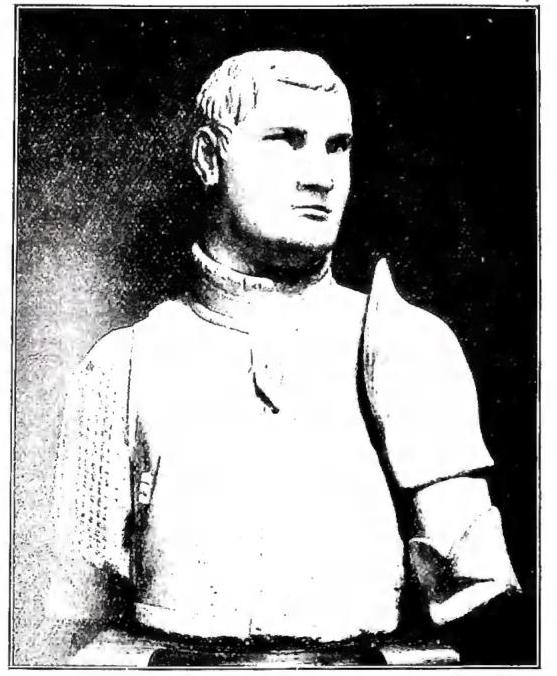
(photo Enzi)
SANGALLO, FAMIGLIA - Giovanni dalle Bande Nere. Marble bust by Francesco S. - Florence, Museo nazionale.
He left a profound imprint on sixteenth-century architecture.