
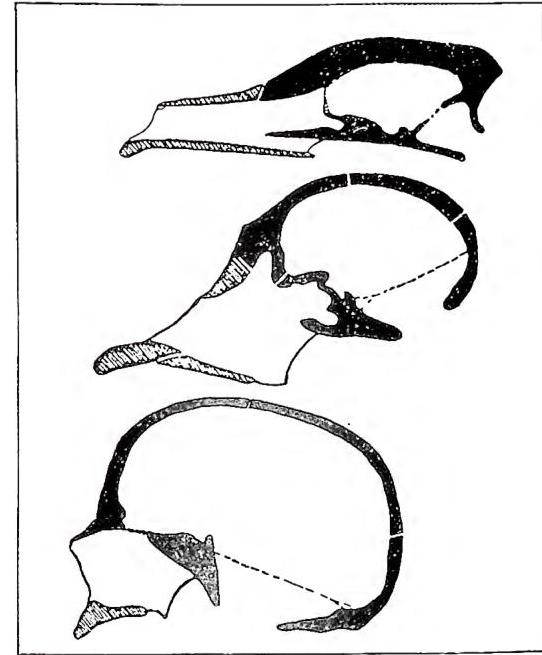
ANTHROPOLOGY — Cross-section of the skull — From top to bottom: of a dog, of an orangutan, of a modern human. In black: neural skull; in hatching: visceral skull.
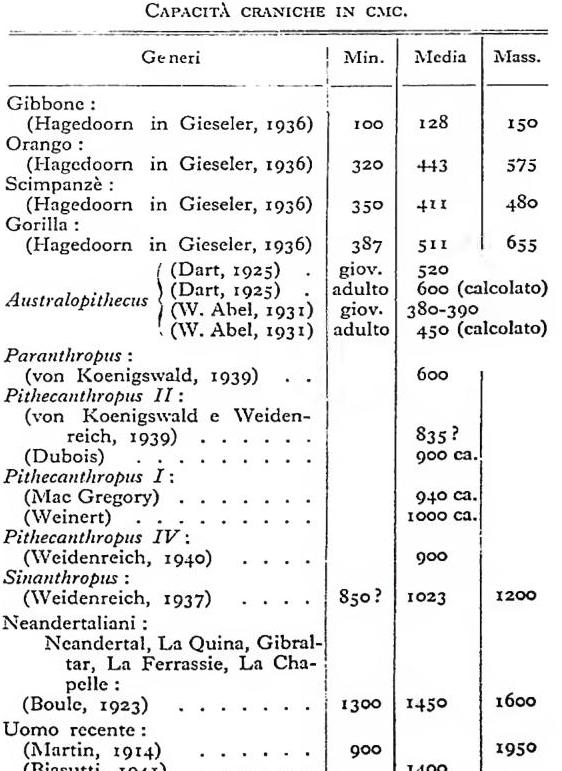
The cranial capacity of the anthropoids, even if only “estimated,” remains as a maximum value 655 cc and as a minimum for humans 900 cc. The difference is 250 cc. It should be noted, however, that minima of 900 cc among humans are extremely rare, and the averages among Europeans are around 1500 cc, while in races with more limited capacity, such as the Australians, they hover around 1250 cc.
In connection with brain development is the shape of the skull. In humans, proportionally to the increase of the cerebral skull, there is a decrease in the visceral skull, that is, the part of the skull where the systems of respiration and digestion begin. Moreover, in humans the visceral part is situated below the cerebral part; in anthropoids, on the other hand, it projects noticeably forward. Furthermore, in the human skull it is noted that the anterior part, that is, the forehead, is more developed and higher, and the frontal lobes extend to the level of the outer margins of the orbits, whereas in the chimpanzee and gorilla the frontal lobes of the brain do not reach halfway up the orbit.
Young anthropoids, however, in this respect are more similar to humans than adult anthropoids are. Other differences between the brains of anthropoids and humans are noted, in addition to development, in the conformation of individual parts.
The parietal region is much more developed in humans than in anthropoids, and so, as we have seen, is the frontal region. The convolutions are much greater in the human brain.
Differences dependent on upright posture. — Only humans possess upright posture, that is, they stand upright on legs that are vertical, with the trunk and head likewise vertical. The penguin, among birds, and the kangaroo, among mammals, do not have true upright posture. Their trunk is only partially straightened by a change in the proportions of the segments of the lower limb and in the angles they form with one another.
Anthropoids have semi-upright posture.
Human upright posture is made possible by a total rearrangement of the skeleton, muscles, and external configuration.
The skeleton shows in the vertebral column a series of curves whose relative proportions, measurements, and purpose are exclusive to humans, especially the forward curve of the lumbar region. The thorax is flattened from front to back. The scapula is applied against the posterior face of the thorax and not laterally, as is generally the case in mammals and anthropoids. The spine of the scapula is almost transverse and horizontal and not strongly oblique as in the latter. The articular cavity that it offers to the humerus faces outward, whereas in anthropoids it faces downward. The head of the humerus in humans is placed internally, on the inner margin of the bone, equally extending over its anterior and posterior faces; in anthropoids it is rather on the posterior face, so as to support the scapula (whose articular cavity faces downward) and consequently the trunk, as in quadrupeds.
In humans, the arm and forearm are in a straight line; in anthropoids, the forearm is always slightly bent on the arm. When the human arm hangs down, the hand has the thumb forward; in the great apes, backward.
In anthropoids, the metacarpals are arched, and the carpal bones are one fewer.
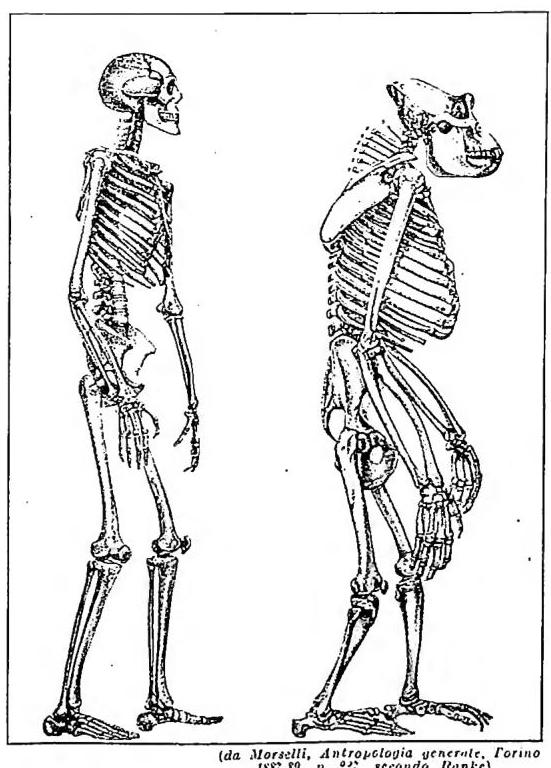
Differences also exist in the pelvis. The iliac bones in humans develop so as to form a true pelvis. The curve formed by the iliac crest and the sacrum is divided, by the vertical line passing through the hip, into two equal halves, one in front and the other behind the femur. In anthropoids, on the other hand, the iliac crest and sacrum lie forward of the vertical line passing through the femur. The hind limbs in humans are relatively longer than in anthropoids, perfectly vertical, and the muscles that originate from the pelvis insert before the knee; in anthropoids they are always slightly bent, and some muscles insert below the knee.
The foot in humans forms two curves: a longitudinal one and a transverse one, and it rests on the ground at three points: behind (heel), in the middle (first metatarsal), and in front (fifth metatarsal). In anthropoids, the foot rests on the ground only along the outer margin, and the inner side with the tip of the big toe. The heel and big toe are poorly developed, and the latter is opposable to the other toes, which are quite long. The foot thus forms a true clamp.
In relation to upright posture is also the position of the head. In humans, who have a developed braincase and a relatively reduced facial skull, the skull rests on the vertebral column immediately behind the middle of the base; in anthropoids, on the other hand, who have strong development of the facial part of the skull, it rests on the column much further back from the middle of the base, in any case much more posteriorly than the point of gravity. Consequently, anthropoids require strong development of the neck muscles to keep the head balanced, whereas in humans much smaller muscles suffice.
As for differences and affinities concerning the blood, V. BLOOD.
---
### CRANIAL CAPACITIES IN CC
| Genus | Min. | Avg. | Max. |
|-------|------|------|------|
| **Gibbon:** | | | |
| (Hagedoorn in Gieseler, 1936) | 100 | 128 | 150 |
| **Orangutan:** | | | |
| (Hagedoorn in Gieseler, 1936) | 320 | 443 | 575 |
| **Chimpanzee:** | | | |
| (Hagedoorn in Gieseler, 1936) | 350 | 411 | 480 |
| **Gorilla:** | | | |
| (Hagedoorn in Gieseler, 1936) | 387 | 511 | 655 |
| **Australopithecus:** | | | |
| (Dart, 1925) | 387 | 520 | 650 |
| (Dart, 1925) | 387 | 520 | 650 |
| **Paranthropus:** | | | |
| (von Koenigswald, 1939) | 600 | | |
| **Pithecanthropus II:** | | | |
| (von Koenigswald and Weidenreich, 1939) | 835 | | |
| **Pithecanthropus I:** | | | |
| (Mac Gregor) | 940 | | |
| (Weinert) | 940 | | |
| **Pithecanthropus IV:** | | | |
| (Weidenreich, 1940) | 900 | | |
| **Sinanthropus:** | | | |
| (Weidenreich, 1937) | 850 | 1023 | 1200 |
| **Neanderthals:** | | | |
| Neanderthal, La Quina, Gibraltar, La Ferrassie, La Chapelle: | | | |
| (Boule, 1923) | 1300 | 1450 | 1600 |
| **Modern man:** | | | |
| (Martin, 1914) | 900 | 1950 | |
| (Biasutti, 1941) | 1400 | | |