
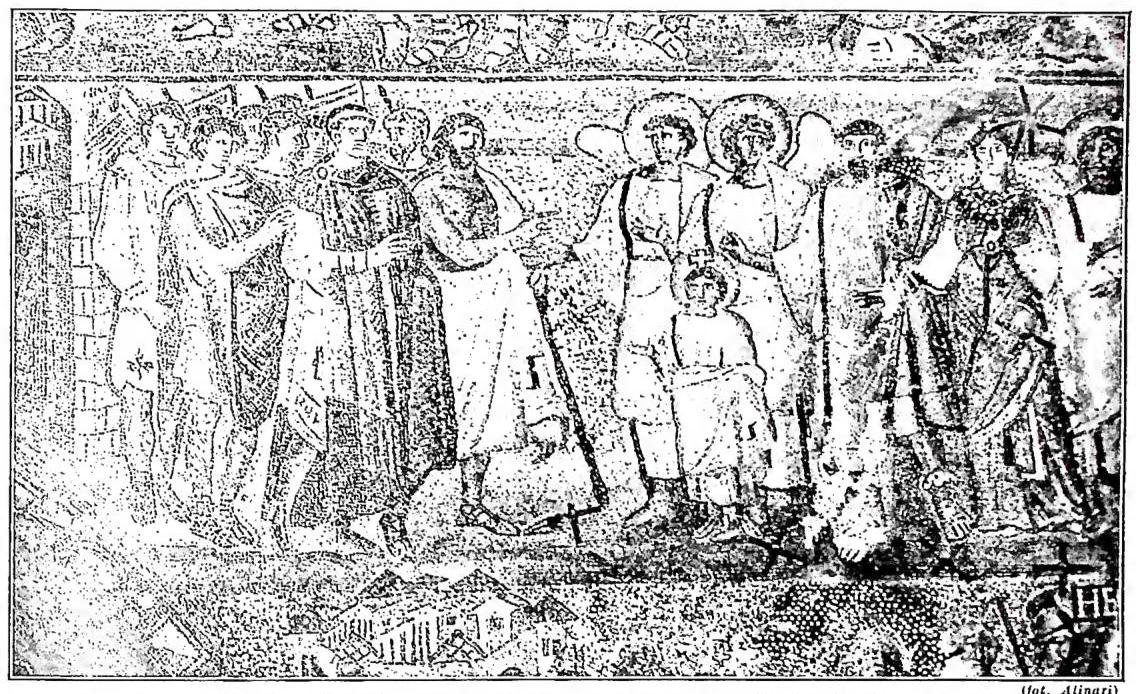
APOCRYPHA — Encounter of the Holy Family with King Aphroditus, mosaic on the triumphal arch of St Nicholas with the Arcadians of Rome.
(Ital. Alinari)
(Note: the Gospel narrative of Pseudo-Matthew, ch. 24. S. Maria Maggiore (432-440) — Rome.)
(hälākhāh) which specifies and multiplies legal provisions, now the narrative element that adorns biblical material with often fantastic tales, with didactic intent (haggādāh). Finally, numerous are the works with an apocalyptic background (v. APOCALYPTICA), which seek to lift the misery and pain of the oppressed people with bright future prospects.
Since all these apocrypha are treated in their own particular articles, it suffices here to list them, dividing them according to their predominant subject-matter:
1. — HISTORICAL A.: Book of Jubilees, 3 Esdras, 3 Maccabees, Life of Adam and Eve (Apocalypse of Moses, Testament of Adam, Armenian Adam writings), Ascension of Isaiah, History of the Rechabites, Paralipomena of Jeremiah (or Words of Baruch), Prayer of Aseneth, Testament of Job, Testament of Solomon.
2. — MORAL OR DIDACTIC A.: Testaments of the XII Patriarchs, Psalm of David in Iot, Psalms of Solomon, Odes of Solomon, Prayer of Manasseh, 4 Maccabees.
3. — PROPHETIC A. OR APOCALYPSES: Book of Enoch (Ethiopic), Book of Enoch (Slavonic), Book of Enoch (Hebrew), Assumption of Moses, 4 Esdras, Apocalypse of Baruch (Syriac), Apocalypse of Baruch (Greek), Apocalypse of Abraham, Apocalypse of Elijah (Apocalypse of Zephaniah), Apocalypse of Ezekiel, Sibylline Oracles.
THE APOCRYPHA OF THE NEW TESTAMENT, as is natural, are all of Christian origin. They reflect the desire to supplement the scant information handed down by the canonical writings regarding the life of Jesus and the Apostles. Hence the favourite themes are the infancy of Jesus, the story of the Virgin Mary, and the missionary activities of the various Apostles. Nor are more or less fantastic representations of eschatological events lacking.
The pious curiosity of the faithful, mingled with great veneration for the protagonists, spurred obscure authors to spin their tales, more or less seriously. Already Tertullian (De Baptismo, 17) informs us that the Acts of Paul were composed by a priest of Asia, who, when called to account for it, confessed that he had acted out of love for Paul.
Not a few apocrypha, however, betray the heretical ideas (encratism, Gnosticism) of their authors; indeed, according to the declarations of many Fathers, some were composed with the precise intention of promoting and spreading heretical opinions.
According to literary genre, the apocrypha of the New Testament, like the canonical writings, are divided into Gospels, Acts, Letters, and Apocalypses:
1. APOCRYPHAL GOSPELS: Gospel of the Hebrews, Gospel of the Egyptians, Gospel of the Ebionites, Gospel of the Twelve Apostles, Gospel of Peter, Proto-Gospel of James, Gospel of Thomas, Gospel of the Infancy of the Saviour (Arabic), Gospel of Pseudo-Matthew, History of Joseph the Carpenter, Gospel of Nicodemus (comprising: Acts of Pilate, The Descent into Hell), Transitus Mariae, Gospel of Bartholomew, Gospel of Philip, etc.
2. APOCRYPHAL ACTS: Acts of Peter, Preaching of Peter, Acts of Paul, Acts of Peter and Paul, Acts of John, Acts of Andrew, Acts of Thomas, Acts of Philip, Acts of Matthew, Acts of Barnabas.
3. APOCRYPHAL LETTERS: Letters of Jesus and King Abgar of Edessa, Letter of the Apostles, Letter of Paul to the Laodiceans, to the Alexandrians, to the Corinthians, Letter of the Corinthians to Paul, Letter of Paul to Seneca and of Seneca to Paul.
4. APOCRYPHAL APOCALYPSES: Apocalypse of Peter, Apocalypse of Paul, Apocalypse of Thomas, Apocalypse of Stephen, Apocalypse of John, Apocalypse of the Virgin Mary, Apocalypse of Bartholomew, Apocalypse of Zechariah.
It is difficult, however, to draw up a precise list of the apocrypha, particularly those of the New Testament, given the indeterminacy of the criteria to be followed. Anyone wishing to record as apocrypha all the writings deemed inspired by some ancient ecclesiastical writer would have to extend the above list by several items. Not infrequently, for example, works of the Apostolic Fathers are counted among the apocrypha, such as the Letter of Clement, that of Barnabas, and the Shepherd of Hermas, which some ancients regarded as inspired (for the last two cf. Origen, De principiis, III, 2nd ed. by P. Koetschau: CB, V, p. 251 and PG 11, 309). Various catalogues of the apocrypha can be read in ancient works: Apostolic Constitutions, VI, 16: PG 1, 949-56; Decretum Gelasianum: PL 59, 159-80; Synopsis Scripturae Sacrae of Pseudo-Athanasius: PG 28, 432; stichometric index of Nicephorus of Constantinople: PG 100, 1055-60.
Many apocrypha are known only by title; others have come down to us fragmentarily or in translation, while few can still be read in their original text. Not a few fragments have been discovered recently in papyri or in the libraries of ancient Eastern monasteries. The recent discovery of the apocryphal Gospel of John in an Arabic codex at the Ambrosiana (cf. Biblica, 24 [1943], pp. 194-95) is also noteworthy.
From a literary standpoint, the apocrypha do not merit particular consideration: they are popular tales, written in unadorned language. The mania for the marvellous, the desire to specify down to the smallest details the improbabilities of many narratives, distance these works considerably from the simplicity and freshness that make the Gospels and canonical books so attractive, even from a literary point of view.
As is evident from their titles alone, the Old Testament apocrypha, like those of the New, lay claim to being part of the sacred books, whether Jewish or Christian. Indeed, for some Old Testament apocrypha it has been claimed that they were used as canonical books by New Testament authors. Nowadays, few give weight to the assertion of Origen (Comm. series 117 in Mt., 27, 9, ed. Klostermann: CB, XI, p. 250) that Paul cited (1 Cor 2:9) the Apocalypse of Elijah (in secretis Eliae) as an inspired writing and derived the detail of Jannes and Jambres (2 Tim 3:8) from an apocryphon (Liber Iamnes et Mambres). Already St Jerome dismissed the passage in the Letter to the Corinthians as a free citation from Isaiah and spoke with contempt of the «ravings of the apocrypha» («apocryphorum deliramenta conticeant, quae ex occasione huius testimoni ingeruntur ecclesiis Christi», in Is. 64:4: PL 24, 646). Nor does a citation from the Book of Enoch in Jude 9 and 14 appear certain. Perhaps such passages derive from Jewish oral tradition; in any case, they do not justify the inference that the two Apostles regarded the aforementioned apocrypha as inspired.
Some Fathers and some particular churches accorded undue honour to writings of this kind, which were subsequently absolutely repudiated by the Church. In the works of the Apostolic Fathers there are passages introduced as biblical quotations whose provenance is unknown or which are found only in apocryphal writings (e.g., Clement, Ad Cor. 17:5; 23:5; 46:2; Barnabas 4:3; 16:5 [cf. Enoch 89:56, 66]; 12:1 [cf. 3 Esdras 5:5]. The same phenomenon is found in other writers, such as Justin, Irenaeus, Origen. The question is more delicate for 3 Esdras (v.), which was part of the Greek Bible at least until the 5th century.
In the Clementine edition of the Bible it was deemed advisable to append some apocrypha (Prayer of Manasseh; 3 and 4 Esdras) «lest they perish entirely, since they are sometimes cited by certain holy Fathers and are found in some Latin Bibles, both manuscript and printed»: «ne prorsus interirent, quippe qui a nonnullis sanctis Patribus interdum citantur, et in aliquibus Bibliis latinis tam manuscriptis quam impressis reperitur».
Nevertheless, the official Church, despite the differing attitudes of individual scholars, consistently showed justified hostility toward such works. Already in the Muratorian Fragment one can detect a scornful rejection, in which the apocrypha are compared to gall in relation to the honey of the canonical books (“Fel enim cum melle misceri non congruit”). Innocent I, writing to Bishop Exuperius of Toulouse, not only labeled them as “to be rejected,” but also as “to be condemned” (“non solum repudianda, verum etiam noveris esse damnanda,” Enchir. Bibl. 17). An identical judgment is found in the Gelasian Decree (v.) and in other ancient documents.
Today, however, the texts of the apocrypha are willingly sought out, their contents studied to derive insights into the environment in which they were composed. Indeed, from them one can often discern the religious ideas favored in certain circles or the history of particular institutions.
Their use as historical documents, however, presents greater difficulties. A natural sense of skepticism accompanies the reader through this labyrinth of minute details and apocalyptic descriptions. Efforts are now being made to at least salvage the historical core of some apocrypha, but the undertaking remains highly uncertain. Lacking other sources, one cannot trust the fanciful narratives written for edification or for more or less propagandistic purposes. Even more daring is the attempt to trace, through the apocrypha, the existence of a simple Christianity, quite distinct from the doctrinal and juridical Christianity already evident in the earliest writings of the Fathers. It is undeniable, however—though perhaps to a lesser extent than might be expected—that the study of the apocrypha is useful for understanding the religious mentality of the period immediately preceding or following the beginning of the common era. The apocrypha are especially valuable for knowledge of Palestinian Judaism of those years. For example, in angelology the Book of Enoch is of the greatest importance; in the 4th Book of Ezra (8, 46-49) one reads one of the most explicit statements regarding original sin. Finally, the history of Jewish messianism receives from the apocrypha some fundamental testimonies that explain the slow and gradual misunderstanding of prophetic assertions.
The study of the New Testament apocrypha is also beneficial for understanding certain sectarian tendencies and aspects of ancient Christian piety, especially since they in turn influenced later works, the liturgical life of the Church, and particularly art.
In the liturgical life of the Church, James (v.) has had a special influence, from which derive the institution of particular feasts, such as the Presentation of Mary in the Temple (November 21). In liturgical books, moreover, there are texts literally borrowed from the apocrypha. The very common invocation for the dead, *Requiem aeternam*, is adapted from a passage in the 4th Book of Ezra (2, 34-35). From 4 Ezra 16, 53 is taken the well-known liturgical verse for the Christmas Vigil. Other brief prayers of the Roman Missal or Breviary are similarly derived.
The influence of the apocrypha was even greater in art. From the simple depictions of the Presentation of Mary in the Temple or the bathing of the Infant Jesus, which can be admired in very ancient frescoes, to the paintings of the finest modern artists, the detailed narratives of the apocrypha and their lively dramatization have abundantly inspired art. Indeed, certain pictorial scenes cannot be fully understood without recourse to these distant apocrypha, inexhaustible sources of popular legends.
No less influence did these writings exert in literature, particularly Italian. The *Divine Comedy*, and even more the works of the type of the *Golden Legend* by James of Varazze, are not unaffected by the ancient fantastic tales preserved in the apocrypha. This influence can be traced in other literatures, not only European, for there are clear traces of the apocrypha in the Qur’an, explainable by the very ancient existence of Arabic translations or reworkings.
General treatments: M.-J. Lagrange, *Le Messianisme chez les Juifs*, Paris 1909; E. Schürer, *Geschichte des jüdischen Volkes*, III, 4th ed., Leipzig 1909, pp. 268-468, 524-592; G. Felten, *Storia dei tempi del Nuovo Testamento*, Italian trans., II, Turin 1913, pp. 289-404; St. Székely, *Bibliotheca apocrypha*, I, Freiburg in Br. 1913; W. Ferrar, *The uncanonical Jewish books: a short introduction to the Apocrypha*, London 1918; J. B. Frey, *Apocryphes de l'Ancien Testament*, in *DBS*, I, cols. 34-460; id., *De libris apocryphis*, in *Institutiones biblicae*, I, 5th ed., Rome 1937, pp. 158-210; E. Amann, *Apocryphes du Nouveau Testament*, in *DBS*, I, cols. 460-535; P. Volz, *Die Eschatologie der jüdischen Gemeinde im neutestamentlichen Zeitalter nach den Quellen der rabbinischen, apokalyptischen und apocryphen Literatur dargestellt*, Tübingen 1934; R. H. Malden, *The Apocrypha*, London 1936; A. Oepke, *Biblica auxoquo*, in G. Kittel, *Theologisches Wörterbuch zum N. T.*, III, Stuttgart 1938, pp. 987-99.