
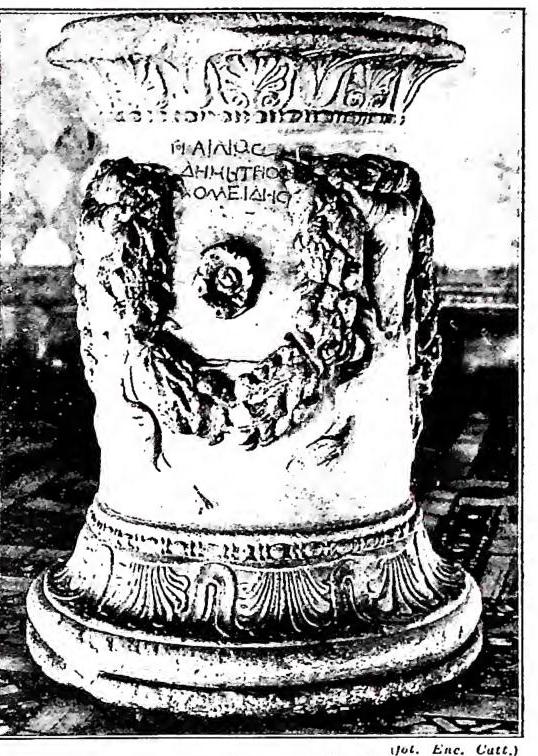
AR ("ar" is a Moabite form for "city," or "ar vulture") of Moab. — Capital of the Moabites (Num. 21, 15, 28; Deut. 2, 9, 18, 29). God forbade the Israelites from conquering it (Deut. 2, 9). Its Moab (v.) or represents II.
The Aroer (v.). Some identify it with Umm er-Raşşs northeast of the Arnon, or with Muhaţtat el-Hağğ at the mouth of the Wādi Enkel-hel into the Arnon; but commonly with Hürbet er-Rabbe', at 930 m. above sea level, 22 km. south of the Arnon, with important Roman ruins, which corresponds to Rabbath Moab (the great [city] of Moab), identified with Ar Moab at least since the 4th century (Eusebius, St. Jerome).
In the 4th century (Eusebius, Onomasticon, s.V. Možžb; St. Jerome, Liber de situ et nomin. loc. hebr.; PL 23, 909, c. Comm. in Is., 15, 1; PL 24, 167) it was called Areopolis (from 'Ar'; Ares or Mars is depicted on the coins of Rabbath Moab), perhaps near el-'Ejr. Included in 'Palestina tertia', it was a bishopric (three bishops of Areopolis are known from the 5th and 6th centuries: Anastasius, Polychronius, Elias). It was partially destroyed by an earthquake (1340-1355).