Machine translation of the 1948–1954 Italian original. The original text is authoritative.
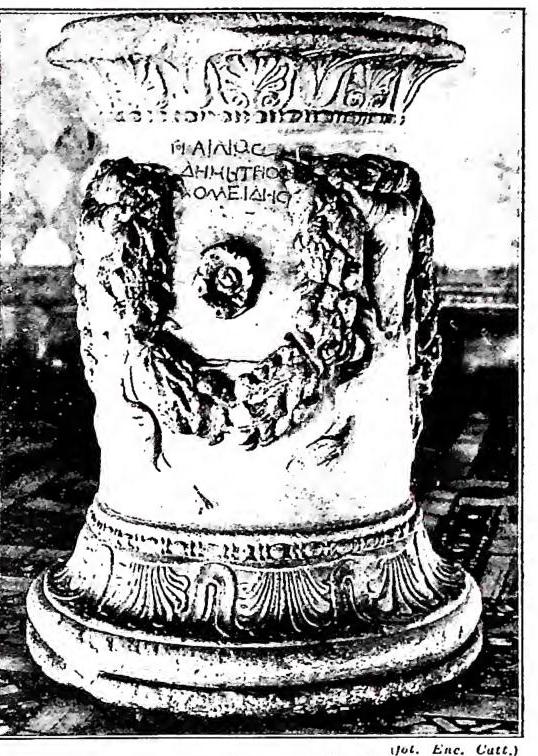
ALTAR. – It is a limited space, at least ideally, on which sacrifice is made to the divinity—that is, where the offerings intended for it are placed and often consumed. It is the table of bloody and unbloody sacrifice, always distinct from the person and image of the god. It therefore has great importance in worship, since an altar may exist without a temple, but not a temple without one. It serves for the worship of the gods or of the dead. It possesses a sacred character, and from this derives the practice of obtaining immunity by grasping the altar or taking refuge beside or upon II. It is rarely made of wood; sometimes it consists of clods of earth (Rome, for rural divinities), but generally of stone; altars made of horns have also existed (περάττινος βοχός: the altar of Apollo at Delos and at Dreros in Crete). In form it often imitated the table of human beings: it could be a carpet on which bread and beverages were placed (predynastic Egypt), or a smoothed boulder into which hollows were made (the megalithic civilization, the earliest strata of Canaan), or a cubic block hewn from the rock (Phrygia). In general the altar was made of brick or masonry, sometimes with steps or a platform, so that the crowd could follow the sacrifice. On the altar the ashes of the sacrifice were sometimes left, forming an altar of ashes (the altar of Zeus at Olympia). Characteristic of Italy, especially of Etruria, is the altar with plinths and mouldings separated by a deep groove. The altar was also used to enclose the ashes of the dead.
BIBL.: [E.] Reisch, Altar, in Pauly-Wissowa, Realencycl. der klass. Altertumswiss., I (1894), cols. 1640-91; M. Ebert, s. V. in Reallexikon der Vorgeschichte, I (1924), pp. 107-12; D. Mustilli, s. V. in Enc. Ital., II, pp. 628-87; A. Orsi, Ubicazione e ricostruzione dell'a. etrusco-italica, in Studi Etruschi, 16 (1942), pp. 211-28. Luisa Banti
ARA. – Greek personification of the curse (ἀρά), and therefore a goddess of vengeance, not unlike the Erinyes. A temple of A. in Athens is mentioned by Aristophanes.
BIBL.: [R.] Wernicke, s. V. in Pauly-Wissowa, Realencycl. der klass. Altertumswiss., II, 1, cols. 337–38; T. Bolelli, Interpretazione di ἀρά ἀράσματα, in Annali della Scuola norm. sup. di Pisa, 2ª serie, 15 (1946), pp. 75–94. Paolino Minazzini
Cite this article
“ARA.” Enciclopedia Cattolica, vol. I (1948), p. 1027. Azione Romana digital edition, https://azioneromana.com/article/ara.