
ARCHAEOLOGY. – In the amphitheatre of this town Domitian forced the consul Acilius Glabrio to fight with wild beasts; Glabrio later perished perhaps for the Christian faith (Suetonius, Domit., 4, 19; Dio Cassius, Hist., LXVI, 3 and LXVI, 13.14; Juvenal, Sat., IV, 99). Later, Constantine donated to the Church the barracks of the Parthian legion and the quarters that remained empty in the city after the dissolution of that unit. Moreover, he had a basilica built in honour of St John the Baptist for that community, which was later destroyed and rebuilt in the 9th century by Leo III, who dedicated it to St Pancras. The same Pope also restored and enriched the basilica of St Peter, now damaged by war. Another basilica had already been erected by Pope Hormisdas. Near Castel Savello Adrian I restored the basilica of St Theodore; Pope Donus had also erected a basilica there to St Euphemia.
But the most important early Christian monument is the catacomb, first discovered by Boldetti and explored at various times up to 1902: the only one now known of the several that were found in the vicinity.
AL
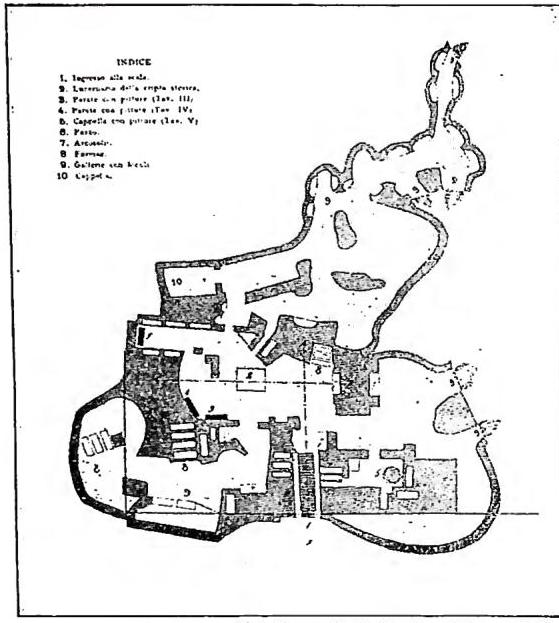
Albano – Bell tower of the church of St Peter (12th c.).
BANO – Plan of the catacombs.
and 107 regular. The minor seminary is at A., the major one at Anagni, common to the other dioceses of the lower Lazio. A., situated on the eastern slopes of the Alban Hills along the Appian Way, 25 km from Rome, derives its name from the famous villa built by the emperor Domitian in the territory of ancient Alba Longa. As a populated centre, however, it is only attested from the 5th century AD and owes its origin to the Appian Way, a stretch of which forms the main street of A. The inscriptions found in A. and its surroundings, and the devastated catacombs of the ancient diocesan territory, together with the cemetery of St Senator himself, have yielded no certain evidence of a Christian community prior to the 4th century; yet there is no doubt that such a community existed and that the diocese of A. dates back to the pre-Constantinian age.
The Liber Pontificalis, in the Life of Sylvester, records that the emperor Constantine “feci basilicam in civitate Albanensi sancti Iohannis” (ed. L. Duchesne, I, p. 184). Recent excavations have uncovered the original columns of this basilica, which was remodelled many times and at least from the 8th century dedicated to the Roman martyr St Pancras, patron of A. On the basis of the error of Socrates and Sozomen (PG 67, 301.1129), who had called Dionysius, bishop of Milan (c. 355), bishop of Alba, Ughelli and others place a Dionysius on the see of A. in the year 355. The series of bishops of A. known to us begins in the 5th century with Romanus, who is found among the subscribers to the Roman synod of 465. Of these bishops, Nicholas Breakspear and Alessandro de’ Medici ascended the papal throne under the names Adrian IV and Leo XI respectively, and Bonaventure of Bagnoregio is numbered among the Doctors of the Church.
The diocese of A. also includes the town of Anzio, which must have had a Christian community at an early date, although its first bishop appears only in 465 together with Romanus of A. After Vindemius, who was still present at the Roman synod of 502, no further trace is Anzio (v.).
ALBANO – Bell tower of the church of St Peter (12th c.).
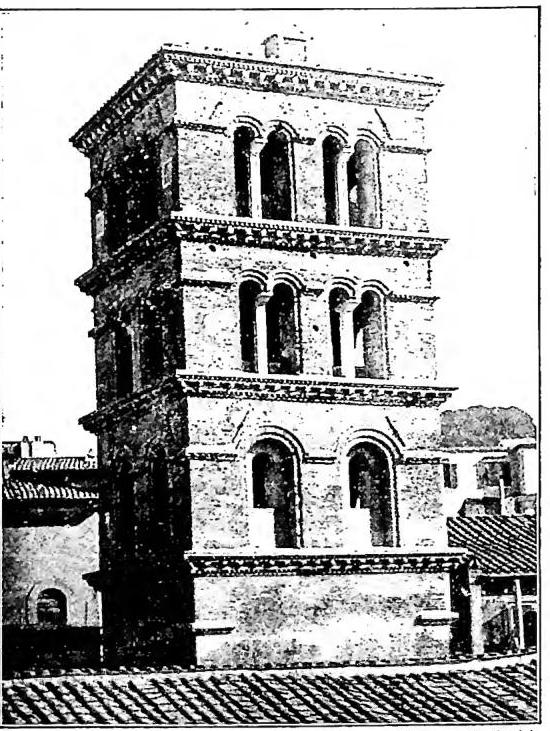
Albano – Plan of the catacombs.