
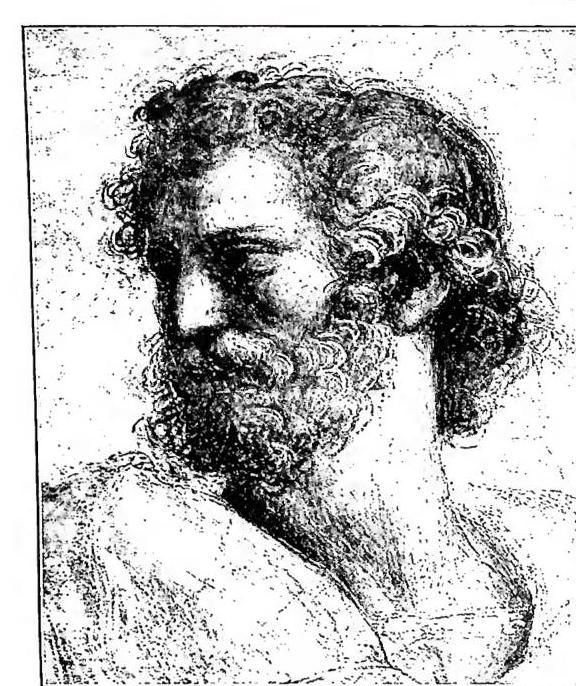
ARISTOTLE — Portrait of Aristotle, detail from The School of Athens. Raphael — Vatican Rooms.
After Aristotle’s death, his works must certainly have been the object of commerce, in which the Lyceum itself may not have been uninvolved. We possess a precious document of this in a fragment of a letter by Epicurus, which mentions the Analytics and the works On Nature (v. ETICA, ed. C. Diano, Florence 1946, no. 165). Aristotle’s personal manuscripts, which, according to Strabo (XIII, 1, 54) and Plutarch (Sull., 26), were bequeathed to Theophrastus, passed, upon his death, to Neleus of Scepsis, son of Coriscus. His heirs, hiding them in a cellar to prevent them from falling into the hands of the Attalids of Pergamum, later sold them, damaged by worms and damp, to Apellicon of Teos, an official of Mithridates. Sulla, having taken Athens in 86 BC, seized them and brought them to Rome. Andronicus of Rhodes, the tenth scholarch of the Lyceum, obtained copies from Tyrannio, Cicero’s librarian, and used them for his great edition, which is the source of our manuscript tradition. The story is true; false, however, is what the two aforementioned authors add—that apart from these, no other copies existed in the Greek world. The Library of Alexandria possessed them (v. Zeller, p. 145 ff), Eudemus had them in his school at Rhodes (cf. Simplicius, Phys., ed. H. Diels, vol. II, Berlin 1895, p. 923, 10), and the Lyceum could not have lacked them, without which Andronicus would not have been able to give us the text that we possess. Moreover, all later philosophy presupposes direct knowledge of them.
The order of the works that have come down to us largely goes back to Aristotle. It begins with the logical works. These are followed by the physical works, which include psychology and biology, then metaphysics, ethics, politics, rhetoric, and poetics.
Logic, later called the Organon by the Peripatetics, comprises five works: 1) *Categories*, among Aristotle’s earliest works in content; chapters 10–15 (*Postpraedicamenta*) are spurious; 2) *De interpretatione*, apparently later than the *Prior Analytics*, whose authenticity was doubted by Andronicus; 3) *Prior Analytics*, Books I–II, from the second Athenian period; 4) *Posterior Analytics*, Books I–II; much of Book I dates from the Academic period; 5) *Topics*, Books I–IX; Books II–VII date from the Academic period; Book IX, which also bears the title *Sophistical Refutations* (i.e., Refutations of Sophistical Arguments) and where the name of Coriscus occurs, was composed in Assos.
The works on nature (τὰ περὶ φύσεως) are:
1) *Physics*, Books I–VIII, resulting from the union of two works cited separately by Aristotle under the titles *On Nature* (Books I–IV) and *On Motion* (Books V–VI, VIII; Book VII was already considered by Eudemus as not part of the work, cf. Simpl., *Phys.*, II, 1036); Jaeger places its elaboration, if not its composition, in the Academic period, while placing Book VII in the second Athenian period; 2) *De caelo*, Books I–IV; 3) *De generatione et corruptione*, Books I–II, both composed during the period of teaching at Assos; 4) *Meteorologica*, Books I–IV; 5) *De mundo*, spurious and later than Posidonius.
Following these are the psychological works: 1) *De anima*, Books I–III (Jaeger attributes the material of Book III to the Academic period, though with little justification); this is followed by a series of works collectively known as the *Parva naturalia*: 2) *De sensu et sensibili*; 3) *De memoria*; 4) *De somno*; 5) *De somniis*; 6) *De divinatione per somnum*; 7) *De longitudine et brevitate vitae*; 8) *De vita et morte*, whose first part also bears the title *De iuventute et senectute*; 9) *De respiratione*; 10) *De spiritu*, which contains the distinction between veins and arteries and dates to the 3rd century.
The biological works include: 1) *Historia animalium* (Περὶ τὰ ζῷα ἱστορίαι), Books I–IX, of which Books VII, VIII, 21–30 and IX are considered spurious; some manuscripts include a Book X, which is at least a generation later than Aristotle; 2) *De partibus animalium*, Books I–IV; 3) *De motu animalium*; 4) *De incessu animalium*; 5) *De generatione animalium*, Books I–V.
A group of spurious works follows: *De coloribus* (Theophrastus); *De audibilibus* (Strato); *Physiognomonica* (perhaps 3rd century BC); *De plantis*, Books I–II (a Latin translation into Greek of an Arabic translation of a text perhaps by Nicolaus of Damascus); *De mirabilibus auscultationibus* (a collection of extracts from Theophrastus and Timon of Tauromenium); *Mechanica* (Strato); *Problemata physica* (in 38 sections, a late compilation based on originally Aristotelian material); *De lineis insecabilibus* (attributed to Theophrastus by Simplicius); *De ventorum situ* (perhaps by Theophrastus); *De Xenophane, Melisso et Gorgia* (late in form but drawn from Aristotle’s works).
The *Metaphysics*, in 14 books, numbered A, α (ἐλάσσων), B–N, has constituted the greatest problem in Aristotelian philology. After the studies of Brandis, Bonitz, and Schwegler, it is to W. Jaeger that credit is due for its solution. Apart from Books A, α, Δ, and K, 9–10, it consists of parts of different periods that Aristotle provisionally united pending a definitive redaction. α (= II), which the ancients already attributed to Pasicles, nephew of Eudemus of Rhodes, is the notes of a lecture by the master. Δ, which Aristotle himself cites as a separate work under the title *Πρὸς τὰς ποσότητας*, and which Hesychius catalogues separately, is a philosophical lexicon compiled for the convenience of the School. K, 9–12 is a collection of extracts from *Physics* II, III, V, by a student. K, 1–8, parallel to B, Γ, E, I, also appears to be by a student but is older. A, in its concise form, is “a complete metaphysical system in outline” (Jaeger), whose composition belongs to the Assos period. Chapter 8 and § 13 of this book are later additions dating after 330 BC. A, B, Γ, E serve as an introduction to the following group, Z, H, Θ, which deals with substance and (in Θ) potentiality and actuality. I treats of the One and the system of oppositions. M, 1–9, 1086a21 is a critique of the doctrine of Ideas and ideal numbers; the remainder of M and N constitute an older redaction on the same subject, which in turn resumes A, 4. Chronologically, the oldest nucleus, arising from the lectures at Assos and contemporary with *De ideis* and *De philosophia*, a three-book dialogue that was the first public exposition of the new system, consists of A, B, K 1–8, A M 9, 1086a21–N. The most recent, from the Lyceum period, is Z, H, Θ, I, M 1–9, 1086a21. Between these stand Γ and E I, which, with modifications to B, develop the outline of K 1–8. Chapters 2–4 of E serve as a transition to Z and following.
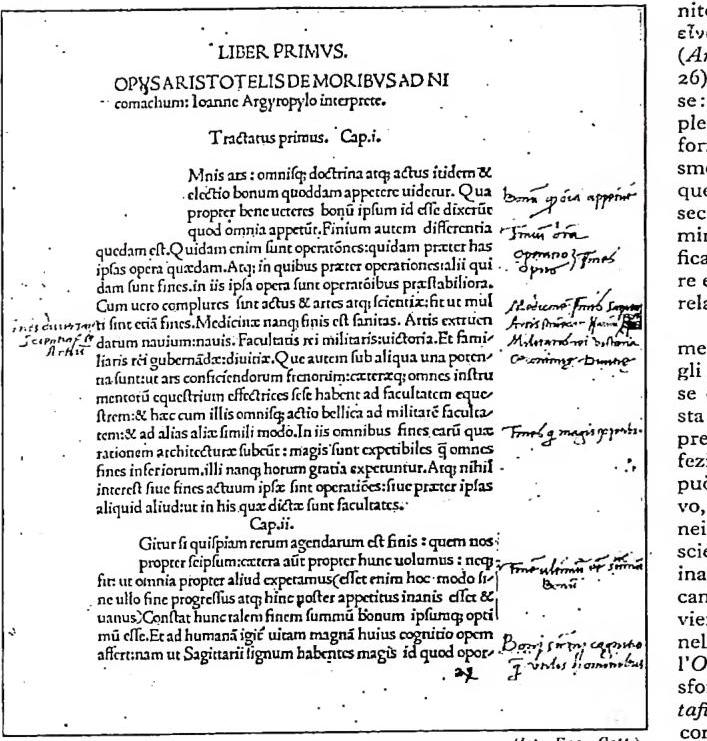
On ethics, we have four works: 1) *Nicomachean Ethics*, Books I–X; 2) *Eudemian Ethics*, Books I–VII (but Books IV, V, and VI are identical to *E.N.* V, VI, VII); 3) *Magna moralia*, Books I–II, which, though based on Aristotle’s lectures, postdate his death; 4) *De virtutibus et vitiis*, entirely spurious. The first two derive their names from being edited by Nicomachus, Aristotle’s son, and by Eudemus of Rhodes, respectively. The second, long considered spurious and attributed to the latter by many 19th-century critics, was definitively restored to Aristotle and placed in the Assos period by Jaeger, preceded by the *Protrepticus*.
The *Politics*, Books I–VIII, is, like the *Metaphysics*, a composite work. Books IV, V, and VI form a self-contained unity, distinct from the rest both in method and in conclusions. According to Jaeger, they were composed in Aristotle’s last Athenian period and were later combined by Aristotle himself with Books II–III and VII–VIII, which were written at Assos. The composition of Book I, an introduction to the work, also belongs to this period. Spurious is the *Oeconomicus*, which in our collection follows the *Politics*. From two papyri, the *Athenaion Politeia* (Constitution of Athens) was restored in 1891; it served as Book I of the *Politics* in the IIoI, II editions, where the constitutions of 158 states were examined.
The last works in the collection are: the *Rhetoric*, Books I–III (the authenticity of Book III was demonstrated by Diels), the so-called *Rhetoric to Alexander*, which is the work of Anaximenes of Lampsacus (c. 340 BC), and the *Poetics*, originally in two books, of which only Book I survives. Of Book II, which dealt with comedy and catharsis, we have extracts in the *Tractatus Coislinianus*.
Of the exoteric works, we possess fragments of some length only of the *Eudemus* and the *Protrepticus*, composed during the Academic period, and of the *De philosophia* in three books, written at Assos. The *Eudemus* and the *De philosophia* were dialogues of the type known to us through the imitation preserved by Cicero, who declares that he follows “Aristotle’s manner” (*Ad Att.*, XIII, 19, 4). The former, which bore the subtitle *On the Soul*, took its name from the Academic Eudemus of Cyprus, who died fighting for Dion in Sicily in 354 BC; it dealt with the immortality of the soul. The *Protrepticus*, an epistolary discourse in the style of Isocrates, was addressed to Themison, prince of Cyprus. Through the imitation preserved by Cicero in the *Horace*, it exercised a decisive influence on St. Augustine (cf. *Conf.*, III, 4, 7; VIII, 7, 17). The *De philosophia*, contemporary with *Metaphysics*, Book XII, contained the first public exposition of Aristotle’s system.
Among the lost works should be noted: the three-book dialogue *On Poets*, the *Didascaliae* (i.e., the collection of documents relating to dramatic performances in Athens), the juridical collections concerning the Greeks and the Barbarians (ἀρχαιομάχαι πόλεων and Νόμιμα βασιλαιών), and the great work on constitutions mentioned above. One of the most serious losses is that of the *Letters*, of which we have only scanty and doubtful fragments.
An indispensable complement to the *Works* is the *Corpus of Commentators*, which occupies 26 volumes in the edition published by the Berlin Academy.
3. HISTORICAL DEVELOPMENT OF ARISTOTLE’S THOUGHT
W. Jaeger deserves credit for having, building on the work of his predecessors, established for most of Aristotle’s works the chronological limits of their composition and, through the reconstruction of his early works (for which the foundations had already been laid by Bernays), outlined the development of his thought across the three periods into which his life falls: the Academic, the Assian, and the Lyceum periods. In the first period, as revealed by the fragments of the *Eudemus* and the *Protrepticus*, Aristotle is still entirely under Plato’s influence. The soul, whose immortality he rigorously argues, is still conceived as a substance separate from the body. Ethics is placed among the exact sciences, and the highest form of existence is identified with the exercise of φρόνησις understood in a Platonic sense. Though considering numbers and geometric magnitudes as εἴδη, Aristotle had already developed the doctrine of the categories and, with his theory of demonstration, overturned the logic of the Academy. From here he proceeded in the following period—but this process may already have begun before Plato’s death—to overturn ontology. In the fragments of the *De philosophia*, the *Περὶ τῶν σωμάτων*, the oldest parts of the *Metaphysics* and the *Physics*, the new position, which is the historical one, now clearly emerges. The doctrine of Ideas is subjected to radical criticism and shown to be contradictory. The heavens are cleared of the empty Ideas of the One and Being, identified with the Good, and in their place is placed an individual entity, God, whose unity Aristotle affirms (*Met.*, XII, 10) and defines as the Unmoved Mover. Yet he still conceives the heavens, in keeping with the later Academy, as ensouled, and introduces for their matter a fifth unnamed element, already posited by Plato (*Tim.*, 55 c; cf. Simplicius, *Phys.*, p. 1165, 35) and known in the *Epinomis* (981 c), which uses the Homeric term for the luminous part of the atmosphere, the aether, to designate II. He still makes the soul a kind of aether, which, in accordance with the ἀρχαιομάγοι νομοθέται, he calls by the new term ἐντελέχεια (Cicero, *Tusc.*, I, 10, 22; cf. R. Hirzel, in *Rheinisches Museum*, 39 (1844), pp. 169 ff.; E. Bignone, *Aristotle’s Lost Works*, *Über Entelechie und Endelechie*, I, pp. 227 ff.). Against Plato, he affirms the eternity of the world even *a parte ante*.In the same period he writes the first *Ethics*, preserved under the name of *Eudemian Ethics*, and the first *Politics*. The *Eudemian Ethics* already presents the doctrine of the virtues in a fully developed form, though the general problematic largely remains that of the *Protrepticus*, and the supreme end is placed in the contemplation of God (*E. E.*, VII, 3). The years of the Lyceum are the years of paternity. The lines of the system remain those of the preceding period, but inquiry sharpens them, restates their problems with tireless care, and exacerbates their aporias in certain points. Logic finds its definitive form in the *Prior Analytics*. Metaphysics is enriched by the remarkable three books on substance. Psychology is organized on strictly scientific foundations, in which metaphysical speculation is fused with observation of phenomena. Ethics and politics also descend from the abstract to the concrete. This does not make Aristotle a positivist: the end is always a universal, the form toward which each thing tends, whose reality is dynamic rather than static—the Idea has been transformed into an Ideal. The greatest monument of these years is the organization of scientific research. As for method, chapter 5 of Book I of *De partibus animalium* is one of the most beautiful and moving pages ever written by a scientist.
4. DIVISION OF PHILOSOPHY
In accordance with the threefold activity of man, Aristotle divides the sciences into poetic, practical, and theoretical (*Top.*, V, 6, 145 a 15; *Met.*, VI, 1). The theoretical sciences have as their object the necessary and the end in themselves; the poetic and practical sciences concern the possible and have their end in something else: in production the former, in action the latter; but the end of action is action, and the end of production is the product (*Met.*, I, 1; II, 1; *E. N.*, I, 3; VI, 3, 5). Poetic sciences are the arts (τέχναι) in their manifold variety, but properly philosophical are only those that have spiritual activity as their object, such as poetics and rhetoric. More definite is the scope of the practical sciences, divided into ethics, economics, and politics (*E. E.*, I, 8; *E. N.*, VI, 9). Mathematics, physics (also called “second philosophy,” *Met.*, VII, 11, 1037 a 14), and theological philosophy (the “first philosophy”) form the complex of theoretical sciences. Logic, which Aristotle himself calls Analytics (*Rhet.*, I, 3, 1359 b 10) or Apodictics (*An. Pr.*, I, 1), has a partly propaedeutic character insofar as it is, in his conception, the doctrine of demonstration. *Logica* is a late term. Later Peripatetics regarded it as a “tool,” hence the name *Organon*.### LOGIC
The problem of logic presented itself to ARISTOTLE as a problem of method within the Academy itself. It was the problem of the School: the task was to arrive at a deduction of all reality from a single principle that would at the same time be the “common principle” of all the sciences. The sciences (μαθήματα) par excellence were mathematics, a propaedeutic to dialectic, the science of being and of ideas, under which, in the eidetic form given to them by Plato, they too ultimately fell. There were two “methods” in use: division (dieresi), which proceeded dichotomously through opposites and, by successively eliminating the arts, provided the basis for the demonstration of the matter in question, and analysis, which consisted in “leading back (ἀνάγειν = ἀναλύειν) the object of inquiry to an agreed principle” (Proclus, In Eucl., 211, 18).
From the earliest parts of the Organon and the Physics, ARISTOTLE’s position is clear: there is science only of the necessary, and necessity is given by the cause (An. Post., I, 2; 4, 6); the method of science is analysis (Phys., II, 7). But analysis is the moment of research; in the moment of science the order is reversed: it descends from the principles and from them shows the necessity of the consequence; its ultimate form is demonstration or apodeixis. The discourse that expresses it is the syllogism, “a discourse in which, certain things being posited, something else follows of necessity, which is different from the things posited, through the things posited themselves” (Top., I, 1; cf. An. Pr., I, 1). This necessity, however, can be only formal (An. Post., I, 6): for it to be absolute, the relation that obtains between the things posited must be a relation of universality (χάθάλους), and this is so only if it is of totality (κατά-παντός) and per se (καθ' αὐτό). And since what is per se is the attribute that either is contained in the essence of the subject or contains the subject within itself, and whatever cannot be attributed in either of these two ways is an accident (συμβεβηκός) and falls outside demonstration and science (ibid., 4), the principle of demonstration is the essence (ibid., 6; cf. Met., VII, 9).
The syllogism is illustrated by the well-known example (Bonitz, Index, 770 b 20) of the isosceles triangle, which, being a triangle, has the sum of its angles equal to 2R. But the task of science is not so much to show that the properties of the genus belong to the species—which is not demonstrated—but rather that these properties belong “as first” to the genus (ibid., 5). “Every demonstrated science rests in fact on three things”: 1°, the genus (“for arithmetic, unity,” “for geometry, the point or the line”), of which it “considers the attributes per se”; 2°, these attributes themselves (“for the dispositions,” “straight and broken”); 3°, the axioms “from which the demonstration proceeds.” Genus and attributes form the “proper principles,” the axioms the “common principles” (ibid., 7; 10). Of the axioms ARISTOTLE gives three examples: the principle of non-contradiction, that of the excluded middle, and that by which equal subtractions from equal quantities yield equal remainders (ibid., 10; 11). At the same time he affirms that, whereas for the genus “both definition and existence are posited,” for the attributes, on the other hand, “only the definition is posited,” but “existence is demonstrated either from the common principles (i.e., the axioms) or from other things previously demonstrated” (ibid., 10).
Now, since these attributes proceed by opposites and in the examples given by ARISTOTLE are all mathematical, and since, on the other hand, the opposites deduced on the basis of the two ontological principles of non-contradiction and the excluded middle—which the Elements of Euclid ignore—proceeded in the Academy by the “dieretic method” of which Proclus speaks, one must, with Solmsen, conclude that in this first phase of ARISTOTLE’s logic the axioms have the true function of premises, and the syllogism that proceeds from them is nothing other than the demonstration for which division provided the basis. An example of this is found in An. Post., I, 4, 73 b 16 (cf. Top., I, 8, 103 b 5; VI, 6, 143 b 14), and from Met., V, 30 it must be inferred that the same form was that by which the property of the triangle was demonstrated. To the dieretic method, however, this syllogism is related only in function, but as demonstration it is itself an analytic operation. And since the common principles are such only by analogy and each science uses them in the form appropriate to its own genus (An. Post., I, 10; 11), and necessity always derives from essence (ibid., 32, 88 b 3), essence remains the principle of every demonstration.
Here is the point at which ARISTOTLE answers the problem of the Academy and overturns the Platonic position. Every proposition being an interval (διάστημα) that the middle term fills by giving form to a new proposition and a new interval, the process neither goes to infinity nor terminates in a single principle to which all genera and all demonstrations can be referred. Essence is finite, therefore the number of middle terms is also finite. Moreover, it has an order, which is that of predication. Now, every thing has an essence and a definition, but, absolutely speaking, only what is subject per se and not per accidens. And here is the doctrine of the categories. In every proposition something is predicated (κατα-γορέται) of something. Considered in themselves, the terms distribute themselves into ten forms (συμβαλλα) of predication or categories, which are the ten genera under which being presents itself (τὰ γένη τοῦ ὄντος): substance (οὐσία), quantity, quality, relation, where, when, position (e.g., seated), condition (e.g., shod), doing, and being affected (An. Post., I, 22; Cat., 4, 5). Substance is being in the primary and absolute sense, divided into first and second substance. First substance is being determined individually (τὸ δέον), the subject of every incidence and predication. Second substance is the species from which the first has its form, and above it the genus. The other categories form the accidents or affections of substance, and exist only for it (Cat., 4-5). As the supreme genera at which analysis stops (Met., V, 28), no category can be resolved into another: their only common element is the analogy of oppositions; at the center of all is substance, which, having no contrary, receives all in itself (Cat., 5; 10-11; Met., IV, 2; X, 4).
Consequences: every science has its own proper genus and proper principles: the definitions, which, having no middle term, are no longer demonstrable. Demonstrations are proper to each genus, and every passage from one genus to another (μετάβασις εἰς ἄλλο γένος) is excluded. What they have in common are only the axioms, in which the system of oppositions is expressed, but it is a community of analogy. Being and the one, to which Plato wished to reduce all others as to a supreme genus, are not genera; they have as many meanings as there are categories: the term to which all converge is the individual reality of substance (An. Post., I, 3; 7; 9; 22-23; 32). And it is from reality that the principles are drawn, through a process inverse to demonstration, namely induction (ἐπιστήμη). Sense gives the intellect the matter of the universal, but this was already in it potentially and is brought to act by a second intellect, which is the active intellect (ibid., I, 19; cf. 18; 23; V. sotto).
The universal is, in this way, immediately apprehensible, but the definition in which the essence is explained must be constructed (ibid., II, 7, 92 b 2). The method of the Academy was division, and in reality there is no other (ibid., II, 13). It presupposes, however, induction (ibid., Top., I, 14, 105 b 27), which can no longer be reduced to an immediate intuition; it is a process, a search akin to hunting (An. Post., II, 13) and must be supplemented by syllogism. For at every step, it is a problem, a question in which a choice is proposed (πρότασις) between two contraries (ibid., 5; An. Pr., I, 31)—the dialogue that gives its name to dialectic (An. Post., I, 2; 10; Top., I, 4; 10)—and a choice entails a reason. Since this reason can only be formal, one of the relationships of the oppositions through which division proceeds, the syllogism is not at its disposal.
That the empty generality of common principles is a syllogism precisely "logical" or dialectical, not apodictic (An. Post., II, 8, 93 a 15): apodictic proof presupposing essence, definition cannot be demonstrated (ibid., 3-9). And since matter lacks that unity which only essence can provide, the forms of argumentation are many (ibid., I, 22). Hence the "method" given by the Topics, where these forms are cataloged and studied. These are the "elements" of dialectic, and, borrowing a term from sophistic mnemonics, they are called "places" (τόποι), "eae quasi sedes e quibus argumenta promuntur (Cicero, Top., 8). Division, logical syllogism, and inductive discourse are the "organs" of dialectic, which, being below essence, has no ground other than the probable (τό ἐνδόξον), and in moving between contraries, while aiming for one, always does so with the fear of the other (St. Thomas, In An. Post., I, 1). Remove this fear, and you have sophistry (Rhet., I, 1; Soph. E., 11). The reversal of Plato’s position is complete: dialectic is not only not the queen of the sciences, but it is not even a science; it is an art of discussion pro and con (Top., I, 1; 2), and though indispensable as a path to principles, it can be employed for any end. Will the sciences remain isolated in the irreducibility of their principles?
In the terms in which the problem was posed by the Academy, yes; but as all categories have their center in substance, it is the science of substance that must serve as the principle for all others: the place of dialectic is taken by first philosophy.
Such, in broad outline, is the framework of Aristotle’s first logic. His researches in the field of natural and human reality, expanding his scientific horizon, compelled him in his final period to reformulate the problem of demonstration. Hence the Prior Analytics, which, by unifying the methods of apodictic proof and dialectic, transform what had been a methodology into a genuine formal logic. To understand this transformation, one must return to the doctrine of the necessary and the accidental. In apodictic proof, the necessary is defined as "what does not admit (μὴ ἐνδεχόμενον) of being otherwise" and is traced back to the universal, understood as a relationship of totality and essence or per se. Consequently, the accidental is the ἐνδεχόμενον, "what admits of alternation," and does not fall within essence. In the Prior Analytics (I, 13), the ἐνδεχόμενον is specified into two classes of events: those that occur "for the most part (ὡς ἐπὶ πολὺ)" and those "due to chance (ἀπὸ τύχης)." Parallel to this historical and quantitative conception of necessity and contingency is that of the universal reduced to the sole χρῆσι παντός, whose explicit specification in a "all" or "none" is demanded by the Analytics. Hence, by contrast, the "some." Once the concept is reduced to a mere designation of class, the principle of the syllogism could only be a relationship of inclusion. The χρῆσι παντός (μὴ ἐνδεχόμενον) (whence the "dictum de omni et nullo") is defined as "ἐν δόξῃ ἐλίγει" (An. Pr., I, 1, 24b 26). This allowed: first, the complete formal unification of the logical and apodictic syllogism; second, the determination and classification of figures and moods, along with their respective conversions.
Considered in isolation, the theory of the Prior Analytics, while representing a formal perfection—indeed, a definitive one—may yet appear inadequate and mechanical from the standpoint of science. But if it is viewed within the whole of the Organon and against the backdrop of the Metaphysics, and if one bears in mind that the "all" is understood by Aristotle only as an index of the necessity of essence, one must conclude that the formalism of the Prior Analytics has functional value. For Aristotle, the principle of every demonstration remains essence itself, and it is for this reason that only the first of the three figures is perfect, while the others must be reduced to II. As for the inductive syllogism of the Prior Analytics (II, 23), which, starting from what in apodictic proof is the conclusion, ascends through the minor premise to the major, the complete enumeration it requires for the reciprocation of the minor term and the middle term is possible only because it concerns species and not individuals, and these presuppose a system of the universe that should allow their deduction.
6. METAPHYSICS
The object of metaphysics, or what Aristotle calls first philosophy, is "being as being" (Met., IV, 1; cf. I, 2; VI, 1), and since the absolutely real being is God, it is also the science of God or theology (ibid., VI, 1). Being is spoken of in many senses, according to the different categories, but being in the primary sense is substance, of which all others are affections (πάθη) or accidents, and being par excellence.
It is the individual, the only thing that exists separately and in itself, the "this something" (τόδε τι). When we ask what this or that individual presented to us by the senses is in itself, and strip away the proper accidents, we have, on the one hand, the complex of determinations by which it is in itself what it is—the essence, that is, the substance itself as the object of thought, which Aristotle calls precisely "the what it is" (τό τί ἐστιν), and, with a formula that, uniting past and present, highlights its permanence and identity, "the what it was to be" (τό τί ἦν εἶναι); on the other hand, the substratum (ὑποκείμενον) which has its form in this and constitutes its matter (ὕλη). To speak of matter and form is to speak of becoming. For what becomes becomes something (τό τί), and this is the form, from something (τό ἐξ οὗ), and this is the matter (ibid., VII, 7). Fixed terms of all becoming, for the four categories of being, quantity, quality, and place, under which it is understood (Phys., III, 1), are the contraries. But it is not they that become, rather it is the substratum that has the capacity to receive them (τό δεκτικόν) and that remains, and this substratum is matter with respect to the contrary of which it is deprived and in whose possession (ἕξις) it will be that determined reality whose definition is the form. The principles of becoming are: matter, privation, and form, but the first two make numerically one (ibid., I, 7; Met., XII, 1-2). Since privation and possession are understood only in relation to the same subject (ibid., X, 4), it follows that becoming is not from absolute non-being, but from being in potency (δυνάμει) to being in act (ἐνεργείᾳ), from what can become what it is not yet to what it is in fact (κατὰ τὸ ἔργον, i.e., Met., IX, 8, 1050 a 21), and which, as the final term (τὸ τέλος) of motion, is the complete realization or entelechy (ἐντελέχεια, ibid., XII, 5; IX, 6-8; Phys., I, 8).
Matter, which can only be defined by analogy (Phys., II, 2, 194 b 9; I, 7), is not a privation but a substratum (ibid., XII, 2): it is always a “this,” in relation to which form is a “such” (ibid., VII, 8), and thus, apart from that relation, a “this which.” If we ask of it the same question “what is it?”, we obtain another substratum and another form. But the process does not go on to infinity: the ultimate real substrata are the elements. Beyond them lies being without further determinations, pure potentiality of contraries by which those are understood, the “prime matter,” the common substratum of all, but which, as such, has no knowable mode of existence (Phys., III, 5).
If we repeat the same questions for form, we dissolve into a genus, which, as the possibility of differences, acts as matter, and a difference that acts as form (Met., V, 28). Ascending from genus to genus, we arrive at being which, in the irreducible multiplicity of categories, is no longer the form of anything and is the intelligible matter of all forms. Thus, matter is a substance, form or species is a substance, and within it the genus is a substance, but absolutely substance is the whole constituted by matter and form or the *synolon* (σύνολον, ibid., VII, 3): the universe is constituted of individuals (Phys., I, 3, 186 b 35).
Matter is potentiality; it can receive form and can fail to receive II. For the transition from potentiality to actuality to occur, the action of a cause in act is necessary (Met., IX, 8), and since the transition is motion, the cause must be a moving cause. The ultimate term (τὸ ὡς) of the motion and the end for the sake of which (τὸ οὖ ἔνεχει) it occurs is the actuality of the form. But the end is a *post*, the motion an *ante*; therefore the form must be present in the moving cause. This is what experience shows us: every substance is generated from a synonymous substance; man generates man, and the house, present as an idea in the architect, generates the house (ibid., VII, 7). There are thus four causes: material, moving or efficient, formal, and final (cf. Zeller, p. 327 ff.). The formal and the final are one; the moving cause is now united with the form, in events according to nature and art, now with matter, in those attributed to fortune and chance, or accidental (Phys., II, 6-9). The causes of the latter are themselves accidental (Met., VI, 2; Phys., II, 8). Hence two kinds of necessity: one formal and absolute, which goes from antecedent to consequent and governs demonstration (Gen. et Corr., II, 11), the other material and hypothetical (ἐξ ὑποθέσεως), which, proceeding from consequent to antecedent, is such that it is only after the event is completed, and admits both being and non-being (ibid.; cf. Met., VI, 3).
Every individual, with respect to form, is identical to all others of the same species. What differentiates it? Matter (ibid., V, 6, 1016 b 32; XII, 8, 1074 a 33), not however as an abstract condition of form—which is also a universal (ibid., VII, 10, 1035 b 27)—but as this or that matter (ibid., 8, 1034 a 5) localized in space and time (An. Post., I, 31). This individuality, however, is not the concrete individuality of the *synolon*, in which essence and existence are one, and which owes its reality solely to form (ibid., VIII, 2, 1043 a 2), but the abstracted individuality of existence. From this point of view, the individual can only be contingent: full individuality belongs to eternal substances, to intellect and to God.
While the substances subject to generation and corruption are contingent in individuals, they are necessary in species, which are eternal (Gen. et corr., II, 11). Indeed, form is eternal, matter is eternal, and motion is eternal (Met., VII, 8; Phys., I, 9). Motion could not have a beginning or cessation except through the action of another motion, and since time cannot be dissociated from it, and being in the instant—which “embraces beginning and end”—is eternal, motion too must be eternal (ibid., VIII, 1; Met., XII, 6). This presupposes the eternity of the cause, which must be one and immobile: one, because motion, to be eternal, must be continuous, and this is so only if it is one (Phys., VIII, 6). As for immobility, since the series of causes cannot go on to infinity and must terminate in a first mover, this is either immobile or moves itself. Now what moves itself implies a movable and a mover, which, to be first, must be immobile; but immobile in itself, it is movable by accident as part of the whole of which it is a part. The absolutely first mover must therefore be separate from all that is moved and absolutely immobile (ibid., 5-6; Met., XII, 6-7). This first immobile mover, “from which depend heaven and nature,” is God. As the first essence par excellence (τὸ τί ἦν εἶναι), absolutely simple, He is pure form, pure act, necessary of a necessity that admits no other, and in His necessity perfect (ibid., 7; V, 5). Outside of time, which He comprehends in His eternity (αἰών) (ibid.; De caelo, I, 9), He is also outside space (Met., XII, 7; but in Phys., VIII, 10, He is placed at the periphery of the universe). As pure form and in act, He is not only intelligible but also intelligent: intellect (Νοῦς) always in act: thought. As such, He has life, and since every activity is pleasure, He is supremely blessed (Met., XII, 7; 9; E. N., X, 7; 9). His object is Himself, so that “His thought is thought of thought” (νόησις νοήσεως), which, excluding