
ARISTOTLE - Premises to the editio princeps, edited by Aldo Manuzio, Venice 1495.
In its simplicity, He undergoes no change, “possesses Himself” in the indivisible identity of the eternal (Met., XII, 9). As He who is an end in Himself, no practical or poetic activity can be attributed to Him (E. N., X, 8; De caelo, II, 12), and if the “envy of the divinity” is a fable of poets (Met., I, 2), it would be ridiculous to claim that He loves us as we love Him (E. E., VII, 12; E. N., VIII, 9; cf. contra ibid., X, 8, 1179 a 22).
As the cause of motion, God moves directly only the “first heaven,” and with a circular motion, which alone is one and continuous (Phys., VIII, 5-7; De caelo, II, 6; 12), and He moves it “as an object of love” (ὁς ἐφώμενων) (Met., XII, 7). For the other heavens, A., who in the period of Assos had conceived them as animated (De caelo, II, 2; cf. 12; 6), in the later Athenian period, accepting and provisionally completing in a hypothetical way the systems of spheres of Eudoxus (d. 365) and Callippus (in Athens in 330), assigns to each its own separate, eternal, and unmoved mover, the future intelligences of the Scholastics (Met., XII, 8). This theory, left unfinished and already the subject of dispute in the School, has occupied interpreters at all times. It seems, however, that we must exclude the possibility that A. abandoned the principle of the unity of God professed in Met., XII, 10.
7. PHYSICS
Nature. Nature is the substantial form (ὁσύλα) of things that have within themselves the principle of movement; it is this same principle insofar as it is form (Met. V, 4, 1015 a 13; cf. St. Thomas, in h. l.). It is distinguished from art, which imitates and completes it, in that art is in another and is free, while nature is in the same and is necessary (Met., XII, 3). Both are for the sake of an end, but, being tied to matter, they do not always achieve it (Phys., II, 1; 8); and both can sometimes, without the action of form, accidentally arrive at effects that normally presuppose it (Met., VII, 9). There is then that kind of chance which A. calls “the by itself (τὸ ἀπὸ τοῦ αὐτομάτου)” and from which he distinguishes, as opposed to deliberate will, fortune (τὸ αὐτόματον, II, 5-6).Ciò che dalla potenza passa all'atto, fino a che questa dura, è in movimento. Movimento è «l'atto della potenza in quanto potenza» (ibid., III, 1). Ammettono il movimento: la sostanza, la quantità, la qualità, il luogo; onde si hanno: generazione e corruzione, accrescimento e diminuzione, alterazione, e traslazione, movimento primo e condizione di tutti gli altri (ibid., V, 1-2; VII, 7). Ogni movimento in sé preso è continuo (ὑνέχης), e però divisibile all'infinito. E poiché tutti, presupponendo la traslazione, sono nello spazio e tutti si misurano sul tempo, connessi col problema del movimento sono quelli dell'infinito, dello spazio e del tempo (ibid., III, 1). L'infinito non è nulla che esista in atto, né come cosa a sé, né come attributo di una grandezza o di un numero. Grandezze non vi sono infatti che per i corpi, ma i corpi son limitati, e il numero è, d'altra parte, numerabile. Ma le grandezze sono infinitamente divisibili e i numeri infinitamente aumentabili: e poiché il numero delle parti divise aumenta proporzionalmente al decrescere della grandezza, l'un fatto è l'aspetto dell'altro. Le parti divise son sempre finite e di numero e di grandezza, ma oltre di esse ce n'è sempre un'altra: l'infinito quindi non è che potenza, una potenza che non può mai venire all'atto (ibid., III, 4-8). Spazio è ciò in cui le cose sono contenute. Gli atomisti lo identificavano col vuoto, ma il vuoto è nulla e renderebbe il movimento impossibile (ibid., IV, 8-9). Non essendo il vuoto e non potendo essere un corpo, resta che sia un limite: «il limite immediato ed immobile del contenente». Ne segue che tutto essendo contenuto dal cielo, ma il cielo da nulla, l'universo è nello spazio quanto alle sue parti, non lo è quanto al tutto (ibid., IV, 1-5). Nello spazio vi è un ordine: ciò importa per il movimento che lo percorre e che solo per rispetto ad esso si determina, un prima e un poi. «Il numero del movimento secondo il prima e il poi è il tempo». Ma non di qualunque movimento, perché il tempo è uno e continuo, quindi di un movimento che sia tale: quello del primo cielo. Fuori di esso non c'è tempo (ibid., 10-14). Ogni grandezza, essendo divisibile all'infinito, è continua. Continuo è «ciò le cui estremità fanno uno». Il punto, la linea, la superfice sono limiti: potenza e non atto: la divisione vi tende senza raggiungerli, ma ad ogni istante li sorpassa (ibid., V, 3; VI, 1). Continua la grandezza, continuo il movimento e di conseguenza il tempo. Ma anche l'inverso è vero. Difatti il movimento è sempre fra due termini e però sempre diviso, e l'istante (ὁνόματον), limite comune di passato e futuro, è continuata assoluta (ibid., 2 sgg.). Di qui la sua infinità (ibid., IV, 13) e con essa la continuità ed infinità del movimento (ibid., VIII, 1; Gen. et corr. II, 10).
The universe. — From these principles A. deduces the form and parts of the universe. Since movement can be rectilinear, circular, or mixed, and perfect movement, inasmuch as it is one and continuous, is circular, there must be bodies whose natural movement is circular: these are the heavens, simple and eternal, and having no matter other than local (De caelo, I, 1-4; II, 3; Gen. et corr., II, 10). Because of their form and their motion they
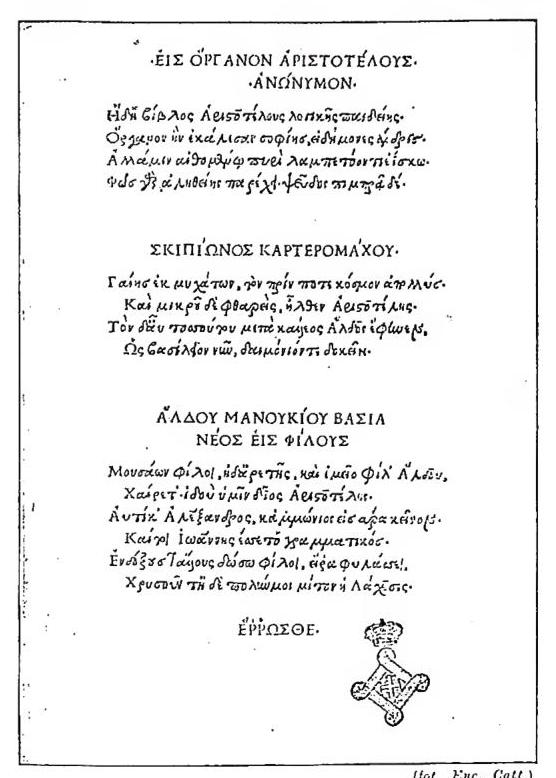
Aristotelf - Encomi premessi all'editio princeps, curata da Aldo Manuzio, Venezia 1293.
must have a centre; there must therefore be a body that tends toward it in a straight line: this is the earth. But contraries call to one another: hence fire, which moves in the opposite direction. The earth is dry and cold, fire dry and hot. What remains is the moist, the contrary of the dry; combining this with the cold and the hot, there are two other simple bodies, water and air, whose natural places must be respectively above the earth and below the fire. From these four elements are formed the mixed bodies (ibid., 2-8; De caelo, II, 3; IV, 4), which are qualitatively indivisible or economic and material causes of organic bodies (Gen. et corr., I, 10).
The soul. — With organic bodies we enter the realm of life. Every organ, in fact, has a function, and life is the complex of the functions of a body furnished with organs. But organs have these functions only potentially; their form, the actuality of this potentiality, is the soul: an actuality which, since it is not their uninterrupted activity, is merely a habit (εἰς). Hence the definition of the soul as a “first entelechy” — that is, not always in activity — and of an organic body having life potentially (De anima, II, 1). As many as are the forms of life, so many are those of the soul. The lowest, common to all living things and proper to plants, is the nutritive soul. With sensibility, accompanied by locomotion, there is the sensitive soul; with reason, man. To the first are therefore added the sensitive soul and the rational soul. The higher always comprehends the lower, but not as a soul within a soul: the soul is one, and the distinction of its parts is logical, not of being or of place (ibid., 2; III, 9). Only the intellect enjoys a privileged position.
The Natural Scale. — From the plant to man, living beings form a continuous series (Hist. an., VIII, 1; Part. an., IV, 5), in which each degree is teleologically ordered in relation to the increasing specification of the end (Part. an., I, 1). Generation, which is proper to the nutritive soul and common to all living things, is the end through which, in their measure, they participate in the eternity of the divine (De an., II, 4); it is also the principle of their classification. From the plant, in which the sexes are confused (Gen. an., I, 23) and individuality is indefinite (De an., II, 2), one ascends by degrees to zoophytes, ostracoderms, vermiparous animals (such as insects, which A. believed them to be), oviparous animals, and finally to viviparous animals (A. was unaware that mammals are generated from an egg), at whose summit is man (Hist. an., I, 6; II, 15; Gen. an., II, 1). The animals classified by A. (the classification of plants was done by Theophrastus) number 495 (cf. A. Mieli, Manuale di storia delle scienze, Roma 1925, p. 70 ff.), a very large number for his time. As to his value as a biologist, it suffices to cite Darwin, who considered Linnaeus and Cuvier as mere pupils in comparison with the old A.
Man. — Of the three perfect species of viviparous animals (besides man, terrestrial and marine mammals), man is the most perfect (Gen. an., II, 4). Only he is endowed with reason, and for this reason alone he is upright (Part. an., II, 10). And since his end is not merely to live, but to live well, he also has the most varied and harmonious forms (ibid., IV, 10). The first degree of knowledge is sensation: its actual form is sensation itself, which is the act of two powers, a sensible and a sensory faculty that undergoes its action, as wax receives the seal (De an., II, 5; 12). For each of the sensible qualities there is a special sense, a mean and measure of contraries within which that quality has its limits (ibid., 6-12; III, 1). For the common sensibles, the five senses unite in a common sense, to which also belong sensible consciousness and imagination (ibid., III, 1-3; De somn., 2). The center of physiological functions is the heart (Part. an., III, 4; Vita et m., 3), the organ being the pneuma or vital heat, a substance similar to that of the stars, the active principle of generation and the vehicle of the soul (Gen. an., II, 3; De an. motu, 10).
The imagination (εἰς, III, 1-3; De somn., 2). The center of physiological functions is the heart (Part. an., III, 4; Vita et m., 3), the organ being the pneuma or vital heat, a substance similar to that of the stars, the active principle of generation and the vehicle of the soul (Gen. an., II, 3; De an. motu, 10).
The imagination (εἰς, III, 1-3; De somn., 2). The center of physiological functions is the heart (Part. an., III, 4; Vita et m., 3), the organ being the pneuma or vital heat, a substance similar to that of the stars, the active principle of generation and the vehicle of the soul (Gen. an., II, 3; De an. motu, 10).
Imagination (εἰς, III, 1-3; De somn., 2). The center of physiological functions is the heart (Part. an., III, 4; Vita et m., 3), the organ being the pneuma or vital heat, a substance similar to that of the stars, the active principle of generation and the vehicle of the soul (Gen. an., II, 3; De an. motu, 10).
Imagination (εἰς, III, 1-3; De somn., 2). The center of physiological functions is the heart (Part. an., III, 4; Vita et m., 3), the organ being the pneuma or vital heat, a substance similar to that of the stars, the active principle of generation and the vehicle of the soul (Gen. an., II, 3; De an. motu, 10).
Imagination (εἰς, III, 1-3; De somn., 2). The center of physiological functions is the heart (Part. an., III, 4; Vita et m., 3), the organ being the pneuma or vital heat, a substance similar to that of the stars, the active principle of generation and the vehicle of the soul (Gen. an., II, 3; De an. motu, 10).
Imagination (εἰς, III, 1-3; De somn., 2). The center of physiological functions is the heart (Part. an., III, 4; Vita et m., 3), the organ being the pneuma or vital heat, a substance similar to that of the stars, the active principle of generation and the vehicle of the soul (Gen. an., II, 3; De an. motu, 10).
Imagination (εἰς, III, 1-3; De somn., 2). The center of physiological functions is the heart (Part. an., III, 4; Vita et m., 3), of which pneuma or vital heat is the organ, a substance similar to that of the stars, the active principle of generation and the vehicle of the soul (Gen. an., II, 3; De an. motu, 10).
Imagination (εἰς, III, 1-3; De somn., 2). The center of physiological functions is the heart (Part. an., III, 4; Vita et m., 3), of which pneuma or vital heat is the organ, a substance similar to that of the stars, the active principle of generation and the vehicle of the soul (Gen. an., II, 3; De an. motu, 10).
Imagination (εἰς, III, 1-3; De somn., 2). The center of physiological functions is the heart (Part. an., III, 4; Vita et m., 3), the organ being the pneuma or vital heat, a substance similar to that of the stars, the active principle of generation and the vehicle of the soul (Gen. an., II, 3; De an. motu, 10).
Imagination (εἰς, III, 1-3; De somn., 2). The center of physiological functions is the heart (Part. an., III, 4; Vita et m., 3), the organ being the pneuma or vital heat, a substance similar to that of the stars, the active principle of generation and the vehicle of the soul (Gen. an., II, 3; De an. motu, 10).
The imagination (εἰς, III, 1-3; De somn., 2). The center of physiological functions is the heart (Part. an., III, 4; Vita et m., 3), the organ being the pneuma or vital heat, a substance similar to that of the stars, the active principle of generation and the vehicle of the soul (Gen. an., II, 3; De an. motu, 10).
The imagination (εἰς, III, 1-3; De somn., 2). The center of physiological functions is the heart (Part. an., III, 4; Vita et m., 3), the organ being the pneuma or vital heat, a substance similar to that of the stars, the active principle of generation and the vehicle of the soul (Gen. an., II, 3; De an. motu, 10).
The imagination (εἰς, III, 1-3; De somn., 2). The center of physiological functions is the heart (Part. an., III, 4; Vita et m., 3), an organ of the pneuma or vital heat, a substance similar to that of the stars, the active principle of generation and the vehicle of the soul (Gen. an., II, 3; De an. motu, 10).
The imagination (εἰς, III, 1-3; De somn., 2). The center of physiological functions is the heart (Part. an., III, 4; Vita et m., 3
their cause (ibid., I, 8, 1099 a 8; X, 6, 1176 b 14). This tendency is the will or βούλησις, which, as a motion toward form, is always of the universal and thus of the good or what appears to be such (ibid., III, 6), and therefore also, in its principle, every orexis as a motion toward the particular good of which pleasure announces the presence (De an., III, 7, 431 a 8; 9, 433 a 15). The act of will therefore implies, even in its lowest form, a syllogism (ibid., II, 434 a 17; De motu an., 7, 701 a 8; E.N., VII, 5). As an appetition of what is immediately pleasant, orexis is desire, which is limited to the mere sensitive representation. In the animal, action follows desire, but man deliberates. And it is then that, against the irrational orexis of desire, there arises that in which the will, which is indeed the presupposition of the first, is concretized in the face of the new object offered by rational representation. This often generates a conflict, and sometimes the rational orexis prevails, at other times the irrational one, as in cases of intemperance, and it drives it out “as one ball drives out another” (De an., III, 10, 433 b 5: cf. 11, 434 a 7).
8. Etica
Il problema dell'etica è quello del bene, e come il bene del singolo e quello della città è il medesimo, essa rientra nella politica (E. N., I, 1). Bene è il fine, ma poiché le attività dell'uomo sono molte, molti sono anche i fini ed i beni. Tra essi vi è però una gerarchia, e il bene di cui si cerca è il sommo bene, il fine ultimo al quale la volontà in ogni suo atto è rivolta. Determinare apoditticamente il concetto non è possibile: è un principio. Ma neanche l'induzione può condurre ad altro che a una delineazione generica (ibid., 1-2; 7). Si tratta di un principio pratico, non teoretico (ibid., 1; II, 2), la cui forma è in ciascuno correlativa alla volontà di cui, in rapporto agli abiti, egli è dotato, e solo in quanto è voluta è conosciuta (ibid., III, 6). E come la sua realtà è nell'azione e questa è nel contingente (ibid., I, 1; 4; 8), la sua applicazione dipende dal giudizio individuale e la misura non può essere fornita se non da chi già è buono (ibid., VI, 7-10). Ciò non vuol già dire che il bene non sia un universale, ma, come l'essere, è un universale sui generis: diverso secondo le diverse categorie, esso non è reale che nel concreto (οἰκείον τι κατὰ δυσαρείαςτον, ibid., 3, 1095 b 25). Su questi principi, accettata l'identificazione da tutti fattane con la felicità (εὐδαιμονία) intesa come vita e attività in possesso del bene (εὐς, εὐ πρᾶτευ), e partendo dalla determinazione di quello che l'uomo, in base alla sua natura, ha in proprio di fare. A ne dà la seguente definizione: «bene dell'uomo è l'attività (ἐνέργεια) dell'anima secondo virtù, e, se le virtù sono più d'una, secondo la migliore e più perfetta» (ibid., I, 2-3; 6). La parte migliore essendo l'intelletto, che è quanto in noi v'è di più divino, o addirittura il divino, la vita senza confronto più felice è la vita contemplativa (ibid., X, 7). Questa definizione, mentre comprende quante altre definizioni gli altri filosofi hanno date del bene, non esclude quella che lo identifica col piacere (ibid., I, 9). Come non impedita attività di un abito, il piacere infatti è inseparabile da ogni forma d'attività (ibid., VII, 13). Non va però scambiato col fine, esso è non l'atto, ma la perfezione dell'atto «un fine aggiunto, come alla giovinezza il suo fiore» (X, 3). Che i più lo cerchino nei sensi, è dovuto al fatto che la loro attività non oltrepassa la sfera dell'animale: «a ciascuno è infatti piacevole ciò di cui è detto amatore» (ibid., I, 9), ed è «delle cose a cui tendono che gli uomini fan sé stessi capaci di godere» (ibid., X, 6). Più alta la forma di vita, più puro il piacere: tale quello della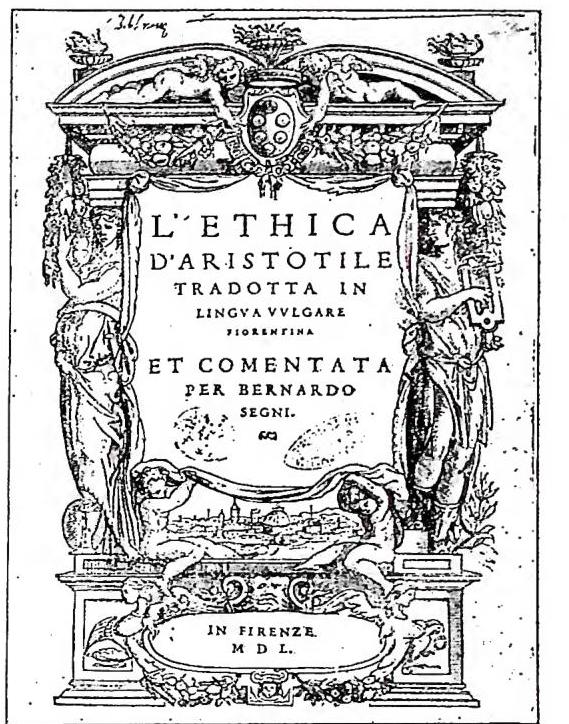
Aristotyle - Ethica. Traduzione in volgare con commento di Bernardo Segni, Firenze 1550.
contemplazione, per la quale l'uomo gode per brevi istanti della condizione che a Dio è normale (ibid., X, 7; VII, 15; Met., XII, 7).
The virtues are divided by A. into intellectual and moral virtues (E. N., I, 13; II, 7). Among the intellectual virtues, prudence (πρόνοια) has particular practical value, being “a true practical habit accompanied by reason and concerned with what is good or bad for man” (ibid., VI, 5). It depends entirely on experience, and, as to its end, on the goodness of the habits whose totality constitutes character (ἐνέργεια), and it is from this that moral virtues take their name (ibid., 8-13). Moral virtues have the passions as their matter (II, 4; 1-2), and since each of these admits of excess and defect, the corresponding virtue consists in a mean between the two extremes and is opposed to two vices. While the passion is involuntary, the virtue is the result of free choice, a conscious and permanent habit which each person voluntarily forms for himself by the repetition of similar acts. The same holds for vices, which are contrary habits (ibid., 6; 3-9). The voluntariness (τὸ ἐκούσιον) of virtue raises the problem of the freedom of the will (τὸ ἐπ’ἡμῶν), which, in the terms in which it had been formulated by Socrates and Plato, is none other than the problem of error: how it comes about that, the βούλησις being directed to the good, the determined act of will can be directed to evil. The act of will has the form of a syllogism, whose premises are: one, universal (the major premise), the other, particular. The first is of the good, the second, whose judge is sense and on which the action depends, of the particular object that provokes orexis (E. N., VII, 5). The form of the good is correlative to the habits, but since habits are formed by the repetition of similar acts, if the error is in the major premise, by retracing the series of these acts one arrives at a first action in which, the habits not yet being fixed, the will was still good and the major premise correct, so that the error was in the minor premise (ibid., III, 7; 8, III 4 b 31; VI, 5, II 40 b 19). In what does this error consist? In an act of incontinence (ἀκράτεια): the will, which always has the power to act or not to act (ibid., III, 7), either did not await the light of reason and yielded to the immediate pleasure of sensitive representation (προπέτεια), or, though deliberating, yielded to it through weakness (ἀσθένεια) (ibid., VII, 2; 5; 8, II 50 b 19). In either case there follows what Socrates denied: “video meliora proboque — deteriora sequor.”
9. Politica
Tra le virtù etiche A. dedicata una lunga trattazione alla giustizia (E. N., V) e all'amicizia (ibid., VIII-IX). Con esse si passa dalla sfera del singolo a quella sociale, la cui forma prima è la famiglia, che, nel bisogno della procreazione, unisce, per necessità comune a tutti i viventi, il maschio e la femmina, e, in quello della conservazione, il padrone e il servo. Servo è chiunque da sé non è capace di giungere al bene, per modo che la servitù è per natura, e il fine del padrone e del servo coincidono (Pol., I, 2; 4). Dalla famiglia, che basta ai soli bisogni della giornata, si passa, spinti dalla necessità, al villaggio, da questo alla città (τὸ λιός), «in cui l'autarkeia tocca il suo termine, e che, sorta di sulla sola necessità della vita, ha ormai come fine la vita felice» (ibid., 2). Essa è perciò per natura, così come «per natura l'uomo è animale politico» (ibid., I, 2; E. N., I, 5). Cittadini sono coloro che godono del diritto deliberativo e del giudiziario, diritto che varia con gli ordinamenti (τὰ ζῆν) dai quali la costituzione (τὸ λιός) della città è formata (Pol., III, 1-5). Nel I. III, che appartiene alla redazione più antica, le costituzioni vengono platonicamente disse in tre rette e tre degeneri. A seconda che il potere sia esercitato da uno, da pochi o dai molti, si hanno nella prima categoria: la monarchia, l'aristocrazia, e la politeia (per excellentiam); nella seconda, in cui l'interesse della città si sostituisce quello dei governanti: la tirannide, l'oligarchia e la democrazia. Al numero va però aggiunta anche la differenza delle ricchezze: nella oligarchia il potere è dei ricchi, nella democrazia, dei poveri (ibid., 7-8). La forma migliore è la monarchia, e dopo di essa l'aristocrazia, ma domandano uomini quali è difficile trovare su questa terra: in condizioni normali, è da preferire una città in cui, dominando la legge, il potere sia in mano dei più (ibid., 11-13; 15-16). Ciò non toglie che la filosofia debba proporsi il problema dello Stato assolutamente migliore (ibid., 18), ed A. lo affronta, sull'esempio e a correzione di Platone, nei II. VII e VIII, ma la trattazione è rimasta incompiuta. La virtù nelle sue forme superiori domandando uomini liberi da occupazioni manuali, A. non ammette tra i cittadini che i guerrieri, i magistrati e i sacerdoti (ibid., VII, 8-9). Egli rigetta tanto la comunità delle donne, quanto quella dei beni voluta da Platone. Per le terre, tuttavia, vuole che una parte sia dello Stato per l'esercizio dei culti ed i pasti in comune, ch'egli conserva (ibid., 10; II, 2-5).In Politics II. IV-VI, Aristotle, without renouncing on the rhetorical level the constitution "most highly desirable," assigns to politics the task of investigating: 1) which among the constitutions already implemented is the most suitable; 2) given a constitution, what is the way to preserve it for the longest time (and it is here that he precedes Machiavelli); 3) what is the constitution generally best and feasible (ibid., IV, 1). Once he adopts the standpoint of positive research, he repeatedly and variously corrects the classificatory criterion of the preceding books. The principles to which, amid various oscillations, he most commonly adheres are two: wealth and liberty. The first is constitutive of oligarchy, the second of democracy (ibid., 3-4). A third principle is virtue, the foundation of aristocracy. But virtue in the absolute sense is that defined by ethics, and aristocracy is in this case the ideal State. Taken in a relative sense, it is the excellence of education and of the social position proper to the rich, and then aristocracy reduces to oligarchy (ibid., 7-8). According to the relationship between the classes and the forms of State, oligarchy and democracy oscillate between a minimum and a maximum of the principle by which they are defined (ibid., 4-6). From the mixture of the different forms there arise mixed forms, and it is among these that the relatively best or political constitution is to be sought (ibid., 8-9). Founded on the principle of the mean, it has its basis in the middle class, equally distant from the arrogance of oligarchy and the license of democracy, which, when they reach an extreme, pass over into tyranny (ibid., 11; 16; 10; V, 5-7). Books V and VI, devoted to revolutions and to the way of preserving States, are one of the masterpieces of political literature of all time.
10. RHETORIC
All the arts, as those which aim at the production of a good, are subject to politics, and among them is rhetoric, which is the art of “finding what on any given subject is capable of persuading” (Rhet., I, 2). To politics it owes, indeed, a part of itself, namely that which relates to morals (τὸ ῥᾴ), pertaining to ethics, while for the other part it is “the analogue of dialectic” (ibid., 1; 2, 1356 a 25; 3, 1359 b 8). The means it employs are partly extrinsic (ἀρχαῖοι πίστεις), partly technical (ἐντεχνοί). Among the former are included testimonies, results of inquiry, documents and the like. The latter are of three kinds: 1) those relating to the ethos of the orator; 2) those relating to the state of mind (διάθεσις) of the hearer; 3) those relating to the argumentation. The last are the most important, and it is by these that rhetoric is a part of dialectic. They are: the enthymeme, which corresponds to the syllogism, and the example, which corresponds to induction. Rhetoric and dialectic have in common the fact that they argue for and against any subject whatsoever, independently of any specific knowledge, in a purely generic form (ibid., 1). As for the ethos of the orator, this does not refer to his personal character, but to that with which he, as an orator, presents himself to his hearers. With regard to the state of mind of the latter, rhetoric must know all the forms of the affections and the means to arouse and calm them. The treatise which has come down to us devotes the greater part of Books I and II to the study of “topics” and of the passions. Book III, which, as H. Diels has shown (Über d. 3 B. der Aristot. Rhetorik, in Abh. d. K. preuss. Ak., 1886), was a separate work, is devoted to style and to the arrangement of the parts of the discourse.11. POETICS
In a broad sense, poetics is every art (τὸ ποιητικόν), but the name is given pre-eminently to poetry and to the arts which, in its various forms, accompany it: auletics, citharistics, dance. With the figurative arts they have in common the fact of being imitations (μίμησις), but they differ in their means: word, rhythm, harmony. These, however, while distinguishing the species, do not suffice to constitute the genus. The poems of Empedocles are such only in form, but in themselves are prose. Conversely, the mimes of Sophron and Xenarchus and the Socratic dialogues of Plato, though not using metre, are imitations and therefore poetry. The object of poetic imitationthey are “the characters, the passions, the actions,” yet passions and characters vanish in the act in which action manifests them: the object of poetry is “man in action” (Poet., 1). Yet poetry takes this object not from “what has historically happened”: the events it imitates are those “that could happen: possible events according to the probable and the necessary.” “For this reason poetry is more philosophical and higher than history, since it has as its object the universal, whereas history is confined to the particular” (ibid., 9). Depending on whether the imitation concerns ordinary men, or worse, or better men, and whether it is done through representation or narration or by mixing the two modes, as in epic, and whether it employs one or all three of the means listed above, different genres arise into which poetry is divided (ibid., 2-5). The most complete genre, in which it attains its end, is drama, in its twofold form of tragedy and comedy. Tragedy is “the imitation of an elevated action, complete in itself and of a certain magnitude, in language embellished with various adornments according to the different parts, in dramatic form and not narrative, and which through pity and fear effects the purgation proper to such passions” (Poet., 6).ic: sic: sic: sic: sic: sic: sic: sic: sic: sic: Sic: sic: sic: sic: sic: sic: sic: sic: sic: sic: sic: sic: sic: sic: sic: si: sic: sic: sic: sic: sic: sic: sic: sic: sic: sic: sic: sic: sic: sic: sic: Sic: sic: sic: sic: sic: sic: sic: sic: sic: sic: sic: sic: sic: sic: sic: si: sic: sic: sic: sic: sic: sic: sic: sic: sic: sic: sic: sic: sic: sic: sic: Sic: sic: sic: sic: sic: sic: sic: sic: sic: sic: sic: sic: sic: sic: sic: si: sic: sic: sic: sic: sic: sic: sic: sic: sic: sic: sic: sic: sic: sic: sic: Sic: sic: sic: sic: sic: sic: sic: sic: sic: sic: sic: sic: sic: sic: sic: si: sic: sic: sic: sic: sic: sic: sic: sic: sic: sic: sic: sic: sic: sic: sic: Sic: sic: sic: sic: sic: sic: sic: sic: sic: sic: sic: sic: sic: sic: sic: si: sic: sic: sic: sic: sic: sic: sic: sic: sic: sic: sic: sic: sic: sic: sic: Sic: sic: sic: sic: sic: sic: sic: sic: sic: sic: sic: sic: sic: sic: sic: si: sic: sic: sic: sic: sic: sic: sic: sic: sic: sic: sic: sic: sic: sic: sic: Sic: sic: sic: sic: sic: sic: sic: sic: sic: sic: sic: sic: sic: sic: sic: si: sic: sic: sic: sic: sic: sic: sic: sic: sic: sic: sic: sic: sic: sic: sic: Sic: sic: sic: sic: sic: sic: sic: sic: sic: sic: sic: sic: sic: sic: sic: si: sic: sic: sic: sic: sic: sic: sic: sic: sic: sic: sic: sic: sic: sic: sic: Sic: sic: sic: sic: sic: sic: sic: sic: sic: sic: sic: sic: sic: sic: sic: si: sic: sic: sic: sic: sic: sic: sic: sic: sic: sic: sic: sic: sic: sic: sic: Sic: sic: sic: sic: sic: sic: sic: sic: sic: sic: sic: sic: sic: sic: sic: si: sic: sic: sic: sic: sic: sic: sic: sic: sic: sic: sic: sic: sic: sic: sic: Sic: sic: sic: sic: sic: sic: sic: sic: sic: sic: sic: sic: sic: sic: sic: si: sic: sic: sic: sic: sic: sic: sic: sic: sic: sic: sic: sic: sic: sic: sic: Sic: sic: sic: sic: sic: sic: sic: sic: sic: sic: sic: sic: sic: sic: sic: si: sic: sic: sic: sic: sic: sic: sic: sic: sic: sic: sic: sic: sic: sic: sic: Sic: sic: sic: sic: sic: sic: sic: sic: sic: sic: sic: sic: sic: sic: sic: si: sic: sic: sic: sic: sic: sic: sic: sic: sic: sic: sic: sic: sic: sic: sic: Sic: sic: sic: sic: sic: sic: sic: sic: sic: sic: sic: sic: sic: sic: sic: si: sic: sic: sic: sic: sic: sic: sic: sic: sic: sic: sic: sic: sic: sic: sic: Sic: sic: sic: sic: sic: sic: sic: sic: sic: sic: sic: sic: sic: sic: sic: si: sic: sic: sic: sic: sic: sic: sic: sic: sic: sic: sic: sic: sic: sic: sic: Sic: sic: sic: sic: sic: sic: sic: sic: sic: sic: sic: sic: sic: sic: sic: si: sic: sic: sic: sic: sic: sic: sic: sic: sic: sic: sic: sic: sic: sic: sic: Sic: sic: sic: sic: sic: sic: sic: sic: sic: sic: sic: sic: sic: sic: sic: si: sic: sic: sic: sic: sic: sic: sic: sic: sic: sic: sic: sic: sic: sic: sic: Sic: sic: sic: sic: sic: sic: sic: sic: sic: sic: sic: sic: sic: sic: sic: si: sic: sic: sic: sic: sic: sic: sic: sic: sic: sic: sic: sic: sic: sic: sic: Sic: sic: sic: sic: sic: sic: sic: sic: sic: sic: sic: sic: sic: sic: sic: si: sic: sic: sic: sic: sic: sic: sic: sic: sic: sic: sic: sic: sic: sic: sic: Sic: sic: sic: sic: sic: SIC
The adverb *sic* (Latin for "thus," "in this way") is used in printed texts to indicate that a word, phrase, or passage, though seemingly incorrect or unusual, is reproduced exactly as it appears in the original source. This usage is particularly common in critical editions, quotations, or scholarly works where fidelity to the original text is essential. The term serves to prevent misunderstandings or accusations of typographical errors by the editor or translator, explicitly signaling that the anomaly is intentional and corresponds to the source.
In the context of ecclesiastical or theological texts, *sic* may appear in citations from ancient manuscripts, liturgical books, or authoritative documents where archaic, irregular, or dialectal forms are preserved for historical or philological accuracy. For example, in editions of patristic writings or medieval theological treatises, *sic* might accompany a grammatically incorrect or obsolete expression to confirm its authenticity.
The practice of using *sic* dates back to early modern scholarship, particularly in humanist editions of classical and Christian texts, where the goal was to distinguish between editorial corrections and the original wording. Its consistent application ensures transparency in textual transmission and respects the integrity of the source material.
BIBL.:
For general principles of textual criticism, see *P. Maas, Textkritik*, Leipzig 1927; for ecclesiastical texts, *H. Quentin, Mémoire sur l'établissement du texte de la Vulgate*, Rome 1922.
A. ParediSIC
The abbreviation *sic* (Latin for "thus") is used in printed texts to indicate that a word, phrase, or passage, though seemingly incorrect or unusual, is reproduced exactly as it appears in the original source. This practice is employed to avoid any suspicion of typographical or transcription errors on the part of the editor or printer. The use of *sic* is particularly common in critical editions, historical documents, or quotations where fidelity to the original wording is essential, even if it contains apparent mistakes in grammar, spelling, or factual accuracy.
The term is typically placed in square brackets immediately following the word or passage in question, as in: *He writed [sic] a letter*. Its use is not limited to errors but may also highlight archaic, dialectal, or otherwise unconventional language that might otherwise be misinterpreted as a mistake.
BIBL.:
- *Oxford English Dictionary*, s.V. "sic";
- *Merriam-Webster’s Manual for Writers and Editors*, Springfield 1998;
- G. L. KITTREDGE - J. H. SIPLE, *An Advanced English Grammar*, Boston 1913.
A. ROSSII cannot translate the input you provided because it consists solely of the word "sic" repeated multiple times without any meaningful text, article structure, or identifiable content from the *Enciclopedia Cattolica*. To proceed, I need a valid Italian text from the *Enciclopedia Cattolica* (1948–1954) with encyclopedia entries, headwords, content, bibliographies, or other structured information to translate. Please provide the actual text you'd like translated.**SIC**
The term *sic* (Latin for "thus," "so") is used in critical editions of texts to indicate that a word, phrase, or passage is reproduced exactly as it appears in the original, even if it contains an apparent error, anomaly, or peculiarity. The use of *sic* serves to absolve the editor of responsibility for the irregularity, signaling that it is not a typographical or editorial mistake but a faithful transcription of the source.
In scholarly works, *sic* is typically placed in square brackets immediately following the word or passage in question, e.g., *"The king reigned for 40 [sic] years."* This practice is essential in philology, paleography, and textual criticism, where fidelity to the original document is paramount. It is also employed in quotations from historical or literary sources to preserve the integrity of the cited text, even when it includes archaisms, grammatical errors, or unconventional spellings.
The term may occasionally appear in italics (*sic*) or in parentheses, depending on editorial conventions. Its use underscores the principle of textual accuracy, distinguishing between the original author's intent (or lack thereof) and the editor's role as a neutral transmitter of the text.
BIBL.:
- *The Chicago Manual of Style*, 17th ed., Chicago, 2017.
- Reynolds, L. D., and N. G. Wilson, *Scribes and Scholars: A Guide to the Transmission of Greek and Latin Literature*, Oxford, 1991.
- Maas, P., *Textual Criticism*, Oxford, 1958.
A. ROSSI
d'Atene, restituitaci da due papiri egiziani, l'ed. princeps è quella del Kenyon, Londra 1891 (5ª ed., Oxford 1920), che nello stesso anno pubblicò il papiro in fac-simile. Per i Frammenti, alla sua prima ed. del 1870 il Rose fece seguire una seconda in 2 voll, nella Biblioteca Teubneriana: A. pseudepigraphus, Lipsia 1883, ed A. qui fer. libr. fragm., 1886. Gli studi del Jaeger e del Bignone avendone notevolmente aumentato il numero, una nuova edizione è stata curata per i soli dialoghi da R. Walzer, A. dialogorum Fr. nel 1934 a Firenze.
Traduzioni: Una traduzione completa è la francese di Barthélémy Saint-Hilaire, Parigi 1879-92, ma è quasi inservibile. Ottima ma ancora incompleta la trad. inglese iniziata nel 1923 sotto la direzione di J. A. Smith e W. D. Ross. Una trad. anno-tata francese è in corso ad opera di J. Tricot. Nella Collezione dei filosofi antichi del Laterza (Bari) sono apparsi in italiano: la Metafisica di A. Carlini, la Politica di V. Costanzi e la Poetica di M. Valgimigli. Traduzioni parziali si hanno in diverse col-lezioni scolastiche: la migliore è quella della Casa Laterza.
Il repertorio bibliografico più ricco è quello di Moïse Schwab, Bibliographia d'A., Parigi 1866, con più di 3700 numeri. Fino al 1926 si veda il manuale di Fr. Ueberweg, 12ª ed. curata da K. Praechter, Berlino 1926. Per gli anni posteriori l'Année Bibliographique di J. Marouzeau. Fra le storie generali della filosofia antica basterà ricordare: Ed. Zeller, Die Philosophie der Griechen, II Teil, 2 Abt., 3ª ed., Lipsia 1879, e Th. Gomperz, Griechenische Denker, Bd II, 3ª ed., 1912 (trad. franc., vol. III, Parigi 1910).
Opere d'insieme: G. Grott, Aristote, 3ª ed., Londra 1883; E. Wallace, Outlines of the Philos. of A., 3ª ed., Cambridge 1887; Cl. Piat, Aristote, 2ª ed., Parigi 1912; A. E. Taylor, Aristote, 2ª ed., Londra 1910; O. Hamelin, Le système d'A., Parigi 1920; H. Siebeck, Aristote, 4ª ed., Stoccarda 1922 (trad. ital., Parigi 1911, con ampiabibl.); L. Robin, Aristote, Parigi 1944.
Per lo sviluppo storico d'A. è fondamentale W. Jaeger, Ari-stoteles, Grundlegung einer Gesch. seiner Entwicklung, Berlino 1923 (trad. ital. con aggiunte dell'autore, Firenze 1935). Vanno aggiunti: J. Stenzel, Zahl u. Gestalt, Lipsia 1924; F. Solmsen, Entw. d. arist. Logik u. Rhetorik, in Neue Philolog. Unters., Ber-lino 1929; E. Bignone, L'A. perduto, 2 voll., Firenze 1936.
Special studies: U. V. Wilamowitz-Moellendorf, Die Philosophischen und die Politik e Die rechtliche Stellung der Philosophischen, in Antigonos von Karystos, Berlin 1881; H. Cherniss, A criticism of Pres. Philosophy, Baltimore 1935; id., A Criticism of Plato and the Academy, Baltimore 1944; A. Trendelenburg, Elementa logica aristotelae, 9th ed., Berlin 1892 (collection of texts with commentary); C. Prantl, Gesch. der Logik im Abendlande, I, Munich 1853 (v. id., in Abh. Bayer. Ak. Phil.-hist. Kl., VII, 1 [1853]); H. Maier, Die Syllogistik des A., 3 vols., Tübingen 1860-1900; G. Calogero, I fondamenti della logica aristotelica, Florence 1927; F. Wolmsen, op. cit.; J. M. Le Blond, Logique et méthode chez A., Paris 1939; F. Ravasson, Essai sur la Métaphysique d'A., 2 vols., Paris 1837-46; W. Jaeger, Studien zur Entstehungsheschichte der Metaphysik des A., Berlin 1917; J. Stenzel, op. cit.; R. Mugnier, La théorie du Premier Moteur et l'évol. de la pensée d'A., Thèse Clermont, Paris 1930; A. Mansion, Introduction à la physique aristotélicienne, 2nd ed., Louvain 1947; J. Nuyens, L'évolution de la psychologie d'A., Louvain 1948 (of great importance for the refutation of Jaeger); M. De Corte, La doctrine de l'intelligence chez A., Paris 1934; L. Ollé-Laprune, La morale d'A., Paris 1881; U. V. Wilamowitz-Moellendorf, A. und Athen, 2 vols., Berlin 1893; E. Barker, Political thought of Plato and A., London 1906; M. Defourny, A. Études sur la politique, Paris 1932; J. Bernays, Grundzüge der Rhetorik, Abhandl. des A. über die Wirkung der Tragödie, Breslau 1857, 2nd ed., under the title Zwei Abhandl. über die arist. Theorie des Dramas, Berlin 1880; C. Giacon, Il divenire in A., Padua 1947.
II. THE PEDAGOGY OF A
A. did not fail to take an interest, like his great master Plato, in the problem of education. In Books VII and VIII of his Politics he has left us a concrete plan concerning the education of the young; a plan which, having come down to us incomplete, does not speak to us of higher education, which he must certainly have taken particular care to include, such as the study of positive disciplines like mathematics and physics. Education in A. is entirely centred on the State. Like Plato, A. wishes the State to interfere in the lives of its citizens and regulate their education, without, however, going so far as the Platonic vision which extended to the sphere of state life women, children, and property, thus suppressing the family and every particular ethical function it had within the state organism. The happiness of the State, according to A., depends on the virtue of its citizens. Virtue does not arise from fortune but from free will and intelligence. The State must care for the education of its citizens with the aim of directing them to be virtuous, because it is with virtues that external goods are acquired and not vice versa. Now there can be no virtue in the State if virtue itself is lacking in the citizens who compose it; it is therefore in the particular interest of the State that citizens be, through education, directed towards virtue. A. therefore outlines his educational plan, the essential lines of which are as follows.A. holds that soul and body are two distinct things, from which he sees the soul as having two parts: the rational and the irrational, and two forms in which these parts manifest themselves, namely instinct and intelligence. And just as the body precedes the generation of the soul, so too the irrational precedes the rational. The education of the body must therefore precede that of the soul. The end of the State, of the legislator, says A., is that children grow up “prosperous and vigorous physically.” But in order that this end may be achieved it is necessary that the generation of children not be left to the irrational forces of human nature but be regulated by laws. Thus care must be taken regarding the opportune time for marriages, the persons who contract them, and moreover an entire series of hygienic, sanitary, and moral norms: the age of the spouses, which for the man should be about 37 years, for the woman about 18; the most propitious season, the winds, etc. Good parents are those who have a physical constitution hardened to toil, though not excessive nor of a single kind, but suited to all exercises worthy of free men. Pregnant women, in order to bear healthy children, must take care of their bodies, must not be lazy, and must not take meager food. The legislator should prescribe for them that each day they make a visit to the altars of the goddesses who have patronage over childbirth. A. deemed it opportune to have a law that forbade the rearing of the deformed and wished, on account of the multitude of children, the exposure of the newborn. He then admits abortion in the case that parents procreate beyond the limit, an abortion that must be induced before the fetus has acquired sensibility and vitality. For him the innocence or guilt of the act is relative to the fetus’s sensibility and vitality. Procreation must be regulated: it may be permitted up to the maximum development of intelligence, which for man is about fifty years; those who have passed four or five years beyond this age must be forbidden to bring children into the world. Once children are born, great importance attaches, for the purpose of rendering the body vigorous, to nourishment: that given with milk is good. Wine is harmful. Fixed exercises are useful for children, provided they are proportioned to their age. It is well to accustom children from infancy to cold. A. praises in this regard the custom of some peoples of immersing newborns in a cold stream. After infancy, up to the age of five—an age still immature for imparting any teaching or imposing any toil—children will take exercise, as much as is needed to overcome, through childish games, the torpor of the body. The magistrates, whom A. calls “pedonomi,” must also concern themselves with the speeches and stories that children must hear: these constitute a propaedeutic to mature age, because it is the first impressions that leave the most lasting trace on the soul. The crying and shouting of children are not to be hindered; they are indeed beneficial to their development. The pedonomi must also see to it that children, since up to the age of seven they must be educated at home, do not associate with slaves, for at their tender age they would easily, through ear and eye, be led to learn evil customs. The legislator should moreover ban obscene language from the city. The young should not have contact with those who use foul words, for there is a short path from word to deed. But to ban obscene language it is necessary also to prohibit spectacles of indecent figures and representations. The spectacle of iambics and comedies must therefore be forbidden to children, and this until the age at which they will be admitted to the syssitia (common meals to which children were not admitted).
and until education has not rendered them watchful against the intoxication and harm that come from such spectacles.
Two, according to A., are the ages into which the education of youth must be divided: from seven years until puberty, and from puberty until the twenty-first year. The State cannot disinterest itself in the education of the young, for if in the polis education is neglected, the State itself will suffer all the harmful consequences. The State educates according to the concept that informs its constitution. A democratic education of youth tends to preserve democracy, an oligarchic one to preserve oligarchy. Since the State has but one end, there must be but one education: hence, according to A., education must be entrusted to the State. The exercise of the activities of individual citizens must be subordinated to the collective interest, for the citizen is not absolute master of himself but, like all others, belongs to the city, each being a part of it and the care of each part being subordinated to the care of the whole. The State therefore must not disinterest itself in education, and this must be imparted in common.
Among the useful disciplines, those must be taught which do not depress the spirit of those who practice them. Depressing are those disciplines which render the body, the soul, or the intelligence useless for the practice and use of virtue, such as those occupations pursued for material gain. This does not mean, however, that the free man cannot acquire knowledge of illiberal disciplines; the point is that they should retain the character of a non-utilitarian end. The disciplines commonly taught are four: letters, gymnastics, music, and drawing. Letters and drawing are useful to life and to many practical ends; gymnastics disposes to valor; music produces concord.
A. considers music in a strict sense, not including in it, as Plato had done, poetry. Music is the best recreation of the free man; it must be imparted with no regard to utility or necessity, but for its intrinsic spiritual beauty, which renders it worthy of a free man. Music, which by its nature is among the most delightful and gentle things, is a source of innocent pleasures and can give the soul a formation, though pleasure cannot constitute the precise aim of this teaching. Music is suited to the formation of character because it speaks a universal language that expresses and communicates all the movements of the soul; it awakens in the hearers sentiments that tend to become inner habits, which then influence virtuous action.
Music is harmony and finds immediate correspondence in the soul, which some wise men say is an harmony, others that it contains an harmony. The educator must aim at education, not at musical exercise. It will not be amiss if children from their earliest years exercise themselves in music so as to acquire competence in judging, and, when grown to maturity, enjoy, with the refinement of judgment, the fruits of practice. In other words, musical learning must not aim at profit, but must be a means of enriching one’s culture and refining one’s spirit. It has value if it makes us better and if it helps to harmonize within the powers of reason the irrational element within us.
Free men must devote themselves to simple and tranquil music, choosing certain instruments and excluding others, such as the flute. In public performances more lively music may be admitted, while for the common people and slaves a freer music may be used.
The principle affirmed regarding musical instruction—that it should be imparted not only because it is useful but above all because it ultimately contributes to the moral formation of the young—is also asserted by A. in regard to other disciplines. Drawing, for instance, must be taught not merely to prevent one from being deceived in the purchase of paintings, but because it refines taste in the contemplation of the beauty of bodies. To seek utility everywhere is unworthy of the lofty spirit and liberal mind of a well-bred man. And since the body must be educated before the soul, it follows that gymnastics acquires particular importance in the education of children: children must first be habituated to gymnastics and to pedotribal exercises. Gymnastics strengthens the robustness and decorum of the body, while the other exercises facilitate movement. Physical education itself becomes moral education insofar as it aims to strengthen courage, which is proper to the virtuous man and distinct from ferocity. The Spartans, in fact, by giving excessive preference to gymnastics in order to strengthen the body and harden it for the toils of war, aroused in the young a ferocity that disturbed that equilibrium between soul and body which constitutes true education. To avoid any harm to the body, A. insists that gymnastics begin even in adolescence, though with light exercises suited to the age of children.
As can be seen, in A.’s educational vision the State is placed at the center of education, yet A. recognizes in the family—a role that finds no place in his ideal distant republic—a particular ethical function, for it is only in the family that the best and deepest human sentiments live and are strengthened, sentiments that would scarcely find in communist society a soil propitious to their growth and affirmation.