
ART. — Within the perimeter of its ancient walls, the “old city” raised on the promontory that juts into the sea between the two harbors preserves the most significant monuments of B.: the Cathedral, St Nicholas’s, the church of St Gregory, and the Castle. The Cathedral was founded by Archbishop Bisanzio; construction began in 1034 and within about thirty years it was completed, but the destructions suffered by the city in the time of William I the Norman (1156) led to a general rebuilding that took place between 1170 and 1178. The new cathedral arose with its clear plan in the form of an Egyptian cross and its two apsidal bell towers, of which the one on the right collapsed in an earthquake during the 17th century. Many restorations have altered the fine building; nonetheless, the works begun in 1920 have restored to the church some of its ancient values both externally and internally.
Externally, besides the tall façade, the apsidal window rich in sculpture and the ends of the transept are notable, especially that on the right with its very ornate rose window. The dome that rises at the intersection of the transept with the central nave has a low cupola that barely emerges from the octagonal drum decorated with reliefs of distinctly Arab character. Inside, the three naves are divided by sixteen monolithic columns. Here the distribution of space is characteristic, for the naves grow narrower toward the apse so as to give a sense of greater depth to the structure. The level of the transept and the presbytery is raised by seven steps, and for this reason too this part of the building assumes a character of greater grandeur. The central apse preserves remains of frescoes from the 13th century, while in the transept there are paintings by Tintoretto, Paolo Veronese, and Paris Bordone. Adjoining the cathedral is the “trulla,” a 17th-century building cylindrical outside and decagonal inside; originally a baptistery, today it is a sacristy, and from here one descends into the 12th-century crypt of the cathedral. In the archives of the cathedral of B. ancient parchments are preserved, notably a famous Exultet, a work of Beneventan calligraphers of the 11th century, adorned with miniatures in Byzantine style but certainly by Italian artists.
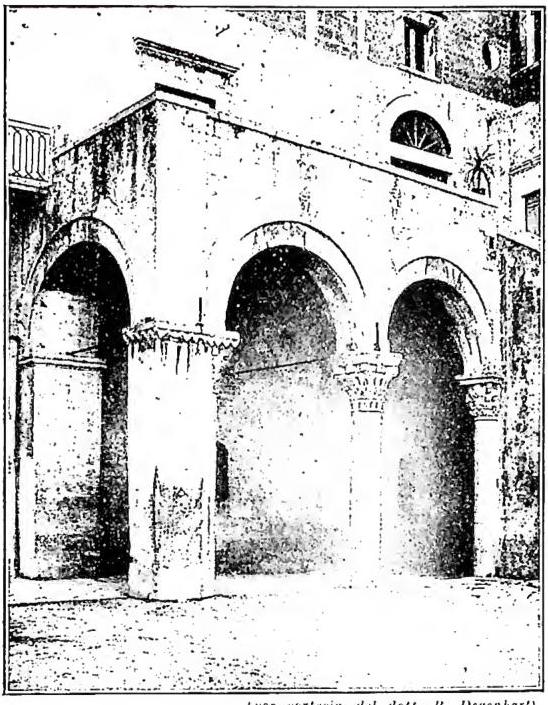
The basilica of St Nicholas, begun in 1087 under the direction of the Benedictine Elias, is without doubt the most important among the Romanesque monuments of Apulia. Its crypt was consecrated by Pope Urban II on 10 October 1089. The building was completed in 1108, but it was consecrated much later, in 1197, by the bishop of Hildesheim by mandate of Celestine III, it is said in the presence of Emperor Henry VI. The handsome façade preserves its original character and reflects in its divisions the forms of the interior, especially in those two pilasters that run the whole length marking the limits of the main nave and accentuating the upward sense of its lines. Two large towers, only partly built, flank, slightly projecting, the front of the church. Inside, this is divided into three naves and, like the churches of Lombardy, has high matronea; while the first three bays of the arcades were reinforced in the 15th century with arches that contribute to give strange effects of picturesque architecture to the interior of this building, which is covered by a rich Baroque wooden ceiling. The ciborium of the high altar is a work of the 12th century adorned also with a Limoges enamel depicting St Nicholas crowning King Roger. Also very famous are the episcopal throne and the vast crypt. Near the sacristy, in the treasury, some reliquaries of great value are kept, while in the archive ancient diplomas, some from the 12th century, bulls, and parchments are preserved.
The church of St Gregory has a Romanesque façade dating from the end of the 11th or the beginning of the 12th century adorned with three fine portals. The castle is one of the finest in Apulia. It has a central nucleus erected by Frederick II between 1233 and 1240 on some remains of a previous Norman construction, probably founded where the ancient acropolis of the Greek city once stood, and then a 16th-century part. In the new city the church of St Ferdinand is notable for its Neoclassical façade by Fausto Niccolin