
ASIA MINOR. (Ἀσία ἢ ἐλλιπτῶς, ἡ μικρά Ἀσία). — A rather late denomination (4th c. AD: cf. Orosius, I, 2) which in learned Byzantine-medieval usage preceded the native (or Levantine country, ἀνατολή, as it must have appeared to the Greeks of the Aegean; whence our Natolia and the Turkish Anatolia; or also Rumili, with allusion to the ancient Roman dominion); toponyms, each of them, of fluctuating territorial significance and in any case different from the more precise modern sense.
SUMMARY:
I. Geography
II. The religions of Asia Minor
III. Christianity in Asia Minor
IV. The Apostolic Vicariate of Asia Minor
V. Archaeology.I. GEOGRAPHY
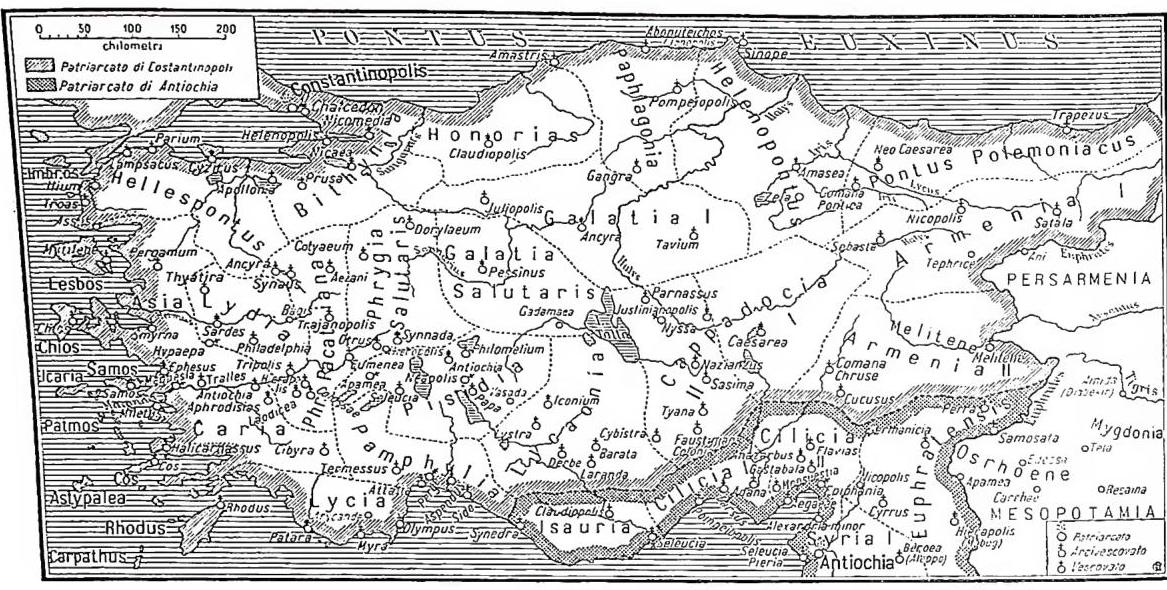
Asia Minor is, after Arabia and India, the largest peninsula of the Asian continent, of which it forms the western extremity. Bounded on three sides by the sea (Euxine or Black Sea to the north, Aegean to the west, and Mediterranean to the south), it is joined to the continental mass in the east by the Armenian plateau, where any dividing line would obviously be only conventional: one may trace a line from the mouth of the Phasis (Rion) to the bottom of the Gulf of Alexandretta. Beyond the first limit the ancients placed Colchis (Georgia), and beyond the second Cilicia was separated from Mesopotamia (Iraq).The area of the peninsula proper slightly exceeds 500,000 sq. km. and is today entirely included, politically, within that of Turkey (q.v.), which is however somewhat larger, since it also comprises part of the neighboring regions. Asia Minor has undergone, in historical times, considerable changes, more in the ethnic composition of its inhabitants than in the natural landscape (alluviation of rivers, especially those flowing into the Aegean, which has enlarged the small coastal plains; changes in the level of inland lakes, etc.). After the exodus of the Greeks from the coastal and western regions and the almost total suppression of the Armenians, who were widespread especially in the eastern interior zones, the population of Asia Minor today consists overwhelmingly of Moslem Turks.
For further geographical information, V. TURKEY.
II. THE RELIGIONS OF ASIA MINOR
The religious landscape of Asia Minor before the Christian era was complex and in a state of development. Its complexity arose from the variety of peoples inhabiting it, with their different languages, customs, and cults. The trend was toward the disappearance of discrepancies and the introduction of a certain common character into all forms.The Hellenistic kings of Asia and Egypt, successors of Alexander the Great, wished to unite the various Asian peoples, Greek or Macedonian, by the bonds of a single civil, social, and religious culture, seeing in this a benefit for the duration of their rule. To achieve this in the religious sphere they could not place much reliance on Greek religion, which, even before Alexander’s expedition, had been heading toward an unstoppable decline. With the exception of Dionysus, who enjoyed wide diffusion in Hellenistic territory, the other Greek deities exercised little influence. It is noteworthy that even in Lydia, a region which opened itself more than others to Hellenism, of the religious inscriptions found, 237 pertain to Anatolian deities, while only 171 refer to Greek deities.
Yet both the philosophy of the time, Stoicism, and the oriental religions worked toward achieving a certain unity of religious conception.
Stoicism taught that a divine force, the logos, animates the entire universe and the beings contained within it, including man. Since all men participate in this force and derive their nobility from it, they are equal, despite differences of race or nationality. With this doctrine Stoicism abolished the distinction, dear to the Greeks, between Hellenes on the one hand and barbarians on the other. The ideal state was one that removed every national barrier, making the entire world into a single great city. Stoicism moreover recognized a single great city. Stoicism moreover recognized a single great city. Stoicism moreover recognized a single great city. Stoicism moreover recognized a single great city. Stoicism moreover recognized a single great city. Stoicism moreover recognized a single great city.
The doctrine found a ready reception among Stoic teachers (with the exception of Panaetius) and their followers, agreeing as it did with their idea of a divine force that governs the world by fixed and inescapable laws; but it also enjoyed wide diffusion among all classes of society. Astrology, however, by reducing man to a mere cog in a vast organism that invariably followed its own paths, in the long run made its oppressive weight felt. And men sought escape from fate.
As a reaction against fatalism, there arose in the Hellenistic period a revival and widespread diffusion of magic. It was thought that there existed formulas and practices by which one could force the hand of the gods and alter adverse fortune.
If the divine stars, by virtue of the unitary connection of all parts of the universe, could exercise their influence upon the earth and upon man, there must exist
By force of the same principle, means were employed in one way or another to counter its action. It was a matter of knowing them and knowing how to use them. The only good aspect of magic was man’s reaction against a doctrine that reduced him to a mere puppet in the hands of a puppeteer. Yet one cannot speak of religion in magical practices. A religious act, in fact, aims to dispose the divinity favorably so as to obtain its aid; a magical act, instead, seeks to force II. In the first case, man’s inner attitude is one of humble submission to the divinity; in the second, it is one of presumptuous superiority, or, as has been said, of selfish arrogance. In any case, the belief became widespread that through such practices one could alter one’s adverse fate and be freed from one’s baleful star.
Yet the people also resorted to it for other specific purposes. A great number of magical papyri have come down to us, containing the most varied and strange formulae, whether to obtain release from an illness, the prosperous success of a love affair, the favorable conclusion of a business transaction, and so on. In such cases, the magician compelled spirits to appear, and by incantations forced them to render service and reveal the cause of an illness or the nature of the remedy. Then it was a matter of driving them away and preventing them from taking revenge, which was again achieved through magical practices.
Astrology and magic, intertwined, spread throughout every region of the Ancient World and Egypt, and from there passed to Rome, where they took firm root and extended throughout the rest of Europe, resisting all attacks even into the Middle Ages.
If astrology came from Babylon and magic chiefly from Egypt, a cult that achieved universal diffusion was the work of the Hellenistic kings: the cult of kings.
After his victories that carried him as far as the lands of the Indus, Alexander had himself recognized as a god by the Greeks. The purpose was political: it was desired to place all the peoples composing the new empire—Macedonians, Greeks, and Asians—on the same level, so that they might feel equal before a god-king. At the same time, it was intended to confer absolute power upon the ruler by elevating him to divinity. For the same reasons, after the empire was divided following his death, his successors in Asia and Egypt, the Seleucids and the Ptolemies, set about instituting their own cults. They proceeded in stages: first, deceased monarchs were deified, then the cult of the living king was established. This institution formed the stepping-stone upon which the ruler’s absolutism was raised. Participation in this cult was required of all subjects of the Hellenistic kingdoms and became the symbol of loyalty. Yet there was little spiritual content in it; and among the thousands of inscriptions with religious content, not one is found that shows anyone directing himself to the king, whether living or dead, to obtain aid for his religious needs. For this, souls turned to the ancient gods.
These local deities were numerous, but, as we have said at the outset, they followed a unifying tendency. Protectors of a particular state and the people that composed it, now that the various states had been absorbed into the great Hellenistic kingdoms, they could no longer be considered guardians of a particular, now nonexistent state; they had to lose their local characteristics and sever their ethnic or state ties in order to acquire more universal traits. In these new conditions, they could address all peoples, even beyond the ancient boundaries of their cult. Men now belonged to an empire and had lost their particular state; they no longer felt bound to the deity of the ancient state but could freely turn, in their religious needs, even to deities previously foreign to them.
To better respond to the broader exigencies of men, the propagators of a deity enlarged its sphere of activity by attributing to it properties and qualities drawn from others. Moreover, the adherents of one religious form did not exclude others or other deities but regarded them as different aspects and names of the same divinity. One could freely follow one or several different cults. In this movement, one cannot speak of monotheism, but rather of a tendency toward a unity of beliefs, or rather of cult, which, however, did not reach its conclusion even shortly before the various religions disappeared when Christianity triumphed. This development is most noticeable during the Roman period at the decline of Hellenism, though its beginnings occurred in this era.
The aspirations of Greeks and Orientals in the decades before the Christian era turned toward salvation. And since men felt powerless to achieve peace by their own strength, they turned their gaze toward aid from on high. Salvation, however, was not conceived in the same way by all. The wars that devastated the various regions of Asia and the upheaval of internal order made men desire peace and the restoration of ordered civil coexistence. This was considered salvation; and when Augustus brought it about, he was exalted with the most divine titles and hailed as a savior. Others groaned under the belief in fate, and for them salvation meant being freed from their baleful star. The Persians, instead, had a doctrine that portrayed life as a continual struggle between good and evil, with men divided into two opposing camps forever at war with each other. And since they saw that evil and falsehood prevailed, they awaited a divine messenger who would come to make the kingdom of justice and truth triumph and restore a new order with a humanity transformed and united in goodness. The helper they awaited had, they thought, been foretold by the very founder of their religion, Zoroaster; and they lived in expectation of him. More than the cults, it was the noble yearnings of man toward salvation that would open hearts to the Christian message.
III. CHRISTIANITY IN THE ANCIENT WORLD
The occupation of the Ancient World by the Romans, preceded by a long period of Greek rule, began with the death of Attalus (133 B.C.), who bequeathed his kingdom to them, and was completed only at the beginning of the second century. The vastness of the territory, but above all the diversity of the peoples and their gradual subjugation, led the Romans to refrain from uniting it into a single province. The provinces varied in number and extent according to the different arrangements made by the emperors.
The Ancient World, where so many cities heard the word of St. Paul and later of St. John toward the end of the first century, is one of the imperial regions where the word of Jesus was most widely preached. The Church of Ephesus, the richest city of the Ancient World, owes its foundation to St. Paul, and, according to a generally accepted tradition, the Apostle John governed it for many years. The Churches of Alexandria, Troas, Laodicea, and Hierapolis, where he resided