Machine translation of the 1948–1954 Italian original. The original text is authoritative.
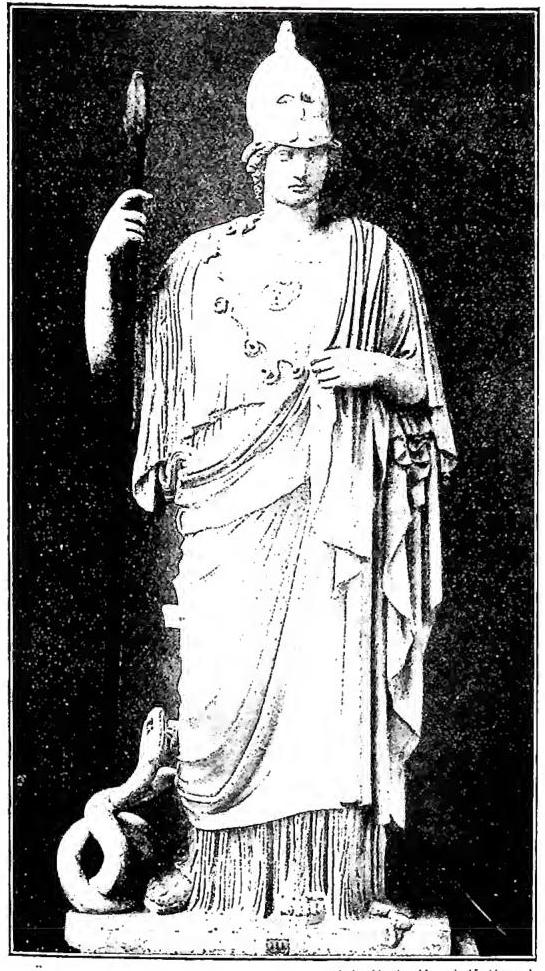
ATENA – Roman copy of a Greek original, known as the A. Giustiniani. Vatican Museums, Braccio Nuovo.
A figure of Athena is depicted in a relief, where, between two adorants, there is a shield with feminine arms, legs, and head. According to some, it would derive from the fusion of a virgin and warrior goddess existing among the Greeks – Πλακίδες, Pallas, “the virgin” – with the Cretan goddess of palaces, from whom she would have taken her name. Neither of these hypotheses is satisfactory. It is certain, however, that the primitive nature of Athena and her origin remain obscure. The Minoan origin is uncertain because the goddess of the princely palaces is only a hypothesis, and the cult of Athena in Greece is little widespread and late. In Homer, Athena already has the characteristics of later ages: having sprung from the head of Zeus, she interprets the will of her father, to whom she owes her attribute, the aegis; she is the protector of heroes, mistress of every art, goddess of war and battles, she who teaches the best arts to achieve victory. She is the πολυείδης goddess, protector of the city and pledge of its fate; yet it is strange to find her as protector of Ilion and not of Greek cities.
Later, Athena’s warrior nature remained only in some epithets (Athena Prómachos). Instead, she became the goddess of the city in its broadest sense: her temple was often on the acropolis, and she was frequently named after the place where she was venerated: Athena Alalcomena at Alalcomene in Boeotia, Athena Itonia at Itonia in Thessaly, Athena Alea at Alea and in other localities of Arcadia.
(fol. Gati. Vatican Museums)
ATENAGORAS – ATHENS
Athenagoras was born in Athens, where he flourished under the emperors Marcus Aurelius and Commodus. The *Supplica* (Legatio pro Christianis) is dated between 177 and 180 AD. The exact date is uncertain: some place it on 27 November 176, the date of Commodus’ accession to the empire, and 180, the year of Marcus Aurelius’ death; others suggest it was written before the middle of 178, perhaps at the end of 177. After the introduction (1-2) and the division, corresponding to the three accusations against Christians – atheism, Thyestean feasts, and Oedipodean unions (ch. 3) – Athenagoras extensively refutes the first accusation, considering atheism in both its theoretical (4-12) and practical (13-30) senses; then he responds to the other two accusations (31-36), and concludes by invoking the assent of the emperors (ch. 37). The treatise *On the Resurrection* aims to be a purely rational demonstration of this dogma for the use of pagans; it first attempts to dispel contrary prejudices (1-10), then provides a positive demonstration of the truth (11-25).
III. PHILOSOPHICAL AND THEOLOGICAL THOUGHT
The core of the doctrine expounded in the *Supplica* is monotheism, whose demonstration occupies the central part. Athenagoras frequently and accurately speaks of the Trinity (4, 2; 10; 12, 2; 18, 2; 24, 2; 30, 4). He mentions angels (10, 3) and elaborates on demons (13-26). The Incarnation appears only in a veiled allusion (31, 4), and Christ is never named; there may be a reference to the Eucharistic sacrifice (13, 3). The inspiration of Scripture is clearly stated (7, 3; 9, 1; 10, 2). In matters of morality, the charity and patience of Christians are highlighted (1, 4; 11, 12, 2), as well as chastity (32-33); abstention from spectacles and condemnation of abortion are noted (35, 2-3).
IV. CHARACTER AND PURPOSE
Addressing pagan intellectuals, Athenagoras seeks to defend Christianity and draw distant souls to it by making use of whatever truth is found in pagan thought, which, in its best currents, has recognized the unity of God: this is the foundation upon which Christian faith is built. The apologies are bridges thrown toward the other shore, introductions to Christianity. Athenagoras was inclined toward this method by his equable and conciliatory spirit, which is evident in his favorable judgments on ancient culture, particularly on poets and philosophers, vehicles of monotheism and participants in a certain divine inspiration (1, 5; 5-6; 7, 2). The writer also distinguishes himself by a composed and balanced equilibrium. The composition is orderly and clear in its broad outlines, though in particular developments there are uncertainties and disorders; the style is elegant, inspired by artistic taste, and the aids of rhetoric are used sparingly.
BIBL.: Editions: 1. The text of Athenagoras has come down to us in the codex Parisinus 451, written in 914; the other manuscripts, all dependent on it, are of little importance. The editio princeps is by Henricus Stephanus (1557). The following editions are noteworthy: P. Maran, Paris 1724, reprinted in PG 6, 887-1024; J. C. Th. von Otto, in Corpus Apologetarum saeculi secundi, VII, 1, 1888; E. Schwartz, in Texte und Untersuchungen zur Geschichte der altchristlichen Literatur, IV, 11, Leipzig 1891; P. Ubaldi and M. Pellegrino (Corona Patrum Salesiana, series graeca, 15), Turin 1947; for the *Supplica* alone, J. Geffcken, in Zwei griechische Apologeten, Leipzig and Berlin 1937; E. J. Goodspeed, in Die ältesten Apologeten, Göttingen 1915. — Studies: A. Puech, Les Apologistes grecs du IIe siècle de notre ère, Paris 1912, pp. 172-206; G. Porta, in Didaskaleion, 5 (1916), pp. 53-70 (dedication and date of the *Supplica*); A. Casamassa, Gli Apologisti greci, Rome 1944, p. 163 ff.; M. Pellegrino, Studi su l'antica Apologetica, ibid. 1947, p. 67 ff.; id., Gli Apologeti greci del II sec., ibid. 1947, pp. 146 ff.