
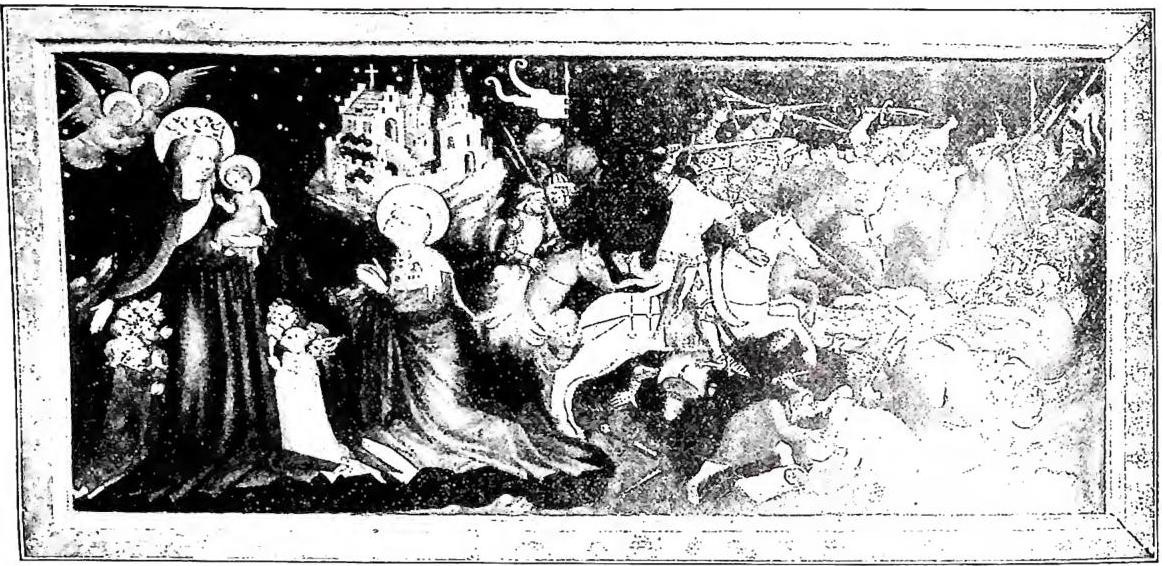
AUSTRIA - Votive panel from the convent of St. Lambrecht (c. 1450), by Hans von Tübingen - Graz, Gallery.
Following the Congress of Vienna (1815) and the establishment of the reactionary system of the “Holy Alliance,” there arose, after the experiences of the period, a need to turn to the Church and religion as guarantees and foundations of the State. Hence the famous motto “Throne and Altar,” which might serve, in a certain sense, as the denominator of the subsequent period up to the fall of the empire.
The period up to the revolution of 1848, the so-called “Vormärz,” is characterized on the one hand by a continuous state domination over the Church, though in a gradually decreasing measure, even though among the higher bureaucracy the true Josephinism persisted for a long time; on the other hand, a growing Catholic reaction began, which had found, as early as 1808 and precisely in Vienna, an outstanding promoter in the person of the Redemptorist St. Clement Mary Hofbauer. He knew how to gather around himself the best forces of the nobility, the most distinguished figures in politics, science, literature, university youth, and the “Hofbauerkreis” (Hofbauer circle) became one of the most effective causes of the Catholic restoration (F. Schlegel, philosopher; Ad. Müller, politician; Gius. Klin-kowstrom, pedagogue; Zace. Werner, Em. Veith, sacred poets and orators; not to mention the Eichendorffs, Brentanos, Günthers, Baaders, and others). The reformer of history, Bishop Rom. Seb. Zangerle, was a disciple of the Saint, as was Gregorio Ziegler, Bishop of Linz, and above all the famous Otmaro Gius. Rauscher, Bishop of Graz, later of Vienna and cardinal. But new forces also began to arise in the provinces; the Redemptorists, founded by the Saint (1820), and the Jesuits, readmitted in 1826, contributed significantly to this with their missions and spiritual exercises for the people and clergy. Even among the secular clergy a certain revival took place (Schlor in Graz, Archbishop Gruber in Salzburg, the venerable Tschiderer, Bishop of Trent, and others).
The year 1848 brought the entire system of absolutism crashing down; it plunged into full liberalism, to the extent that in certain ecclesiastical circles even Josephinism was regretted, since, at least in its moderate form, it had guaranteed the Church a certain freedom of action and rights. In 1855, the Concordat was finally concluded, negotiated, overcoming few oppositions (the Hungarian bishops) especially thanks to Archbishop Rauscher of Vienna and the Minister Count Thun. The Concordat had the misfortune of being tied to a new period of state absolutism, which ended in 1876, after which the establishment of the parliamentary system, with all its succession of parties—liberal, national, social, democratic—in constant struggle with one another, in constant shifts of alliances and oppositions, soon involved the Church in political strife. After the fratricidal German war of 1866, there was a growing pressure from the various nationalities composing the Austrian Empire and from German (Protestant-liberal) nationalism. In 1868, laws on marriage, mixed schools, and freedom of worship were enacted without any agreement with the Holy See; against these, Pius IX protested in the allocution of June 22, 1868. Finally, the dogmatic definition of papal infallibility in 1870 gave the Beust ministry the pretext to unilaterally denounce the Concordat, because (as stated in the imperial decree of abrogation) the Concordat “has lapsed of itself, by virtue of the most recent declaration of the Holy See on the plenitude of the power of the Supreme Head of the Catholic Church.” The vehement struggles over schools, the religious character of marriage, and other issues led almost to a true “Kulturkampf” (various laws were arbitrarily enacted, especially in 1874, on Church relations, ecclesiastical benefices and patronage rights, the exercise of parochial ministry, etc.), but the personal attitude of Emperor Francis Joseph and some of his direct interventions (he, for example, prevented the arrest, already ordered by the government, of the Bishop of Linz, Fr. G. Rudigier) spared Austria the violent outbreak of the struggle. The ecclesiastical laws, in fact, although enacted unilaterally in violation of the Concordat, were on the whole anything but hostile to the Church; so much so that Leo XIII, in a letter of June 15, 1887, to Cardinal Rampolla, his Secretary of State, could affirm that the “outstanding piety” of the Emperor and “his devotion to the Holy See... ensures that the best relations exist between the Holy See and that empire.” Meanwhile, Catholic organizations grew in strength (Vogelsang and the Catholic conservative party; Lueger and the Christian-Socials), the press (Vaterland, Reichspost; the “Presseverein” in the provinces); even the religious life of the people, somewhat decayed under liberalism, revived (religious organizations of the most varied kind, missionary work, the S.J. Fathers (v.), Redemptorist Freund, numerous educational and charitable Catholic institutions of Orders and Congregations, etc.), as well as the activity of Catholics in the cultural, scientific, and literary fields (Kralik and the “Gral,” the “Leogesellschaft,” etc.). The “Los-von-Rom-Bewegung” (anti-Roman movement) at the close of the 19th century, the growing Protestant-tinged liberalism of the German-speaking bourgeoisie, and the socialist labor movement alienated many from the Church, which appeared increasingly tied to the actions of Catholic parties, not without serious detriment to its independent activity. Another grand manifestation of Austrian Catholicism before the world occurred in 1912, with the International Eucharistic Congress.
The internal revolution of 1918, the inevitable collapse of the Habsburg monarchy, and the disintegration, with it, of so many centuries-old institutions, ties, and orders, produced for many years in the new small Austrian republic severe political convulsions and put the entire activity of the Church to a hard test.
The external life, although the Austrian Constitution of 10 Oct. 1920 recognized many of the Church’s rights, was difficult because of many prejudices, fostered especially by the states that succeeded the monarchy; its internal life was even more difficult because of the disastrous economic situation and the struggles among the parties. Among these, the socialists showed themselves ever more openly atheistic and anti-religious, while the German-nationalists inclined toward the absorption of the small republic into Germany and never concealed their hostility toward the Catholic Church; only the Christian-Socialists indefatigably sought a reconstruction of the new Austria on a Christian basis. Unforgettable was the work successfully carried out, especially in the field of international politics, by the chancellor, Monsignor Ignaz Seipel, who thus laid the foundations on which could arise the political construction, of a distinctly Catholic character, of Chancellor Engelbert Dollfuss. It was only natural that the Church should give its full support to such a policy, inspired by the directives of the Gospel and of the Popes for a truly Christian socialism. As this political work was perfected, so too grew the purely religious, social, and cultural activity of the Church itself (one recalls, in the Exhibition of Catholic Press in Rome, the Austrian hall; the liturgical movement, with its center in Klosterneuburg, directed by Fr. Pius Parsch; the academic union).
The Christian policy of Dollfuss was crowned by the new Constitution of the Austrian Confederation (Österreichischer Bundesstaat) based on corporations (Ständestaat), with an equitable distribution of powers and rights among all classes of the population, with Catholic principles for education, marriage, and social legislation; and by the new Concordat, published together with the Constitution on 10 May 1934.
The Concordat, negotiations for which had begun on 17 March 1931 and which was signed on 5 June 1933, is one of the most complete and perfect known. Its spirit is summarized in the first three paragraphs of article 1: “The Republic of Austria assures and guarantees to the Holy Roman Catholic Church, in all its rites, the free exercise of its spiritual power and the free and public exercise of worship. It recognizes to the Catholic Church the right to issue, within the scope of its competence, laws, decrees, and ordinances; it shall neither prevent nor render difficult the exercise of this right. In the fulfillment of their spiritual ministry, ecclesiastics shall receive the protection of the State.” Among other fundamental provisions, one notes: the recognition of the Catholic Church as a public-law corporation (art. 2; cf. art. 29 of the Constitution of 1934); and the referral to canon law for all other matters, relating to ecclesiastical persons and things, not treated in the Concordat (art. 22).
The laws enacted by the Austrian Republic for the implementation of the Concordat in some points seem to diverge somewhat from the concordatory provisions (the marriage law of 1934 is modeled in part on that of Italy of 1929).
But while Catholic Austria once again attempted to revive itself according to its centuries-old glorious religious traditions, the pressure of National Socialist Germany under Hitler began to be felt more and more, with every kind of violence, such as the attack and death of Dollfuss (25 July 1934). Finally, the small republic succumbed in the so-called “Anschluss” of 13 March 1938, which made the name “Austria” disappear along with all the Catholic works and institutions of the country. From that time on, Austrian Catholicism shared the religious fate of Catholicism in the “Greater Reich,” until the liberation and the recovery of the country’s independence in 1945, independence that was somewhat precarious because of the quadripartite occupation and its inevitable consequences. The establishment, however, of the central government and of the governments in the individual provinces, elections to the chambers, and constitutional life were permitted, based, however, on the Constitution of 1920.
The recovery, both material and spiritual, after the Nazi oppression
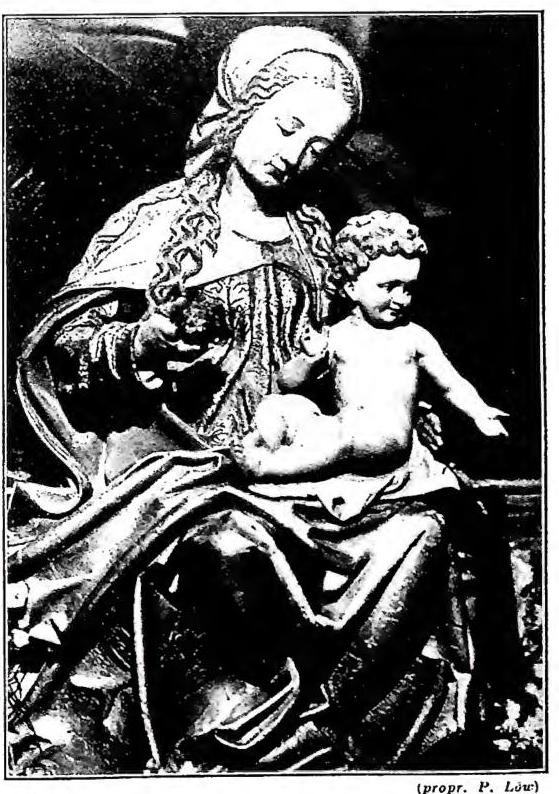
Austria - Madonna, statue by M. Pacher; the Child is from the 19th century - Salzburg, high altar (1486–98) of the Franciscan church.
and all the damage of the war, is very arduous. The Catholic Church, aware of its mission, aids these efforts at regeneration by expanding its specifically religious activity toward the organization of charity in all its most modern forms and of social works. Noteworthy are the “Wiener kath. Akademie,” founded in 1944, to cultivate, from the standpoint of Catholic doctrine, the sciences and scientific research; the “Kath. Laienjahr,” an institute that arose under Nazi pressure (1940) and was rebuilt in 1945, with a two-year course for the formation of lay people to assist in the priestly ministry; the “Seminar für kirchliche Frauenberufe,” established by the conference of the Austrian episcopate in 1947 in Vienna, for the formation of women in all works of charity, social relief, and religious instruction. At Salzburg, the Benedictines of the archabbey of St. Peter, under the direction of the episcopate, have founded an “Institutum liturgicum” to guide the liturgical movement on a secure basis toward a broader action among the people. The Nazi period, with the oppression exercised by the regime and the resistance of the Church, is described and documented in the works of K. Rudolf, *Aufbau im Widerstand; ein Seelsorge-Bericht aus Österreich 1938–1945*, Salzburg 1947, and of J. Fried, *Der Nationalsozialismus u. die kath. Kirche in Österreich*, Vienna 1948.
Statistical Information. — After the war, Austria extended over 83,868 sq. km., and, according to the census of 1934, had 6,760,233 inhabitants (in 1939 another census gave 6,880,800); Vienna, the federal capital, had 1,874,130 inhabitants.
Of these, 6,112,658 were Catholics, that is, 90.5%; the rest were: Evangelicals (of the Augustan or Helvetic confession) 295,452; Israelites 191,481; Old Catholics 36,776; without religion 106,080; others 7,105. The ecclesiastical circumscription comprises two metropolitan sees: Vienna, with the suffragans of Sankt Pölten and Linz; Salzburg, with Gurk (residence in Klagenfurt), Seckau (with residence in Graz), and two apostolic administrations: Burgenland (under Vienna), and Tyrol-Vorarlberg, with seat in Innsbruck; according to the Concordat, Innsbruck was to have been elevated to a diocesan see, but events did not permit the execution. There are counted 6 minor and 4 major seminaries; in addition, 4 faculties of theology (Vienna, Graz, Innsbruck, and Salzburg); there are religious (of 37 Orders) 3,600; and religious women (of 54 Orders) 16,200. Catholics directed 1,050 private schools. Further statistical material is found in: C. de Waal, *General-Schematismus der kath. Pfarrämter und Ordensniederlassungen in Österreich*, Innsbruck 1934; J. Gurtner, *Der Sächsikerlaus und die religiösen Orden Österreichs*, Vienna 1934; *Ecclesia-Almanach* 1948, ibid. 1949, useful for the latest ecclesiastical statistics.
Interesting information on the geographical, geopolitical, and geocultural situation is in H. Gsteu, *Länderkunde Österreichs*, 2nd ed., Innsbruck-Vienna 1948, with an excellent rational bibliography.
For general information on political history, the following works are recommended:
F. Krones-M. Uhlirz, Österreichische Geschichte, 4 vols., Berlin 1915–23;
— More concise: H. Hantsch, Geschichte Österreichs, I (only volume published), 2nd ed., Innsbruck 1947 (covers up to 1948, with an excellent bibliography). For the subsequent period, one may consult the fine study by the same H. Hantsch, Die Entwicklung Österreichs, Ungarns zur Grossmacht (Herders Geschichte der führenden Völker, 15), Freiburg 1933. The history of the last decades, and especially of the final period in the political existence of Austria, is masterfully traced in K. Schuschnigg, Dreiund Österreich, Vienna 1937.
Those seeking information on the broader cultural history of Austria, in all its ramifications (art, religion, commerce, science, etc.), will profit greatly from F. M. Mayer-F. R. Kaindl-H. Pirchegger, Geschichte und Kulturleben Deutschlands, 3 vols., 2nd ed., Vienna 1929–37, with extensive bibliography; or the collection of monographs, all by leading authors, edited by J. Nadler-H. V. Srbik under the title: Österreich: Erbe und Sendung im deutschen Raum, Salzburg-Leipzig 1936. Each article is accompanied by a critical bibliography.
As for the sources of Austrian ecclesiastical history, much material has been collected in the various volumes of the Monumenta Germaniae Historica (see the indices); yet the work of H. Pez, Scriptores rerum austriacarum, 3 vols., Leipzig 1721–45, still retains its full value in many respects.
For ecclesiastical history, one should also note the work of A. Klein, Geschichte des Christentums in Österreich und Steiermark, 7 vols., Vienna 1840–52; among more recent works: C. Wolfsgruber, Kirchengeschichte Österreichs-Ungarns, ibid. 1909; and above all the unfortunately incomplete work by F. Tomek, Kirchengeschichte Österreichs, I (the only volume published), 8vo, 1935, which extends to the year 1500, with a rich bibliography, lists of bishops, and of mother-parishes. Extremely useful supplements are found in J. Thaurer, Atlas der kath. Missionsgeschichte, St. Gabriel 1932; and in the rich collection of maps and diagrams prepared by G. Lüdicke-L. Mackenzie, Deutsche Kulturatlas, the section: Katholische Religionsgeschichte, Berlin 1934.
Special mention should be made of the Austrian Historical Institute in Rome, founded in 1881 by Theodor von Sickel, renowned editor of the Liber diurnus (Vienna 1889), and later directed by Baron L. von Pastor, the noted historian of the popes. For a list of the Institute’s publications, see Ph. Denzel, Das Österr. Hist. Institut in Rom, 1901–1913, Vienna 1914, p. 61; 3rd ed.: H. Kramer, Das Österr. Hist. Institut in Rom, 1881–1931, Rome 1932, p. 45.
For the most recent history, see J. Hollenstein, Das Konkordat, Leipzig-Vienna-Berlin 1934; and G. di Meglio, De novissimo Austriae regimine, Vatican City 1936.
Regarding archaeology, it should be noted that archaeological excavations are officially supported and published by the Austrian Archaeological Institute, which has also conducted celebrated excavations abroad, such as at Ephesus, Salona, and elsewhere. A good synthesis of what pertains to the classical and early Christian periods in Austria is found in R. Egger, Die österreichischen Länder im Altertum, in Nadler-Srbik, Österreich (cited above); id., Die frühchristliche Kunst in Österreich, in K. Ginhart, Die bil
