
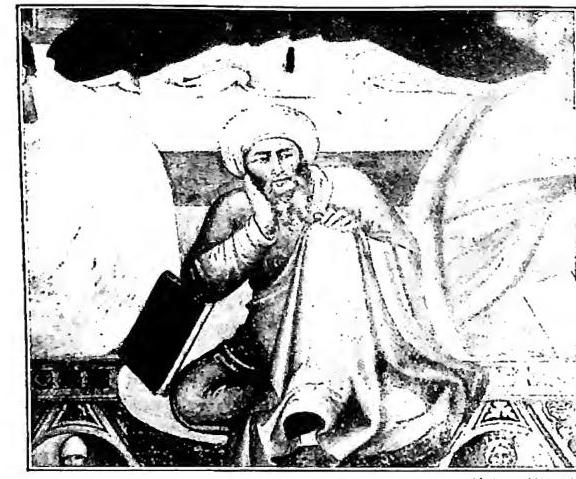
Florence, Spanish Chapel in Santa Maria Novella.
And so it continues, until it reaches the moon, which is moved by the human intellect. The human intellect, as the mover of the moon and the illuminating force that renders each individual soul’s sensible species intelligible according to its dispositions, is identified with the active intellect spoken of by Aristotle; and, as the mirror that reproduces and receives the knowledge acquired in each individual, it is called material or acquired (ὁλκάς). This is to be identified with the “passive” intellect of Aristotelian terminology or the “possible” intellect of other terminologies. The passive intellect is therefore not a certain “preparation” residing in the individual soul, as Alexander of Aphrodisias claimed in his interpretation of Aristotle, but it too is substantially separate from each soul, like the active intellect, and is unique for all souls. The union (coniunctio or copulatio) established between these and the intellect results from the illuminating action that the intellect exercises upon the sensible images proper to each individual, and thus the union occurs through the continuation of the intellect’s intention with us (*De Anima*, ed. Venice, p. 164, V. A.), and is purely accidental. Deeper unions, though still not substantial, occur when the individual participates in abstract essences (mystical knowledge and prophetic illumination). The human intellect, in the final analysis, is absolutely impersonal and, consequently, so is its survival. This doctrine of the single intellect thus certainly negates the immortality of individual souls, and it was around this negation that the heterodox Aristotelianism of the 13th and 14th centuries, known as Latin Averroism, gathered. It should be noted, however, that A. never explicitly deduced the perishability of individual souls from the theory of the single intellect, and it must also be observed that, as he himself confessed, his thought on this matter remained in grave turmoil.
Regarding the relationship between religion and philosophy, A.’s position—contrary to what many believed in the Middle Ages—cannot be accused of impiety. For him, philosophy and revealed religion express the same and identical truth, albeit through different language and methods. The Qur’an, according to A., presents philosophical truth itself through allegories, which are excellent for convincing the unlettered; but it is the task of philosophy, if it wishes to convince the learned of the same truths, to derive from the reading of the Qur’an a scientific interpretation of religious dogmas by stripping them of the deceptive garments of allegory. This position of A., perhaps not always clearly expressed by him, is the source of the doctrine of the double truth that is reproached in some of his Latin admirers of the 13th–14th centuries.
A critical edition of A.’s Latin translations, together with those of the Arabic-Latin versions of Aristotle, has recently been entrusted to the Mediaeval Academy of America. On this subject cf. H. A. Wolfson, *Plan of the Corpus Commentarium Averrois in Aristotelem*, in *Speculum*, 1931, pp. 412–27; *Bull. de la Classe des lettres de l’Académie royale de Belgique*, 18 (1932), 5th series, pp. 345–64; 23 (1937), pp. 294–97; 24 (1938), p. 265.
There is no satisfactory comprehensive study of A., but only a few monographs on particular topics. Thus, the old book by E. Renan, *Averroès et l’averroïsme* (2nd ed., Paris, 1861; the 1st ed. is from 1852; later editions reproduce it without changes) concerns more the history of Latin Averroism than A.’s personal doctrines; L. Gauthier, *La théorie d’Ibn Rochd sur les rapports de la religion et de la philosophie*, Paris, 1909; A. Manson, *La théorie aristotélicienne du temps chez les péripatéticiens médiévaux, Averroès, Albert le Grand, Thomas d’Aquin*, in *Rev. Néoscol.*, 36 (1934), pp. 275–307; C. Nallino, s.V. in *Enc. Ital.*, V, pp. 624–27, which contains extensive information on editions, translations, and studies; rich in bibliographical details as well is the article by M. M. Gorce, *Averroïsme*, in *DHG*, V, cols. 1032 ff., though this too is devoted especially to tracing the history of Latin Averroism; M. De Wulf, *Histoire de la philosophie médiévale*, I, Louvain, 1936, pp. 305 ff. For more recent indications, consult the indices of the *Bull. de théologie ancienne et médiévale* from 1937 onward.