
BACCIA — The Virgin Presenting the Child to St Anne. Oil painting on a probable design by G. L. Bernini. Rome, church of S. Francesco a Ripa.
THE B. IN SACRED ART. — Medieval sources, from the Statuta antiqua of 500 B.C., often mention the liturgical b. (bacinum, aquamani, pelvis, concha, patena, discus, manipulus, lanx, fons), which differs from others only in its decoration, where Christian motifs appear. Examples include Eastern plates from the 6th–7th centuries depicting the Communion of the Apostles (e.g., those from Riha in the Dumbarton Oaks Collection and from Stuma in the Constantinople Museum) or angels before the Cross (Leningrad, Hermitage; London, British Museum; New York, Metropolitan Museum, from Cyprus). Other silver plates are simpler in decoration, such as those from Ostia (4th century, Vatican, Museo Sacro), Canoscio (Perugia, Soprintendenza), Poltava (Leningrad, Hermitage), Lampsacus, and Sutton Hoo (London, British Museum), and Hamah (Baltimore, Walters Art Gallery). The plates from the treasure of Nagy Szent Miklós with 9th-century Bulgarian inscriptions (Budapest, National Museum) were rather for secular use. A large number of bronze b., similar in form and decoration to Coptic types, were also found in barbarian tombs of the 6th and 7th centuries.
Numerous and varied in form are the b. of the early Middle Ages; many treasures preserve brass b. with allegorical representations, perhaps made in northern Germany (e.g., some in the Padua museum), which served, besides for the *lavabo*, perhaps also for Baptism. From the 14th century to the Renaissance, the schools of Flanders, the Rhineland, and from the 15th century Nuremberg produced b. often with hammered scenes (*Beckenschlägerei*), intended for export, especially to Spain and Italy.
consequently a freer chromatic vision of form, though always with firm plasticity, so as to allow the rhythmic flow of the outline for a musical harmony of effect.
The Four Allegories of the Virtues in the pendentives of S. Agnese at Piazza Navona (1668–71) represent the painter’s first complete affirmation of style: followed by the decoration of the ceiling of S. Marta (1672; the two side roundels executed by another hand) and the grand decoration of the Gesù (1672–83; comprising the frescoes of the vault, dome, pendentives, apse conch, and the vault of the chapel of S. Ignatius), commissioned from B. by the General of the Order, Fr. Oliva. In the fresco of the vault, with the Triumph of the Name of Christ, B. avails himself of his skill in foreshortening and the magnificent material of his colour to achieve the boldest conception of masses in motion, sweeping away every architectural term in a manner analogous to what Bernini had achieved in the Chair of St Peter: the decorative tradition summed up by Pietro da Cortona himself was thus thoroughly renewed, opening the way to subsequent developments.
To the same period as the works in the Gesù belong some of B.’s noblest canvases (St John the Baptist in the Wilderness, in S. Niccolò da Tolentino; St Louis Bertrand, in S. Maria sopra Minerva; Death of St Francis Xavier, in S. Agostino at Ascoli Piceno; Nativity, in the Carmine at Fermo; Christ and the Samaritan Woman, Spada Gallery); while in his later activity, purely decorative values sometimes prevail, accentuating theatrical effects (Birth of the Baptist, in S. Maria in Campitelli; St Nicholas of Bari, in S. Maria Maddalena, 1697–98), subduing the vitality of colour to bring it back
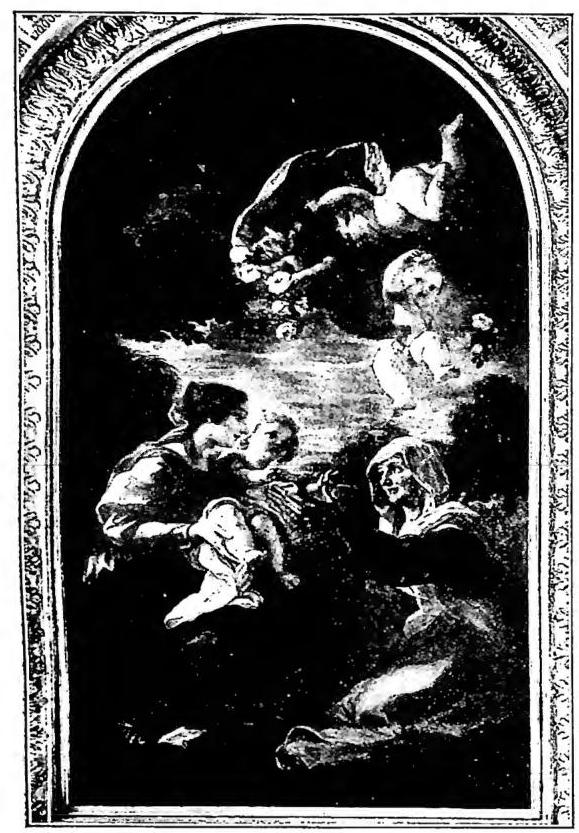
Baciccia — The Virgin Presenting the Child to St Anne. Oil painting on a probable design by G. L. Bernini. Rome, church of S. Francesco a Ripa.
to a more restrained northern style. More precious are the enamelled copper b. of the Limoges school of the 13th and 14th centuries, often found in pairs with identical decoration (Vatican, Museo Sacro; Paris, Musée Cluny; collections in Dresden, Baltimore, London, etc.).
In the Renaissance, the liturgical b. was used especially in pontifical Mass; it became larger, very heavy, and often decorated with engraving or embossing. Almost all great treasuries preserve rich examples of b. made together with the ewer (Vatican, Sistine Chapel; Siena, Duomo, etc.). Neoclassicism also changed the taste for the form of the b., which became simpler and was almost always paired with the ewer (Vatican, Museo Sacro).