
BALAAM (Heb. Bil'am). — A magician, son of Beor, from the city of Pethor on the right bank of the Euphrates in Mesopotamia (Num. 22:5; 6; cf. Deut. 23:5), probably to be identified with the Pitru of Assyrian monuments and the Pedru of the annals of Thutmosis III (c. 1500 BC).
He was the protagonist of an episode described at length in Num. 22–24, and to which reference is made in Deut. 23:4–5; Josh. 13:22; 24:9–20; Mic. 6:5; 2 Pet. 2:15; Jude 1:11; Rev. 2:14.
Toward the end of their forty-year sojourn in the desert, as the Hebrews advanced eastward from the Dead Sea and the lower Jordan, having defeated the Amorite kings Sihon and Og, they camped in the plains of Moab. Balak, the local prince, fearing the same fate as the two previous kings, urgently sent an embassy to Balaam to come at once and curse Israel with his magical power (Num. 22:5–6). Balaam at first refused to go, citing a prohibition received from the Lord, whom he had consulted during the night. New messengers renewed the king’s invitation; Yahweh then permitted him to accept, on condition that he would do whatever was commanded of him. But as the seer set out, God, angered, obstructed his journey by means of His angel (Num. 22:18, 22). For what reason? The text, as it stands, offers no explanation. Perhaps Balaam, in his heart, was no longer disposed to observe the condition imposed by Yahweh, now tempted by the generous promises of the one who had invited him (2 Pet. 2:15 particularly accuses him of venality). The donkey on which Balaam was riding could no longer take a single step along the straight path because the angel stood before II. Beaten by its master, the animal miraculously spoke, complaining. God then allowed Balaam to see the angel, who vindicated the donkey.
Having corrected his intentions, the seer—chosen exceptionally as an instrument of divine revelation—arrived before Balak, who immediately took him to the heights of Bamoth-Baal, from which the vast encampments of Israel could be seen.
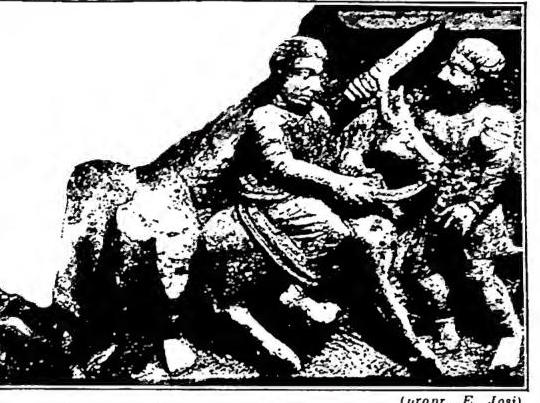
Balaam – Detail of a 4th-century sarcophagus. Rome, Basilica of St. Sebastian.
He sacrificed a bullock and a ram on each of the seven altars erected by him on the spot, and having entered into communication with Yahweh, instead of cursing, he solemnly blessed Israel, justifying himself by saying: “Am I not bound to speak only the words that Yahweh puts in my mouth?” (Num. 23:11–12). Shortly afterward, on two new heights, he blessed and exalted Israel two more times.
The king, dismayed and terrified, begged him to leave. But Balaam renewed his gesture a fourth time, foretelling among other things: “A star shall rise out of Jacob, a scepter shall come forth out of Israel” (Num. 24:17); an oracle announcing the appearance in the chosen people of a person of outstanding splendor (symbolized by the star: cf. Gen. 49:10; Isa. 14:2; Rev. 22:16), a “scepter-king” of power.
The sacred writers cited above, along with Catholic and rabbinic tradition, have recognized the entire biblical narrative of Balaam as historical. The Fathers, both ancient and modern Catholic exegetes, have interpreted the aforementioned prophecy in a messianic sense. The same is true of rabbinic tradition (Targum of Onkelos). Notable is the fact that, with a large following, R. ‘Aqibah (d. AD 135) and other learned rabbis regarded Bar Kokhba, leader of the final national uprising of the Jews (AD 132), as the Messiah, called “son of the star,” precisely because he claimed to fulfill the messianic prophecy of Balaam.
After delivering his oracles, the seer returned to his own land (Num. 24:25).
Near Shittim, Israel was led astray by the women of Moab and the neighboring Midian (Num. 25:1–17) into idolatrous festivals and debauchery. It was Balaam himself who had incited these women to cause Israel to fall into Yahweh’s disfavor (Num. 31:16); and he does not seem to have abandoned idolatry, for he had not blessed the chosen people of his own accord!
To avenge the scandal, Moses waged a holy war against the Midianites, killing five of their princes. Balaam himself perished in their ruin (Num. 25:16–17; 31:1–16). He must therefore have lingered in Midianite territory on his return journey, since the events of Num. 31 follow closely upon those of Num. 22–25 (chapters 26–30, apart from the census account, contain only legislative elements).
---
CHRISTIAN ARCHAEOLOGY. — The prophet Balaam was sometimes depicted in early Christian monuments, always following the account given of him in Num. 22:22–35 and 24:17. From a typological standpoint, the earliest scene is that referring to the prophecy of the star and its fulfillment, namely the well-known scene in the Priscilla cemetery, hitherto interpreted as Isaiah, but comparison with contemporary texts suggests identification with the prophet Balaam, the only one to speak of the star (*orietur stella ex Iacob*); Isaiah, by contrast, speaks only in some places of light, never of a star. It should also be noted that in the marble slab of Severa in the Lateran Museum the star is that of the Epiphany; now it is precisely Balaam, and never Isaiah, whom the Fathers cite when dealing with the Epiphany. This scene is also found in some Christian sarcophagi. A shortened version appears in paintings in the cemetery of Saints Marcellinus and Peter, where the prophet Balaam is depicted pointing to the star.
A rare example is the sarcophagus found in St.
Sebastian, where he is presented as the first king of Moab (Num. 21:26): he may have been Balak’s predecessor or Balaam himself. Upon learning of the irreparable defeat of his erstwhile powerful enemy, he was seized with fear, unaware that God had forbidden the Israelites to attack Moab (Deut. 2:9). The figure of Balaam also appears in medieval art, both in scenes with the donkey and as an isolated figure, as in the cathedral of Siena where he is represented in the pulpit by Nicola Pisano, or with the Queen of Sheba at Chartres, or alone in the capitals of Moissac.
---
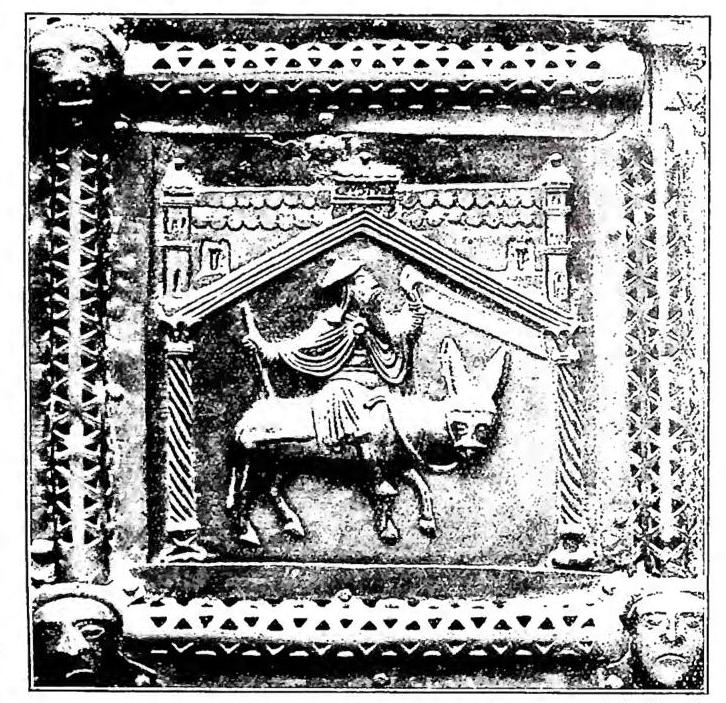
BALAAM. — Detail of the bronze door of S. Zeno (11th cent.) — Verona.