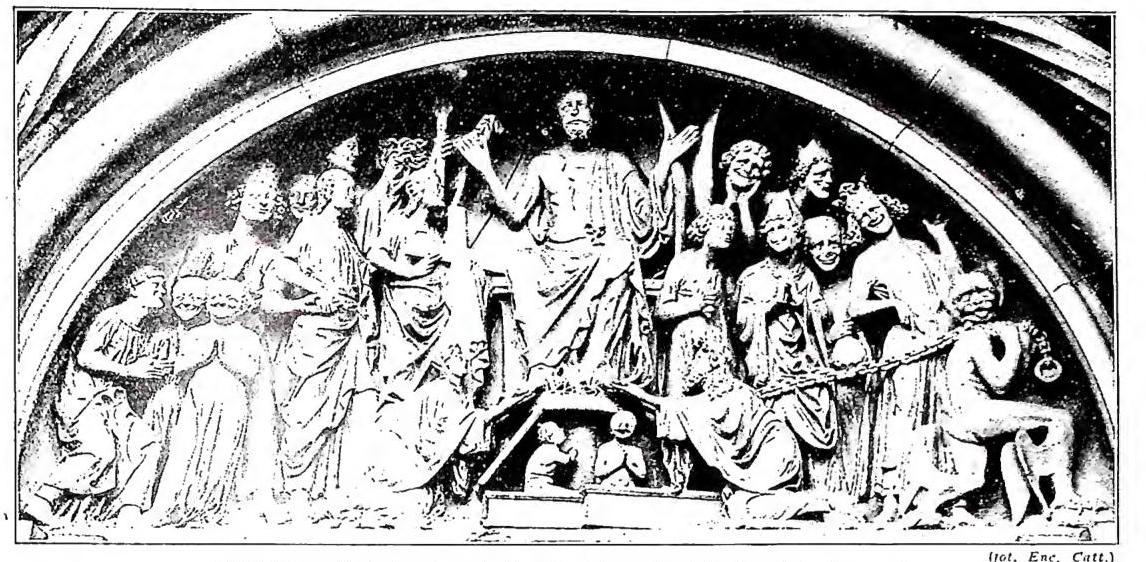
BAMBERG — Last Judgment. Lunette of the cathedral portal (13th century).
The diocese of Bamberg was hard hit by the Reformation. In 1528 Nuremberg and the Margraviate of Ansbach-Bayreuth broke away from Bamberg by accepting the new faith. Of the 190 independent parishes, 105 with their dependent churches passed to Protestantism during the 16th century. The diocese then suffered greatly from the Thirty Years’ War and the Seven Years’ War, as well as from Napoleon’s campaigns. In 1802 the ecclesiastical principality of Bamberg was secularized and incorporated into the Kingdom of Bavaria. In 1808 the diocese was enlarged by 42 parishes formerly belonging to the diocese of Würzburg, and following the Concordat between the Holy See and Bavaria of 5 June 1817, it was raised to an archdiocese with the dioceses of Eichstätt, Speyer, and Würzburg as suffragans.
Among the bishops of Bamberg worthy of note are: Eberhard I (1007–40), who served as chancellor to Henry II (1005), founded the collegiate chapter of St Stephen (1009), and converted the pagan Wends; Suidger (1041–47), who became pope under the name Clement II (1046) but retained governance of his diocese; St Otto I (1102–39), a true reformer of the diocese who founded and restored about thirty monasteries; his name became renowned for the conversion of the Pomeranians (1124–27); Johann Gottfried von Aschhausen (1609–22), under whom the Catholic Reformation made good progress; he invited the Jesuits (1611) to take charge of higher education and the seminary, conducted pastoral visitations, introduced popular missions and Marian sodalities, and was also bishop of Würzburg (1619); Friedrich Karl von Schönborn (1729–40), imperial vice-chancellor and also bishop of Würzburg, famed for the magnificent buildings he commissioned (the chapter house, the civic hospital, the seminary, the restoration of the town hall, the residence palace in Würzburg, and Werneck Castle) and for his generosity toward all cultural undertakings; under his rule the diocese enjoyed a period of true religious prosperity; Franz Ludwig von Erthal (1779–95), one of the greatest princes of his age, likewise held both sees of Bamberg and Würzburg. He visited every parish and founded several institutes of a cultural and social character, showing himself a precursor of modern welfare work.
THE SYNODS OF BAMBERG — The most effective expression of ecclesiastical governance was the assemblies and synods held up to the year 1200. Two popes attended them: Benedict VII (1020) and Leo IX (1052). In 1135 Emperor Lothair was reconciled during the synod with the Hohenstaufen and thereby secured the unity of the empire. During the synod of 1147 the body of St Henry II was transferred to the cathedral, and in 1200 the canonization of St Cunigunde was celebrated. In 1451 CAUSA (v.) attended the synod to settle disputes between the secular clergy and the mendicant orders over Easter confessions.
ABBEYS AND MONASTERIES — Notable among them are: Michelsberg, a Benedictine abbey founded by Eberhard I (1015), renowned in the 11th century for its school of painting. Secularized in 1803, it now serves as a civic hospital. Banz, a Benedictine abbey founded by Margravine Alberada (1069), destroyed in the Thirty Years’ War and rebuilt under Abbot Otto de La Bourde (1164–67). After secularization it was sold to the dukes of Bavaria (1814). From 1920 to 1926 the German Trappists, expelled from Alsace, found refuge there. Michaelsfeld, a Benedictine abbey founded by St Otto I (1119), now an institute for the deaf. Vierzehnheiligen, one of Germany’s most famous pilgrimage sites (120,000–150,000 pilgrims annually), founded in 1448. The present church was built between 1743 and 1772 to a design by Balthasar Neumann.
CULTURAL INSTITUTIONS AND MONUMENTS — As a center of culture Bamberg had a university founded by Bishop Melchior Otto Voit von Salzburg (1648). Bishop Friedrich Karl von Schönborn added the faculty of law, and Franz Ludwig von Erthal that of medicine. The university was suppressed in 1803. The principal monument is the cathedral, standing atop a hill and dominating the city and its surroundings with its four towers rising 81 meters high. Together with the old and new episcopal palaces (Renaissance of the 16th century and Baroque of 1704) and the old canons’ houses, it forms a harmonious ensemble. Founded by Henry II, it was consecrated in 1019. After fires in 1031 and 1185 it was rebuilt in its present form, in a transitional style between Romanesque and Gothic, and reconsecrated in 1237. In 1924, the ninth centenary of the death of St Henry, it was raised to the rank of a minor basilica. It has two choirs and is richly adorned with sculpture. Notable is the so-called Bamberg Horseman, an equestrian statue in the choir of St George whose author and the identity of the figure represented are unknown. The monument to the founder of the cathedral and his consort St Cunigunde is the work of Tilman Riemenschneider. Among the many tombs are those of Emperor Conrad II and of Clement II, the only pope buried in Germany. — See Pl. L.