
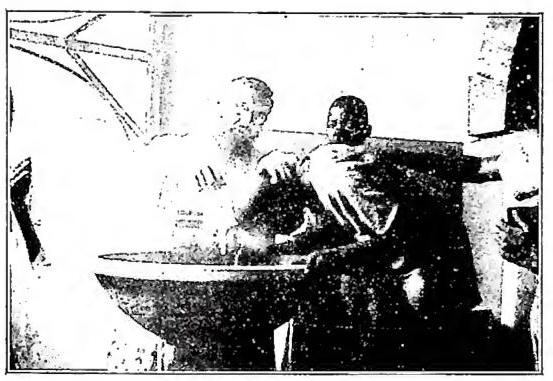
**BAPTISM – B. of an Indigenous Person – Mission of Punta, Congo, Apostolic Vicariate of Stanley Falls**
A simplified form with plural prayers is used when the number of catechumens exceeds ten.
Another issue of interest to the missions is the baptism of children born to non-believing parents. Numerous decrees and instructions on this matter have been issued by the Supreme Pontiffs, by the Sacred Congregation for the Propagation of the Faith, and by the Holy Office, which are almost summarized in can. 750 § 1. Among the various documents relating to this question, the instruction of the Sacred Congregation for the Propagation of the Faith dated April 17, 1777, holds particular importance (P. Gasparri, *Codici Iuris Canonici Fontes*, VII, Rome 1935, no. 4575, pp. 107-15; *Collectanea*, loc. cit., no. 522, pp. 319-23). It establishes: *«non licere nisi in articulo seu moraliter certo imminentis mortis periculo infantes infidelium filios, invitis seu inscitis parentibus, baptizare.»* This response clarified the practice followed by the Venerable Giovanni Martino Moyé of the Paris Foreign Missions Seminary, a missionary in China. During the famine, which claimed countless victims in the Apostolic Vicariate of Sutchuen in the years 1777-79, the Venerable Moyé, with the help of pious women, baptized a large number of children of pagan parents, and after the famine, he continued this practice, inspired by very broad criteria in this matter, which was the subject of debate among other missionaries.
On this matter, in 1779, Msgr. F. Pottier, Apostolic Vicar, and in 1780, Moyé himself, wrote to Rome to obtain a definitive decision on the issue. Meanwhile, the Sacred Congregation for the Propagation of the Faith had issued on April 17, 1777, the *«Instructio super dubiis nonnullis propositis quoad baptismum pro diversis cum personarum tum periculi circumstantiis»*, which resolved the question contrary to the practice followed by the Venerable Moyé and which reached the hands of Msgr. Pottier in the early months of 1782. The Venerable Moyé fully submitted to II.
**
**IV. ASCETICAL TEACHING ON BAPTISM**
The inexhaustible riches of the truths contained in the doctrine of Baptism and in the symbols that permeate its rites have led, from the earliest times, the Fathers and ascetical writers to study deeply the contribution these can make to the spiritual formation of souls, and Christian piety to establish practices that keep them alive in memory.
I. **LIVING ONE’S BAPTISM** – This means, first and foremost, becoming conscious of II. The child, when receiving the Sacrament, does not know what he receives; but as he grows in years, he must strive to understand ever more deeply the gift bestowed upon him. Baptism implants in the soul the divine life; but this is only like a seed; it is for the Christian to cultivate it until, in the words of St. Paul, he attains *«the measure of the stature of the fullness of Christ»* (Eph. 4:13). To live one’s Baptism, therefore, means to develop the riches contained in the seed, to grow Jesus Christ within oneself. This, which is fundamentally the vocation to holiness, is nothing other than the development of baptismal grace.
The imperatives that derive from this and constitute the application of the principle of *«living one’s Baptism»* can be reduced to four: 1) to avoid sin. *«Receive this white garment and bring it back unstained to the judgment seat of Our Lord Jesus Christ»* says the priest in the baptismal rite, placing a white linen cloth on the baptized. And St. Paul: *«Do you not know that all of us who have been baptized into Christ Jesus were baptized into his death? We were buried therefore with him by baptism into death, so that as Christ was raised from the dead by the glory of the Father, we too might walk in newness of life»* (Rom. 6:3-4). 2) to cultivate a filial spirit toward God. *«You have received the Spirit of adoption as sons, by which we cry, ‘Abba! Father!’»* (Rom. 8:15). 3) to cultivate a spirit of sacrifice. Even after receiving the divine life, the Christian retains within himself the possibility of rebelling against right reason; he carries on his lips, with the possibility of giving it one day, the kiss of Judas; he must therefore be strong, struggle, and conquer, and this requires sacrifice. 4) to cultivate a spirit of apostolate. Once incorporated into Christ, all the baptized are united to help one another, and each must cooperate for the spiritual good of others.
II. **DEVOTION TO BAPTISM** – Various practices have been introduced by the Church and by Christian piety to keep alive the memory and thus recall the spirit and promises made at the reception of the Sacrament: 1) to solemnize the date, not only of birth, but of Baptism. The first recalls the entry into the human family; the second, the far more important entry into the divine family. 2) to renew baptismal vows. This can be done privately or by participating in the ceremony held at the beginning of each year, or on the occasion of solemn communions, or the administration of Confirmation. To renounce Satan—that is, to resist the seduction of perverse ideas, so widely spread—is a daily necessity. Therefore, ratifying the pact pronounced in our name by the godfather or godmother is an action that imposes itself upon the Christian who understands what he is doing.
**
**V. ICONOGRAPHY AND FOLKLORE OF BAPTISM**
I. **Iconography.** – The scene commonly called the Baptism was among the earliest New Testament scenes to enter into paleo-Christian art, both in sculpture and in the frescoes of the catacombs. Later, it passed quite naturally into the decoration of baptisteries and liturgical furnishings. Conceived according to a rather simple scheme, it was subject to variations and developments. A description that takes these into account must include among the essential elements of the composition, common to all monuments: the baptized, usually nude; the baptizer, whose clothing varies between the exomis tunic or an animal skin and the tunic with the pallium; an indication of the baptismal bath by means of the very nudity of the baptized and the water represented as a horizontal mass, as scattered sprays around the neophyte, or, in sculpture, as a vertical cascade, which from the 5th century becomes the historic Jordan; and finally, an allusion to the intervention of the Holy Spirit, depicted as a dove which, from the 4th century, can send a ray of light from its beak, and also in the imposition of hands, which is found everywhere except in those monuments where the Baptist helps Christ to rise from the waters of the Jordan. The pouring vessels found in a few ancient monuments are due to recent restorations. The criteria once accepted to distinguish the Baptism of Christ from that of a simple neophyte do not stand up to comparison with all the monuments; it can only be said that in certain cases the former serves as a prototype for the latter. Ancient representations contribute little or nothing to illustrate the different rites of immersion, infusion, or aspersion, because the purpose of art was not to represent a liturgical ceremony realistically, but to compose together the elements most suited to recall in the minds of the faithful the rite of Christian initiation, namely Baptism *«in water and the Holy Spirit.»*
**Iconography of the Baptism of Jesus.** — The theme of the Baptism of Jesus continued throughout the Middle Ages, and in the West it underwent no essential variations, whereas in the East it assumed a more anecdotal and narrative character: the 10th-century frescoes of Tozale Kilissé in Cappadocia influenced, through miniatures, especially Romanesque miniatures (e.g., the conical shape of the waters of the Jordan).
During the Romanesque period the theme underwent some modifications as it was employed in different ways and occasions from previous ones, such as for the decoration of capitals, tympanums, etc. Miniaturists, however, remained faithful to the iconographic tradition (Sacramentaries of Autun and Drogon, *Hortus deliciarum*), often passing down a bearded and blessing Christ. The number of attendant angels varies: in France one or two, in Italy even three (Baptistery of Parma) or four (S. Maria d'Arezzo). Sometimes the Baptist, dressed in skins and girded with a rope, baptizes Christ with a flask.
Later, the subject underwent iconographic variations stemming above all from the growing emphasis on the individuality of the artist and the picturesque taste that sought indistinct opportunities for expression: thus while Giotto (Padua, Scrovegni Chapel) expressed in the Baptism of Christ his human religiosity, Masolino adhered rather to tradition (Castiglione d'Olona) while still showing a taste for iconographic novelty; Verrocchio composed the scene against a luminous landscape with bursts of light, while Piero della Francesca imbued it with his absolute geometric and spatial rigor.
The setting of the scene then became enriched with plants, flowers, and small scenes, as demonstrated, for example, by Perugino, the Bellinis, and especially Tiepolo.
II. **Folklore.** — Popular tradition preserves, surrounding the ceremony of Baptism, a series of original customs which, almost as a supplement to the rite, serve to accentuate and color the festive and solemn character of the event and to highlight the entry of a new member into the Christian community.
As long as the child has not been baptized, in many regions, especially in central-southern and insular Italy, it is called a “Turk” or “little Turk,” or even a “pagan,” and when, after the sacred rite, the godmother returns the child to the mother, she pronounces the sacramental phrase: “You gave me a pagan, and I return him to you a Christian.” In the same sense, the Greeks call him δράχος, serpent, and if it is a girl, δράκαινα, little serpent, in the belief that the unbaptized child is not only a person in the devil’s power but indeed a devil himself.
In places where popular tradition is strongest, there is a tendency to hasten the date of Baptism as much as possible. The baptismal outfit for the newborn generally consists of a long gown and a white cap. It goes without saying that, even in this regard, there are many variations due to climate, environment, social status, individual taste, etc. The prevailing concept, however, is that of innocence (white) and the need to indicate the distinction of sex, so that even a stranger can immediately recognize whether it is a boy or a girl.
The institution of the godfather and godmother, or of the male and female sponsor of Baptism, held extraordinary importance in popular tradition. Although this custom is now fading in many places, until not many years ago in many villages the godfather was truly a “companion,” assuming in the family in which he stood sponsor for the newborn a place of very close spiritual kinship, almost superior to a blood relationship. In some regions, the number of godparents is doubled with another couple chosen from among the children of friendly families: in France these junior godparents are called “parrains babillauds.” It is customary for the two godparents to be the first to be informed of the onset of labor and the birth. In many places, it is the godfather who gives the newborn his name. In choosing the name, people often follow the norms of ancient tradition: first the paternal grandparents are “recalled,” then the maternal ones, then the uncles, i.e., the brothers of the father and mother, unless family circumstances, premature deaths, etc., lead to giving the name of other relatives or friends. This is one of the typical expressions of the sense of tradition and family cohesion among the common people.
In church, the newborn is held in the arms of the godfather (or godmother): at the moment when Baptism is conferred, the father moves away and stands a few steps below the sponsor (the mother never attends the Baptism and is found in bed, even if the ceremony is postponed for a long time after birth). The exit from the church gives rise to expressions of joy, the firing of guns, and the throwing by the godparents of sugared almonds or even hazelnuts, broad beans, wheat, and even money, all as signs and good wishes for prosperity and abundance. The throwing, with a sprinkling gesture, gives rise to contests among the children. Upon returning home, the procession follows the same order as on the way there, except that the priest is given the place of honor if he participates in the feast at the newborn’s home.
At home, then, is the moment for greetings and festive expressions, some according to ritual formulas. As mentioned earlier, the godmother returns the baptized child to the mother. The family offers a refreshment, more or less rich depending on their means. Characteristic are the offerings of sugared almonds, almonds, nuts, sugar-coated sweets, hard-boiled eggs, as well as wine or liqueur and coffee.
All this complex of customs and beliefs serves to give the ceremony of Baptism, in the simple soul of the people, a tone of moving poetry and intimate festivity. — See Plate LXV.