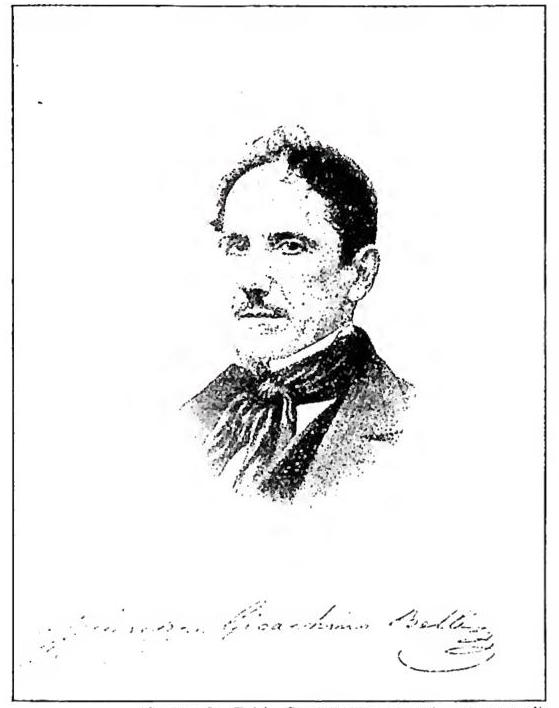
BELLI, Giuseppe Giacchino - Photograph with autograph signature. Rome, coll. V. Cianfarani.
to propose a model, but rather to give a faithful image of what already exists.»
In 1837 his wife died; he then became more than ever irascible and misanthropic: he left the Palazzo Poli, dismissed his servants, and retired to live with some relatives at Via Monte della Farina, no. 11. In 1840 he sought employment from the Pope and obtained a position as a collaborator in the secretariat of the Public Debt Administration, and in 1842 that of head of correspondence. In 1843 he deplored the assassination of Pellegrino Rossi; the following year, terrified by the revolution, he hurled a sonnet against Mazzini. In 1852 he composed twelve chapters and ten sermons against modern civilization and dedicated them to the editors of *La Civiltà Cattolica*. He translated the hymns of the Roman Breviary and composed two little poems in ottava rima on the Passion of Christ. He served as a theatrical censor and as treasurer of the St Vincent de Paul Conference.
The universal significance of B.’s poetry lies in the classicism with which the author frames the vast web of his vivid observations, penetrating environments where the contrast is exposed between the ostentatious manner of a noble tradition and the unprepared, artless attitude of the common folk, who attempt an interpretation of that other noble life, unfamiliar to them, without reverence or mystery. This new epic imposes itself through the delineation of hundreds of characters and scenes: it is the women of the markets, the artisans bound to the old city, who alternate with ecclesiastics and sovereigns in the mordant and earthy accents of the vernacular; it is the eternal contrast of great and small passions brought down to the level of art; a blend of religiosity and superstition, of liturgy and marketplace, of reserve and obscenity, sustained by the force of the dialogues, the spontaneous flow of the hendecasyllables, and the epigrammatic punch of the sonnet’s conclusion.
The edition of Belli’s *Sonetti romaneschi* by Morandi (Città di Castello 1886–89) and the unpublished poems edited by E. Vergara-Caffarelli and G. R. Ansaldi: *Centoventi sonetti roma-*