
BENEVENTANA, SCRIPT AND MINIATURE. —
I. SCRIPT
The term “b.” designates a script characterized by particular calligraphic forms that was used in Latin manuscripts of southern Italy and Dalmatia from the end of the 8th to the 13th century.The name, already attested in ancient examples and now commonly accepted in palaeographic terminology, is meant to indicate that the script originated and developed in the ancient Lombard duchy of Benevento; it was also called Lombard, Langobardic, and even Neapolitan to distinguish its local character in contrast to the Carolingian minuscule, spread by the Normans and therefore called “Frankish.” Mabillon called it Langobardica, confusing it with other Frankish scripts, and on his authority many ancient authors repeated this name; it was also called Lombard-Cassinese or even simply Cassinese from the scriptorium where it reached its most perfected forms. Other names (Gothic cordelée and minuscule of southern Italy) have not gained acceptance.
The region in which it developed can be more precisely delimited as lying south of a line running from Gaeta through Fondi, Veroli, Sora, and Sulmona to the Adriatic near Chieti and Penne, including the Tremiti Islands near the Gargano and, on the Dalmatian coast, Ossero, Zara, Traù, Spalato, and Ragusa. Excluded are Calabria and Lucania, of predominantly Greek culture, and Sicily, of Greek and Arabic culture until the Norman conquest.
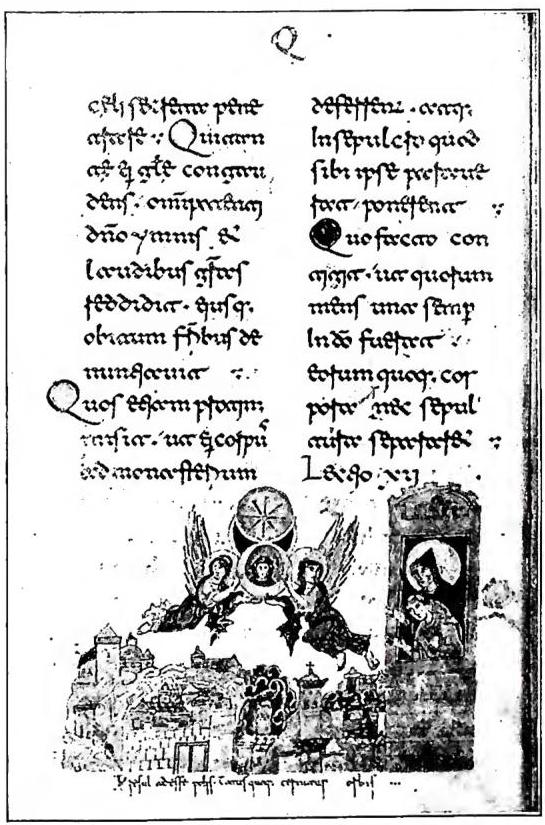
From the last decades of the 8th century, when the earliest examples already display characteristic elements, the script evolved into increasingly regular forms until reaching the height of calligraphic perfection in the 11th century; by the end of the 13th century its normal use had ceased. In its development four periods can be distinguished: the beginnings (from the end of the 8th to the end of the 9th century), formation (from the end of the 9th to the whole of the 10th), maturity (from the 11th to the end of the 12th), and decline (from the end of the 12th to the whole of the 13th).
Relating these periods to the history of Montecassino, the greatest cultural and book center of southern Italy, the first corresponds to a time of notable literary activity at the monastery, which, however, was expressed mainly in the writing forms inherited from previous centuries (especially the onciale) and was anyway cut short in 883 by the Saracen destruction; the second period corresponds to the time when the monks resided temporarily in Capua and, having returned in 949 to Montecassino, still experienced a difficult and troubled life; the third is the golden century that begins with the abbots Adonolfo (1011–122) and Teobaldo (1022–135) and closes with Desiderio (1058–87) and Oderisio (1087–1105); the fourth is a time of decline for the monastery as well, following its previous splendor.
On the other hand, the vicissitudes of the monastery fairly faithfully reflect the cultural conditions of the entire region, so much so that, by considering the genre and number of texts preserved in the manuscripts in Beneventan script, arranged according to period, one can obtain a very interesting view of the cultural conditions of southern Italy. And significant in this regard is the importance that southern codices have for the preservation of Latin classics, some of which (Varro, Tacitus, Hist., II, 1–4 and Ann., II, 11–16; Apuleius, etc.) are known only through copies made at Montecassino, while others have in them the most authoritative text (Ovid, Cicero).
General characteristics. From the earliest examples the Beneventan script displays certain distinctive features that, however, are best observed in their full development in manuscripts of the 11th century.
Derived from minuscola corsiva, which was the common script for letters and documents, it already shows in the 9th century its essential book character with a tendency toward regular and consistent forms, which it retains even when used in the text and in the signatures of documents.
Typical is the overall appearance due to the careful shading of individual letters, in which thick and thin strokes regularly alternate with constant uniformity. The vertical strokes of small letters (i, u, m, n) are broken in the middle, recalling forms and appearance that would later appear in Gothic script.
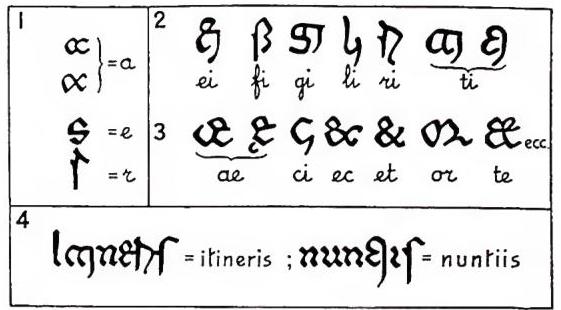
Beneventan script — Characteristic letters (no. 1): common ligatures (no. 2); optional ligatures (no. 3): and the ligature ti for the hard and sibilant sound (no. 4).
Particularly characteristic (v. table, no. 1) are certain letters: a (at first open, like two c’s placed side by side, then closed and like an o placed next to a c); e (with a broad head rising above the line); r (with a high head bent at an angle).
The letter i has two forms: tall when it is a semivowel and at the beginning of a word, small in other cases.
Numerous are the ligatures, some of which are in common use (ei, fi, gi, li, ri, ti: V. table, no. 2), others optional (v. table, no. 3).
In the binding, the first form expresses the hard sound, the second the sibilant sound of the consonant (v. table, n. 4).
Abbreviations are also numerous: in addition to the common forms found in all medieval scripts and others derived from the Irish system, some stand out for the very shape of the abbreviation mark or for the letters composing the compendium (especially characteristic among these are
the apostrophe and a sign resembling a 3 placed high to the right, and a sign resembling a 2 placed above a letter, which respectively indicate = -s [us], -m, -r [er, ur]; oma, gloa, ama = omnia, gloria, anima).
The system of punctuation marks is certainly distinctive. The suspended pause of the period is usually indicated by a thin oblique stroke (virgula), sometimes accompanied by a dot; the medial pause by a simple dot; the final pause by a triple mark, two dots and a comma arranged in a triangle or in line. In direct or indirect interrogative sentences, there is a special mark (a small acute angle open to the right) placed above the word on which the interrogation rests; another special mark (a vertical stroke with a small arm to the right) indicates the words on which the voice rests in an assertive tone. Acute accents (sometimes also circumflexes in properispomenon words) mark the tonic accent and the distinct pronunciation of two vowels that do not form a diphthong.
The varying degree of shading (which determines the general appearance of the script), the shape of the letters, the shape and frequency of ligatures and abbreviations, as well as the use of punctuation marks and accents, are elements that allow one to evaluate the dating of a manuscript.
In the region of Bari and in Dalmatia, the b. script presents a variety known as the Bari type, which is distinguished especially by its more familiar shading, without the strong breaks in the vertical strokes and without the excessive contrast between thick and thin strokes.
II. ILLUMINATION
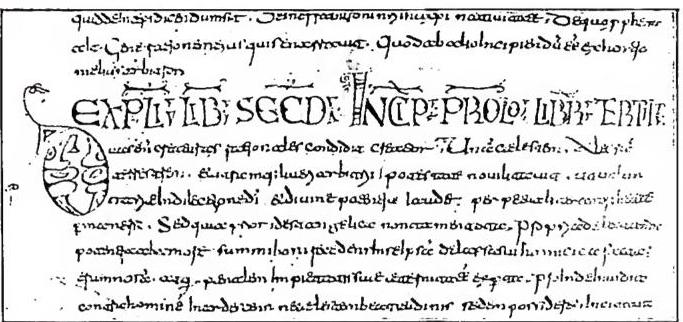
The manuscripts of southern Italy present magnificent examples of the decorative arts, which few other regions attained in the early Middle Ages.In the 9th century, book ornamentation was still very simple and crude, limited to titles in large monochrome and polychrome letters. A notable advance occurred already in the following century with letters of more complex design, featuring floral elements and interlacings, in which a bird’s or dog’s head often appears; human figures are rare and reproduce Byzantine models.
The glorious period that began for Montecassino under Abbot Teobaldo (1022–35) also marked a decisive moment in the development of manuscript decoration at Montecassino and elsewhere in the region, for renewed contacts with cultural centers in Germany (Ottonian art), England (Irish and Anglo-Saxon art), and the East introduced new elements that, through the work of skilled artists, led to the formation of an original and distinctive style.
Outstanding above all for the splendor of its full-page initials is the monk Grimoaldo (ms. 109 of Montecassino). Human representations, however, remain crude, as in ms. 132 of Montecassino, which contains the illustrated encyclopedia of Rabanus Maurus.
The magnificence of colors and of gold used with refined taste finds its liveliest expression in the decoration of the time of Desiderius and, in particular, in the works of the monk Leo. The three sumptuous manuscripts bearing his name (Montecassino 98 and 99, Vat. lat. 1202) are among the finest products of the Cassinese school. The designs are always varied, yet the decorative motifs follow a fixed pattern, with interlacings of ribbons and tendrils from which pink-colored dogs emerge with claw-like circles. Even the figures drawn by the monk Leo show a notable evolution that reveals his personal gifts as an artist.
After the age of Desiderius, there was only monotonous repetition, almost uniformity of stamp, of the earlier models, with heavy colors and drawing.
A special group of illuminated manuscripts consists of the Easter rolls, which, according to the usage of southern Italy, contained large figures illustrating the liturgical text. These were painted in reverse order to the writing, since they were meant to be viewed by the people as the deacon unrolled the scroll from the ambo. — V. Tav. LXXX.
Per la miniatura, trattazioni in E. Bertaux, L'art dans l'Italie meridionale, I, Parigi 1904, pp. 155-67 e 193-212; P. Toesca, Storia dell'arte italiana, I: Il medioevo, Torino 1927, pp. 1047-1052. — Riproduzioni in O. Piscicelli-Taeggi, Le miniature nel
BENEVENTANA SCRITTURA – BENEVENTO
Better times were in store with the Lombard invasion: a column of the new occupiers pushed as far as Samnium, where, under the leadership of a first duke, Zottone, around the year 571, they established a Lombard duchy that soon extended over a large part of southern Italy, later divided into twenty-four counties. Like Alboin, Zottone was a barbarian; and before the influence of Roman civilization and the Church could extend to him and his people, the violence of barbarism was unleashed upon sacred places and priests. Around 589 the abbey of Montecassino was destroyed, and in those same years Zottone is said to have had eighty Christians put to death for refusing to submit to pagan practices.
The Beneventan Lombards abandoned Arianism under Duke Arechi, who became the great reorganizer of the duchy. Shortly before the year 600, through his own baptism, he opened the way to the mass conversion of his people, and on December 15, 600, he had the restored and enlarged cathedral, dedicated to the Virgin, consecrated. Both he and the bishop of Benevento were in contact with Pope Gregory I. In 662 Emperor Constans II besieged Benevento; the legend, inserted into the Beneventan liturgy, relates that a Lombard priest named Barbato promised the lifting of the siege if Duke Romuald would put an end to surviving forms of paganism. Constans II was soon forced to raise the siege; and Barbato was then able to mark the end of the cult of the sacred walnut tree and the golden viper, which the duke himself, now a Christian, had secretly venerated in his palace. From 663 Barbato was bishop and united the see of Benevento with that of Siponto (a union that would last four centuries), with oversight of the famous sanctuary of St. Michael of Gargano. Arechi had steered the duchy toward almost complete independence from the Lombard crown; during the 7th and 8th centuries the prestige of the dukes and the power of the state grew even more. Animated by the zeal of neophytes, Romuald and his wife, Theodrada, built churches and monasteries. For only a brief time did King Liutprand succeed in asserting his authority, for soon Benevento resumed its autonomy; this was sealed by the construction of the cloister of Santa Sofia, begun around the mid-8th century by Duke Gisulf and completed, with the adjacent church, by Arechi II in 760.
A second architect of Benevento’s fortunes was Arechi II, who married Adelperga, daughter of Desiderius. After the fall of the Lombard kingdom, he took the opportunity to assume the title of prince and gather around the southern principality all the surviving Lombard people, continuing the Lombard tradition. The importance of Benevento did not escape Charlemagne; but his attempts came to nothing, and the emperor died before his lordship over the duchy could be anything more than nominal. Benevento then tried to skillfully maneuver between Byzantines, Saracens, Franks, and
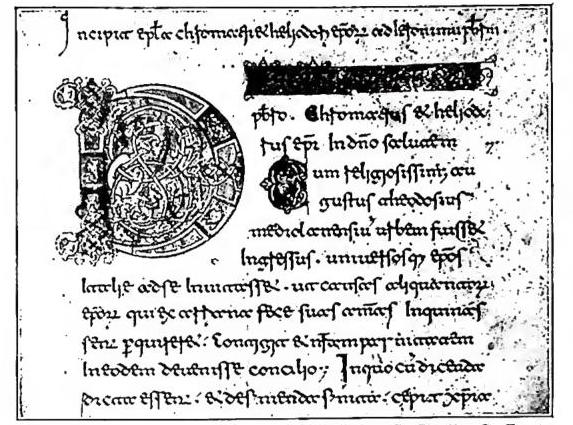
Beneventan script. — Beneventan of the Bari type (end of the 10th century). Donation of the right to fish on the island of Teiego made by the nobles of Zara in favor of the monastery of St. Chrysogonus (c. 995). — Zara, State Archives of St. Chrysogonus, box X.