
### BIAGIO, Saint
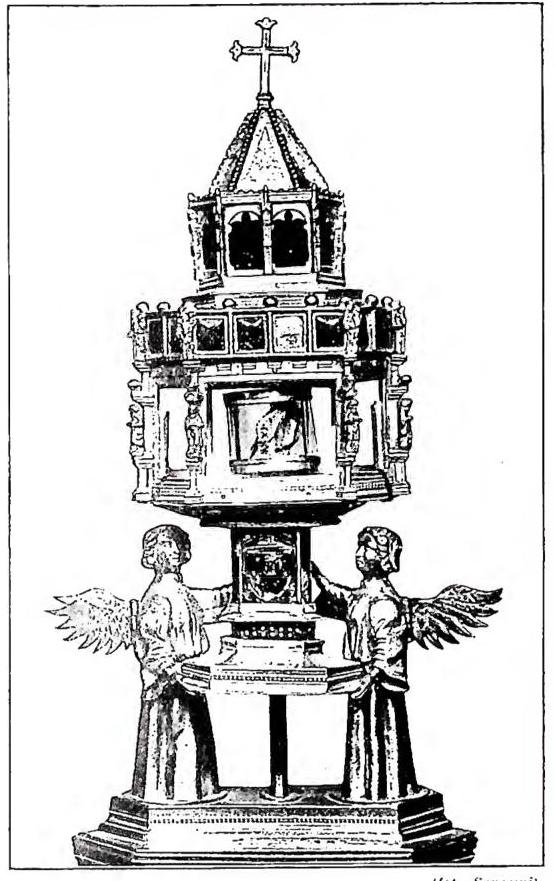
Reliquary containing relics of the Saint, donated by Cardinal Enrico Minutolo in 1402 – Vatican City, Treasury of St. Peter.
In various districts and cities of Italy in 1399. They wore linen garments, customary attire that reached down to their feet. Their heads and faces were covered by a hood with two holes for the eyes; a red cross stood out on their head and chest; a rope belt tightened their waists. As they processed, they marched two or three abreast, holding lit candles in their hands, striking themselves forcefully with whips while singing lauds and begging forgiveness for their sins.
The hymns, of little literary value, were composed for the occasion or taken from a pre-existing repertoire or laudario of the confraternities. In a miniature from the manuscript chronicle of G. Serambini, there is a printed reproduction of the official lauda, a mournful song, *Misericordia, eterno Dio*.
The people in their entirety adhered to the passage of the Flagellants, and alongside the common folk, ecclesiastical and civil authorities also joined (such as the Blessed Giovanni Dominici in Venice, Archbishop Fieschi in Genoa, Marquis Niccolò d’Este in Ferrara, Carlo Malatesta and Carlo Gonzaga in Rimini). A renewal of spirits and customs was expected and hoped for from the Flagellants. Boniface IX, initially distrustful, was later drawn by the piety of the pilgrims and by Sutri (v.), favoring them and even participating in the processions. After traversing all of Italy, though without crossing its borders, the Flagellants died out due to the plague of 1400. Their primary work was to restore peace among discordant cities.
---
### BRAUN, Saint
Reliquary containing relics of the Saint, donated by Cardinal Enrico Minutolo in 1402 – Vatican City, Treasury of St. Peter.
---
### BIANCHINI, Giuseppe
Historian and archaeologist, born in Verona on September 9, 1704, died in Rome on October 13, 1764. In 1732, he entered the Congregation of the Oratory in Rome, where Benedict XIV appointed him secretary of the Academy of Ecclesiastical History, which he had established in 1740. Clement XII had already entrusted him with continuing the *Annales ecclesiastici* of Baronio. Through his works, he gained widespread fame in Italy and abroad.
Notable among his works on Latin biblical texts are: *Vindicia canonicarum Scripturarum Vulgatae latinae editionis* (Rome 1740), in defense of the Vulgate; *Evangeliarium quadruplex latinae versionis antiquae* (ibid. 1749). In historical matters, he completed the edition of the *De gestis Romanorum Pontificum* by Anastasio Bibliotecario (ibid. 1735), begun by his uncle Francesco; *Methodus historiae ecclesiasticae quadripartitae* (ibid. 1746); *Historia chalcographica septendecim annorum jubilaei* (ibid. 1750); *Demonstratio historiae ecclesiasticae* (ibid. 1754). In archaeological matters, he published: *Liturgia antiqua* (ibid. 1746); *Raccolta de’ più illustri pezzi d’antichità sacre di Roma* (ibid. 1746); *Delle magnificenze di Roma antica e moderna* (ibid. 1747). He also left many monographs, including studies on the prophets, the Psalter, and the *Song of Songs*.
---
### Carlo Gasbari